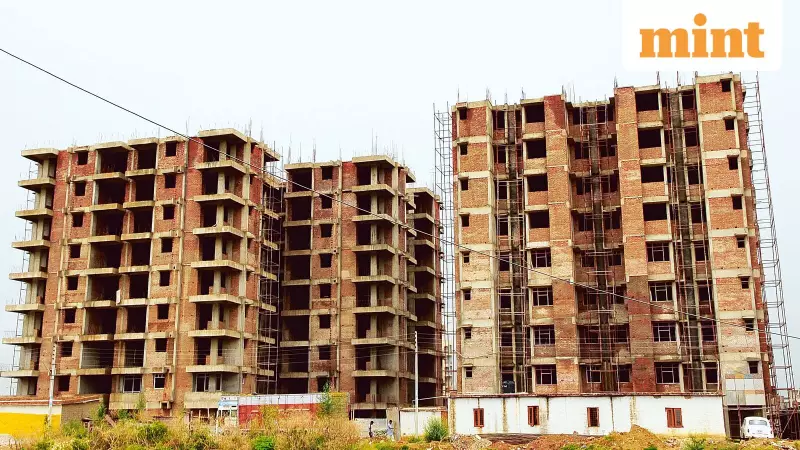
For countless Indian homebuyers, a housing loan represents more than just financing—it's strategic leverage that enables property ownership while providing substantial tax advantages. However, those considering under-construction properties should beware: the anticipated tax benefits may significantly diminish due to specific regulations governing incomplete projects.
The Tax Advantage Dilemma for Under-Construction Properties
According to tax experts, the fundamental issue lies in the timing of interest deductions. Under Section 24(b) of the Income Tax Act, homeowners can claim deductions on the interest component of their home loan, but with crucial limitations for properties still under construction.
"The interest deduction under Section 24(b) starts only from the year in which the construction is completed. Any interest paid during the construction period is accumulated and claimed in five equal instalments beginning from the year of completion," explained Vijaykumar Puri, partner at VPRP & Co LLP, Chartered Accountants.

How Tax Rules Differ for Self-Occupied vs Rented Properties
The restrictions become particularly challenging for self-occupied properties. For such homes, the annual deduction cap stands at ₹2 lakh, and this benefit is available only under the old tax regime. The situation becomes even more complicated when construction extends beyond five years from the financial year when the loan was initially taken.
"If the possession happens after five years, the homeowner can claim only up to ₹30,000 of the accumulated interest per year for five years. This would mean you can deduct only ₹1.5 lakh of the accumulated interest, even if it's higher," highlighted Suraj Nahar, a Jamnagar-based Chartered Accountant.
Consider this scenario: A borrower pays ₹10 lakh in interest during four years of construction. This becomes pre-construction interest, with an annual deductible amount of ₹2.5 lakh. If the current-year interest after possession adds another ₹2 lakh, the total interest eligible for deduction reaches ₹4.5 lakh. However, for a self-occupied house, the borrower can claim only ₹2 lakh—meaning more than half the interest deduction is permanently lost.
The Financial Impact on Homebuyers
The structural limitations create substantial financial consequences. For instance, if you take a ₹50 lakh loan at 9% interest for 25 years on a ready-to-move-in property, the first-year interest amounts to ₹4.47 lakh. Claiming the full ₹2 lakh deduction in the 30% tax bracket saves ₹60,000 annually, effectively reducing your interest burden to ₹3.87 lakh and bringing the true interest rate down to approximately 7.8%.
Contrast this with an under-construction property where the project takes six years to complete. Since possession is delayed beyond five years, accumulated interest can be claimed only at ₹30,000 annually for five years, totaling ₹1.5 lakh. The remaining ₹24 lakh becomes permanently disallowed. Even after taking possession, the annual deduction remains limited, resulting in minimal tax relief and keeping the effective interest rate close to the original 9%.
"The leverage disappears in under-construction properties due to deferred deductions and annual caps," emphasizes Suraj Nahar, pointing to the erosion of the very financial advantage that motivates many buyers.
Alternative Paths and Long-Term Considerations
For rented or deemed-to-be-let-out properties, the scenario appears more favorable initially, as there are no caps on interest deduction itself. Homeowners can claim full interest even if construction completes after five years, and the full pre-construction instalment can be deducted regardless of whether it exceeds ₹2 lakh annually.
However, Prakash Hegde, a Bangalore-based Chartered Accountant, notes a significant limitation: "The overall set-off of all house property losses against other income in a year is limited to ₹2 lakh." This restriction means that even for rented properties, the actual tax benefit remains constrained.

While tax rules permit unclaimed home loan interest to be added to the property's acquisition cost, the benefit isn't immediate. It materializes only when the property is eventually sold, and the tax advantage becomes substantially smaller—around 12.5% compared to the 30% savings available through annual deductions for higher-income taxpayers.
For homebuyers viewing loans as financial leverage, these restrictions on under-construction properties can undermine the very advantages they seek. The combination of deferred deductions, annual caps, and possession delays often results in paying nearly the full interest each year with minimal tax relief, fundamentally altering the investment calculus for prospective homeowners.