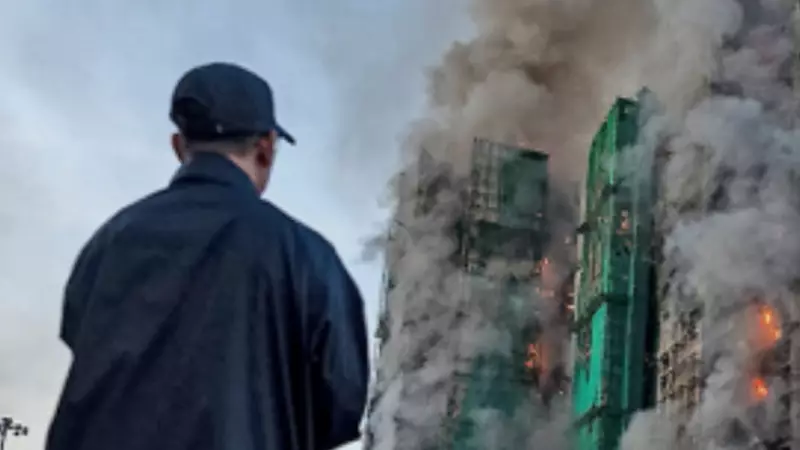
The catastrophic fire at Hong Kong's Wang Fuk Court, which claimed at least 128 lives and engulfed 28 buildings, has triggered global alarm and prompted urgent introspection in India's National Capital Region (NCR). The tragedy has starkly highlighted the widening chasm between the region's relentless vertical expansion and the firefighting infrastructure's ability to protect it.
A Sobering Reality: Equipment Falls Dismally Short
While local developers and officials were quick to differentiate NCR's construction practices from Hong Kong's—where bamboo scaffolding and flammable wraps accelerated the blaze—the core vulnerability remains alarmingly similar. In Gurgaon, the sole government-owned hydraulic ladder, capable of reaching 42 metres (about 14 floors), has been condemned and is out of service. The fire department now relies on a private developer's 90-metre ladder, a precarious stopgap that could cause fatal delays during an emergency. This is a critical weakness in a city hosting towers like Trump Towers Delhi-NCR (201.5 metres) and Raheja Revanta (199 metres).
Noida's scenario is equally concerning. The city possesses four hydraulic platforms with a 42-metre reach and expects a 72-metre crane next year. However, these are hopelessly inadequate for behemoths like Supertech's Supernova, which towers at 307 metres—almost four times the reach of the city's tallest official fire ladder.

Shared Risks Despite Engineering Differences
Indian construction standards do mandate some inherent safeguards. Pradeep Kumar Chaubey, Noida's chief fire officer, confirmed that bamboo scaffolding is banned, with iron or steel being mandatory. Developers also assert that flammable insulation like styrofoam is not used due to the climate.
Yet, the fundamental risk persists. "Yes, equipment and enforcement have not kept pace with the vertical growth," stated Manoj Gaur, MD of Gaursons. Supertech chairperson RK Arora echoed this, emphasizing that ultra-tall buildings need advanced fire automation, service floors every 30 storeys, and rigorous safety drills. The reliance on water hoses at great heights is problematic, as fire officials note a sharp drop in water pressure, making firefighting slow and ineffective.
Residents Sound the Alarm, Builders Shift Focus Internally
The anxiety among residents is palpable. Praveen Malik, RWA president of Rising Homes in Gurgaon, called for frequent fire safety audits and regular drills, citing gross negligence in current practices. He urged the operationalization of the long-delayed fire station in Sector 95 to cut response times.
With external firefighting support being unreliable, builders are increasingly focusing on internal safety mechanisms. "We do not depend on ladders these days," said Yukti Nagpal, director at Gulshan Group, highlighting the use of fire-rated glass, dedicated fire lifts, and comprehensive alarm systems. Sahil Agarwal of Nimbus Realty pointed to sealed floor plates, sprinklers, and RCC facades to slow fire spread. Vaibhav Agarwal of Vision Business Park cited National Building Code provisions like refuge floors and wider staircases as critical safeguards.
The Path Forward: Urgent Upgrades and Strict Compliance
Officials admit an urgent need for systemic upgrades. A senior fire department official stressed that while better gear is essential, high-rises must also renew their No-Objection Certificates (NOCs) and comply with safety norms. Proposals to levy fire-safety fees on developers to fund better equipment and training are under consideration.
Consensus among experts and residents points to non-negotiable measures: more frequent and rigorous audits, operational fire stations in new sectors, mandatory regular evacuation drills, and keeping access roads around high-rises clear. Additionally, awareness in informal settlements about safe electrical connections and evacuation plans is crucial, as past incidents in Gurgaon have shown these areas to be particularly vulnerable.
The Hong Kong tragedy serves as a grim reminder. For NCR, bridging the gap between its skyline and its safety net is not just a matter of infrastructure but of immediate public safety imperative.