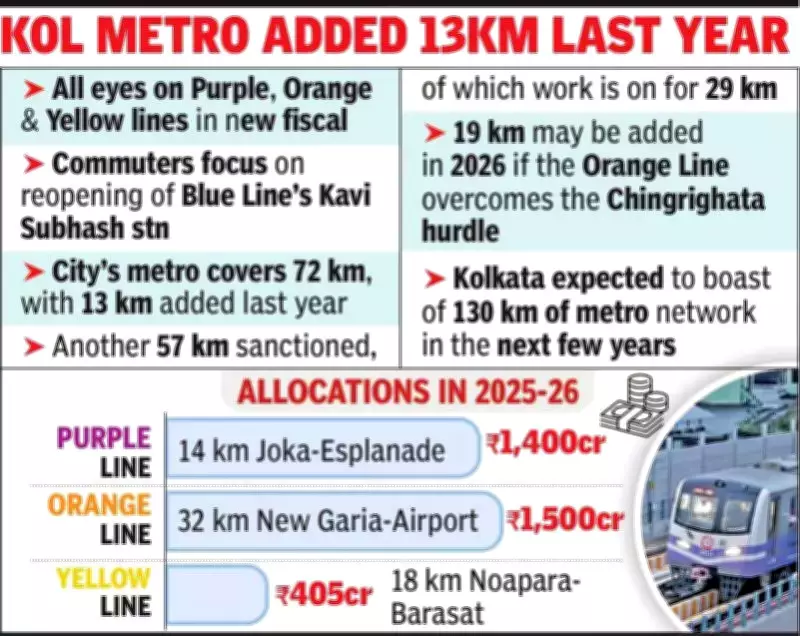
In Kolkata, metro engineers are setting their sights on significant financial allocations in the forthcoming Rail Budget this Sunday, specifically targeting the Purple, Orange, and Yellow lines. This optimism follows a productive year in 2025, which saw the addition of 13 kilometers to the metro network, including the complete operationalization of the East-West Metro (Green Line) and the inaugural airport connectivity service.
Land Acquisition Challenges Loom Large
However, officials have candidly acknowledged that persistent land acquisition issues could potentially derail these ambitious plans. For the daily commuters of Kolkata, the immediate priority remains the reopening of the Kavi Subhash Metro station on the Blue Line. This critical station has been closed since July 28, 2025, due to structural cracks discovered in the piers supporting its platforms.
The Lifeline: Kolkata's Blue Line
The Blue Line, a 41-year-old corridor recognized as India's oldest metro system, serves as the city's essential transport lifeline. Metro authorities have undertaken a major upgrade initiative for this line, which has been plagued by frequent operational glitches. Plans are in motion to commence the comprehensive reconstruction of the Kavi Subhash station, the southern terminal of the Blue Line, starting in April.

Current Network and Future Projections
The existing metro network in Kolkata spans 72 kilometers. An additional 57 kilometers of projects have been sanctioned, with construction actively progressing on 29 kilometers of this planned expansion. Looking ahead, metro authorities project that by linking the Orange Line's Beleghata station at Metropolitan on EM Bypass with the airport, approximately 19 kilometers could be added to the system. Furthermore, by 2029, an extra 10 kilometers are anticipated through the connection of the Purple Line's Majerhat with Esplanade and the linking of the Yellow Line's Bimanbandar (airport) station with Michael Nagar.
Recent Developments and Financial Allocations
The Yellow Line recently received a boost with the commencement of work on the underground Birati station. The corridor's plan has been revised, with the entire 18-kilometer stretch up to Barasat now being designed as an underground route. In the previous fiscal year, substantial funds were allocated: approximately Rs 1,400 crore for the Purple Line, around Rs 1,500 crore for the Orange Line, and Rs 405 crore for the Yellow Line. A considerable increase in funding for all these corridors is expected in the upcoming budget.
Major Roadblocks and Delays
Despite the optimism, significant obstacles remain. "We are not sure how much funds will eventually come the city's way because of the major roadblock at Chingrighata, where 366 meters of the Orange Line's viaduct construction is stuck," an engineer revealed. The Orange Line currently operates over a 9-kilometer stretch from New Garia to Metropolitan and is ultimately planned to extend 32 kilometers to the airport.
The Purple Line is also facing considerable delays. Approximately 6 kilometers of the 14-kilometer Joka-Esplanade corridor, from Majerhat to Esplanade, has seen slow progress. This is primarily due to the unresolved relocation of the BC Roy Market at Esplanade, where 528 unauthorized shops are obstructing the construction of the terminal Esplanade station. The completion of this station is highly anticipated, as it will establish Kolkata's long-awaited metro hub, integrating the Blue (North-South), Green, and Purple lines.
Government Statements on Delays
In December 2025, Railway Minister Ashwini Vaishnaw addressed these delays in Parliament, stating that around 20 kilometers of metro lines in the Kolkata area are held up due to land issues and pending No Objection Certificates (NOCs) with the state government. He specifically highlighted the incomplete 6.2-kilometer Majerhat-Esplanade section of the Purple Line, attributing the delay to the unresolved shifting of the BC Roy Market. "The proposal for NOC for shifting these shops was submitted to the state in February 2022. Shops for temporary shifting were also constructed by the Railway. Regular follow-up with state PWD is also being done. The issue is pending for more than 3.5 years," Vaishnaw stated, underscoring the protracted nature of the bureaucratic hurdles.