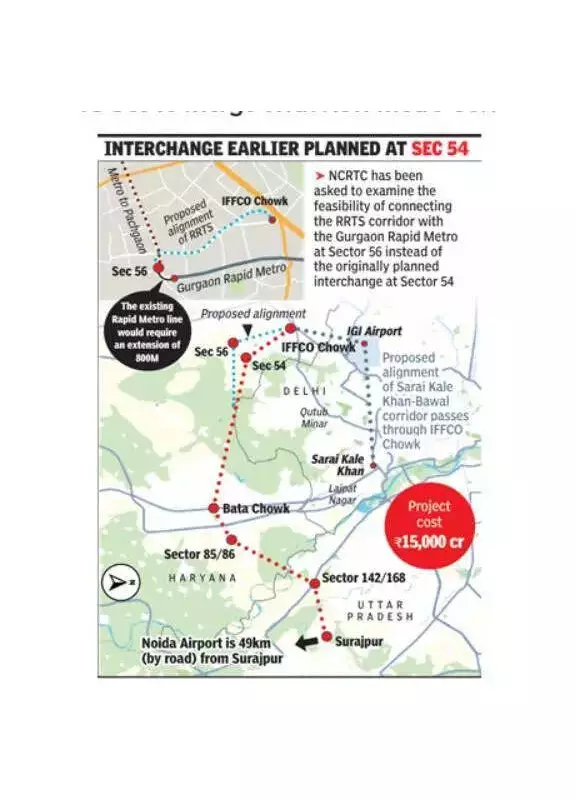
In a significant move to enhance regional connectivity, Gurgaon's urban development authority is now actively considering plans to transform Sector 56 into a major multi-modal transit hub. This involves a key revision to the proposed Gurgaon-Faridabad-Noida Regional Rapid Transit System (RRTS) corridor's alignment to better integrate with existing metro networks.
Revised Plan for Better Integration
On Wednesday, PC Meena, the Chief Executive Officer of the Gurugram Metropolitan Development Authority (GMDA), directed the National Capital Region Transport Corporation (NCRTC) to study the feasibility of a crucial change. Instead of the originally planned interchange at Sector 54, the RRTS corridor could now connect with the Gurgaon Rapid Metro at Sector 56.
The Rapid Metro, which serves key commercial and residential zones in Gurgaon and links to the Delhi Metro, would thus become a central part of this new transit nexus. Officials state this strategic shift is designed to improve connectivity and extend the reach of high-speed public transport to residents living in the newly developing sectors along the Southern Peripheral Road (SPR).

Creating a Seamless Transit Nexus
The proposal was a key agenda item during a review meeting attended by officials from NCRTC, GMDA, Gurugram Metro Rail Limited (GMRL), and Haryana Shehari Vikas Pradhikarn (HSVP). A GMDA official highlighted the broader vision, noting that with a proposed metro line between Sector 56 and Pachgaon already in the works, the convergence of multiple transit lines at one point makes perfect sense.
Sector 56 can be developed as a multi-modal interchange, facilitating smoother transfers between different mass transit systems, the official explained. This plan is further supported by GMDA's parallel work on developing an elevated corridor along the SPR.
Alignment Changes and Land Optimisation
One specific proposal under review suggests routing the RRTS corridor on an elevated track along Golf Course Extension Road and BR Ambedkar Road. This path would go through the Leisure Valley area and terminate at IFFCO Chowk. To achieve seamless integration at Sector 56, the existing Rapid Metro line would need an extension of roughly 800 metres.
This adjustment, however, would add approximately 2.7 kilometres to the total length of the RRTS corridor. During the meeting, CEO PC Meena also emphasised the importance of efficient land use. He instructed NCRTC to optimise land utilisation and avoid acquisition wherever possible, especially in Sector 29 where HSVP had expressed concerns.
Officials were also tasked with exploring the possibility of an RRTS station at Gwalpahari to benefit local residents and examining underground options for the Namo Bharat corridor in sensitive stretches to protect existing infrastructure.
Long-Term Impact on Regional Mobility
The Gurgaon-Faridabad-Noida RRTS corridor is a cornerstone project for the National Capital Region's future mobility. It is designed to provide a high-speed link connecting the Indira Gandhi International Airport in Delhi with the upcoming Noida International Airport in Jewar.
As per the draft project report, the corridor will start at IFFCO Chowk in Gurgaon, pass through Sector 54, enter Faridabad at Bata Chowk, move via the Sector 85-86 junction towards Noida sectors 142/168, and finally link to the Jewar airport through Surajpur. The proposed integration at Sector 56 is poised to make this vital corridor more accessible to a larger population in Gurgaon's southern sectors.