Gurgaon's Affordable Housing Dream Fades as Policy Stalls
The promise of affordable housing is rapidly turning into a distant mirage for thousands of middle-class families in Gurgaon and Faridabad. What was once envisioned as a pathway to homeownership for salaried professionals, young families, and first-time buyers has become a source of frustration and disappointment.
Homebuyers Voice Their Frustration
For prospective buyers like Rajesh Kumar Srivastava, a resident of Sector 70 working in the private sector, the situation has become increasingly disheartening. "We have been waiting for affordable projects for years," he explains. "But there are hardly any new launches. Whatever is available in the market is priced at Rs 2–3 crore, which is completely out of our budget."
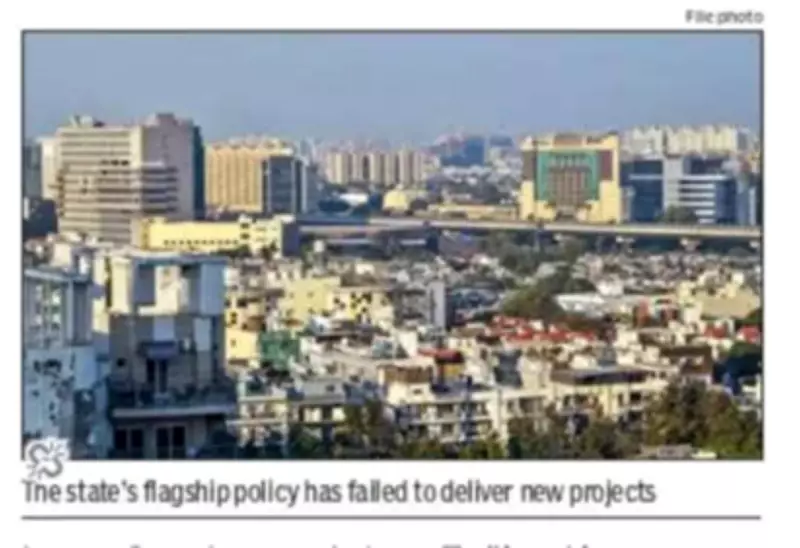
This sentiment is echoed by many who feel the state's flagship affordable housing policy has failed to deliver tangible results. With property prices soaring beyond reach, the scheme is increasingly viewed as a "paper promise" that offers little practical relief to those it was designed to help.

Policy Constraints and Market Realities Collide
Under the current policy framework, the government has capped maximum sale prices at Rs 5,000 per square foot in Gurgaon and Faridabad. However, this fixed pricing structure has created significant challenges:
- Land prices in several Gurgaon sectors have more than doubled over the past five years
- Construction costs have risen by 25–30% during the same period
- Compliance and regulatory expenses continue to increase
Officials from the town and country planning department confirm that no new affordable housing licenses have been issued in Gurgaon or the Gurgaon-Manesar master plan area over the last 18-24 months. This approval freeze reflects the fundamental mismatch between policy pricing and economic realities.
Developer Perspectives on Viability Challenges
Industry experts highlight the mathematical challenges developers face. At current policy rates, a 600–700 square foot apartment would cost approximately Rs 32–37 lakh. However, developers argue this pricing leaves insufficient margin for:
- Land acquisition at current market rates
- Construction costs including materials and labor
- Regulatory compliance and approval processes
- Timely project delivery and quality assurance
Vikas Garg, Joint Managing Director of Ganga Realty, notes the shifting market dynamics: "Rising land, construction and compliance costs have made affordable housing projects less viable in Gurgaon, leading developers to shift new supply to peripheral areas."
The Human Impact and Growing Concerns
For aspiring homeowners, the stakes couldn't be higher. Abhishek Singh, a real estate consultant and prospective buyer himself, captures the dilemma: "If the government fixes prices that developers cannot work with, then no one will build affordable homes. Ultimately, it is buyers like us who suffer."
Piyush Garg, another prospective buyer from New Delhi, emphasizes the urgency: "The middle class depends on such schemes to buy their first home. If rules are not updated, affordable housing will remain only on paper."
Calls for Policy Revision and Market Alignment
Homebuyers, industry bodies, and developers are united in their demand for policy recalibration. Key recommendations include:
- Revising the sale price cap by at least 25% to reflect current market conditions
- Making the policy open and continuous to ensure steady project pipelines
- Aligning pricing with ground realities of land and construction costs
- Encouraging development closer to major employment hubs
MS Mittal, Chairman of ROF Group, acknowledges the policy's initial success while calling for evolution: "The policy was framed with good intentions and has helped thousands of families own homes. However, policies must evolve with market realities. Timely amendments are needed to encourage fresh investments and sustain developer interest."

The Path Forward for Affordable Housing
Despite the current challenges, demand for affordable housing in the Gurgaon-Faridabad-Sohna corridor remains robust. Developers indicate they would return to the segment if pricing structures become economically viable. The need for balanced urban growth that includes affordable options near employment centers has never been more critical.
As market preferences increasingly tilt toward premium and luxury developments along growth corridors like the Dwarka Expressway and Sohna, policy intervention becomes essential to ensure housing diversity and accessibility for all economic segments of society.