

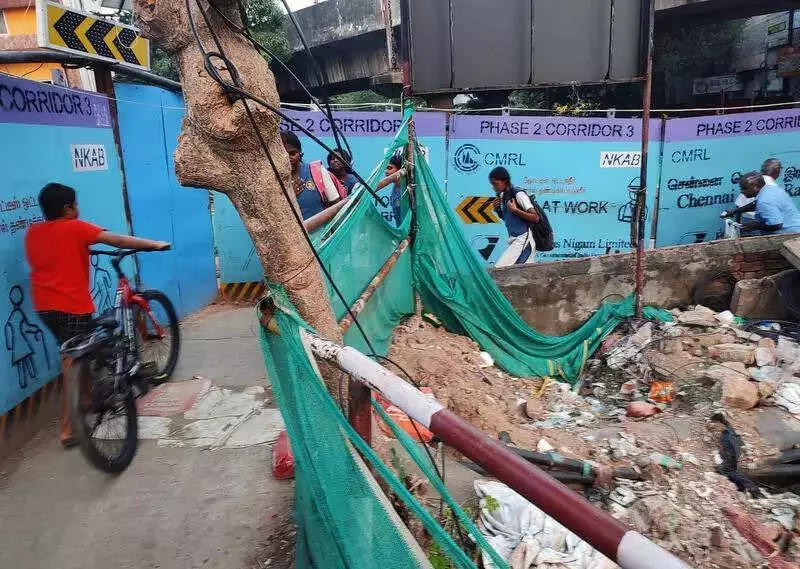
The bold promise on Chennai Metro's barricades reads, "Inconvenience today for a better tomorrow." For thousands of pedestrians navigating the city's streets, the inconvenience is a stark, daily reality, while the promise of a better tomorrow feels distant. The makeshift walkways erected for the massive Phase II metro project have become synonymous with danger, discomfort, and neglect, despite a significant investment of public funds.
A Costly Maze of Problems
The Chennai Metro Rail Limited (CMRL) Phase II project, with an estimated total cost of ₹63,246 crore, includes provisions for pedestrian diversions. Officials state that approximately ₹30 crore has been spent on creating barricaded walkways at 43 locations, primarily near underground stations. This substantial sum, however, excludes the cost of essential amenities like CCTV cameras and proper lighting.
A ground report by TOI across eight key locations—including Mandaveli, Luz Church Road, Thousand Lights, Sterling Road, T Nagar, and Pondy Bazaar—revealed a litany of issues. The walkways are often narrow, ill-lit, uneven, and reek of neglect. Many are barely 1 meter wide, far below the Indian Road Congress norm of 1.8 meters for comfortable pedestrian movement. They are enclosed on both sides with tall, opaque barricades, creating blind curves and unsafe conditions, especially for women.

"The thought of using this walkway for three more years, fighting tipplers and no lights in the evening, sends shivers down my spine," shared a nurse using the Mandaveli walkway near a Tasmac outlet. At the Venkatanarayana Road stretch in T Nagar, 6-foot tall barricades create dangerous blind spots. "If I call for help, nobody can even see me," said pedestrian Sarala P.
Impact on Daily Life and Business
The repercussions extend beyond mere inconvenience. Local businesses report severe losses. A tea stall owner at the Thousand Lights crossover on Anna Salai said his sales have plummeted to barely 25 cups a day as the barricades hide his stall from view. Healthcare facilities along R K Mutt Road have reported lower footfalls and increased difficulty for patients and staff since the barricades went up.
"Most of us take a detour that costs us ₹50 extra. Some lights don't work in the evening. Does the project cost include our losses?" asked Sahaya Mary of BSS Hospital. The situation is compounded by a lack of maintenance, with broken bottles and anti-social elements frequently found within these confined spaces.
CMRL's director (projects), T Archunan, stated that these walkways are "makeshift" and will be removed by 2028, once all three Phase II lines are completed. He claimed CMRL signage is present at all locations, a claim contradicted by on-ground observations where local hospitals and shops have had to put up their own boards after being blocked by the structures.
Systemic Failures and Expert Recommendations
The problem appears systemic. P K Sarkar, a former professor at Delhi's School of Planning and Architecture and an early Delhi Metro consultant, noted that such issues are pan-Indian. He recalled Delhi's metro barricades being 8-9 feet tall with inconsistent CCTV coverage.
Alarmingly, CMRL officials admit they have no dedicated manual for designing pedestrian infrastructure in construction zones. "Our funding agency gives its terms, and we comply," Archunan said. This ad-hoc approach has drawn criticism from urban planning experts.
Aswathy Dilip of ITDP India recommends using steel railings instead of opaque barricades to provide a sense of "perceived safety," especially for women. However, Archunan dismissed the possibility of replacing the existing barricades or installing translucent ones now.

When confronted with the widespread complaints, CMRL managing director M A Siddique told TOI that each walkway was "unique, needing specific solutions," and promised they would soon be "examined" by field teams. For the citizens of Chennai enduring this daily grind, that examination and subsequent action cannot come soon enough. The "inconvenience today" is a heavy burden, and its justification hinges on a transparent and urgent addressal of these critical safety and accessibility failures.





