Bengaluru Plot Owners Protest BDA's Double Taxation on Irregular-Sized Sites
In Bengaluru, a contentious taxation policy by the Bengaluru Development Authority has ignited fresh protests among plot allottees. The issue centers on irregularly-sized plots where owners are being charged nearly double the standard property tax rate for their entire sites, rather than just the excess area beyond standard dimensions.
Unfair Taxation System Sparks Widespread Complaints
Owners of non-standard plots, particularly corner sites with dimensions like 109–110 square meters compared to standard 108 square meter plots on the same streets, argue they're being unfairly penalized despite using identical civic facilities. The current slab-based taxation system applies higher rates to the entire property area instead of just taxing the additional square meters at premium rates.
"Why should we pay double for sites with odd dimensions?" questions Santosh Patil, a 40-year-old allottee at Nadaprabhu Kempegowda Layout, Block 5. "BDA mentioned the irregular markings during the auction, but the taxation implications were never properly explained. Since purchasing my site in 2021, I've been paying almost twice my neighbor's tax for just 4 square meters of extra space."

Systemic Issues Across Multiple Layouts
The problem extends across several major BDA developments including:
- Nadaprabhu Kempegowda Layout
- Banashankari 6th Stage
- Sir M Visvesvaraya Layout
According to association estimates, approximately 3,000 land parcels face similar taxation challenges. Another affected allottee, who requested anonymity, revealed: "I received only 20 square meters extra, yet I'm being charged double the standard rate. This unjust system consumes our hard-earned money without providing any additional benefits."
Historical Context and Failed Resolutions
The controversy traces back to a 2016 BDA board resolution on vacant-property taxation that allottees have consistently criticized as fundamentally flawed. Despite multiple attempts at resolution, including a formal letter sent to BDA in 2023 and a meeting with the finance department on December 6, 2025, the issue remains unresolved.
Sairam, an executive member of the NPKL Open-Forum, explained the bureaucratic impasse: "When we discussed this with BDA's accounts office, they indicated the slab system persists because the IT cell established it. BDA must review and correct the system to implement fair, reasonable taxation similar to income-tax slabs, but no changes have materialized."
BDA's Official Stance and System Mechanics
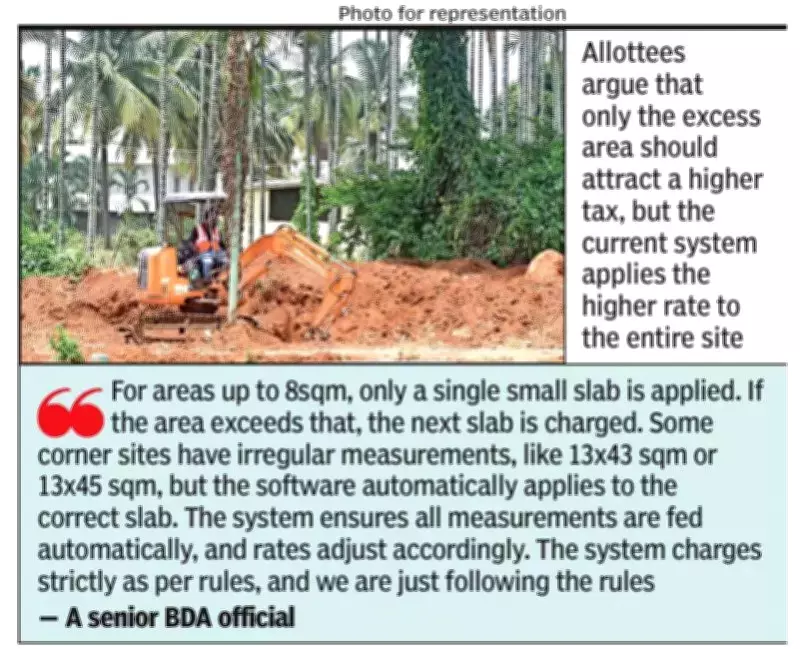
A senior BDA official defended the current system, stating: "For areas up to 8 square meters, only a single small slab applies. When the area exceeds that threshold, the next slab automatically activates. The process is fully automated—corner sites with irregular measurements like 13x43 square meters or 13x45 square meters trigger appropriate slab rates through software programming as part of ongoing reforms."
The official emphasized that the system ensures all measurements feed automatically into rate calculations, adding: "While some request lower rates for smaller areas, the system charges strictly according to established rules. We are simply following protocol."
Previous Reforms and Current Implications
Historical context reveals this isn't BDA's first taxation controversy. On September 28, 2016, following widespread complaints, BDA revised property tax rates for vacant plots for the 2016–17 period. The revision established that:
- Smaller plots (6×9 square meters to 9×12 square meters) would be taxed at 1/4000 of guideline value
- Larger plots (9×12 square meters to 15×24 square meters) would be taxed at 1/2000 of guideline value
This adjustment came after discovery that previous charges were 3-16 times higher than anticipated, with excess payments adjusted against subsequent years' dues. However, current allottees argue the system still contains fundamental inequities that disproportionately affect owners of irregularly-shaped properties.

The ongoing dispute highlights growing tensions between urban development authorities and citizens over transparent, equitable taxation policies in India's rapidly expanding metropolitan centers.