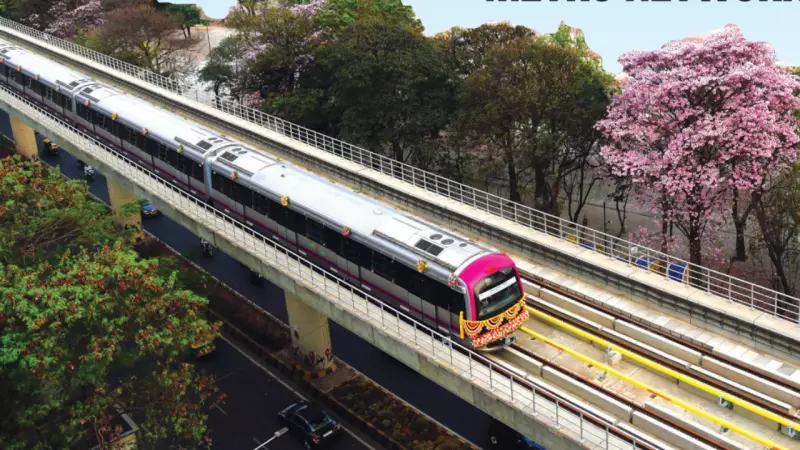
Bengaluru's Namma Metro, which began its journey in 2011 with a single line, is poised for a transformative decade of growth. From its initial 6.7 km stretch, the network has expanded to 96 km, weaving through the city's heart and its major tech corridors. Now, the Bangalore Metro Rail Corporation Limited (BMRCL) has unveiled an ambitious blueprint to expand the network to a staggering 466 km by 2035. This expansion is not merely about adding kilometres of track; it's a strategic overhaul designed to decongest roads, connect burgeoning suburbs, and fundamentally reshape urban mobility in India's Silicon Valley.
Key Corridors Set to Redefine Commutes
The expansion plan is packed with high-impact projects aimed at solving Bengaluru's most pressing traffic woes. A cornerstone of this plan is the Blue Line extension to Kempegowda International Airport (KIA). With over a lakh vehicles navigating to the airport daily, this link promises to be a game-changer. The Hebbal to KIA section is targeted for completion by mid-2027, offering a swift and eco-friendly alternative to the congested road journey.
Another critical project is the metro corridor along the Outer Ring Road (ORR), one of the city's most clogged arteries, handling 4–5 lakh vehicles every day. This dedicated line aims to provide a reliable mass transit option, significantly cutting travel time for thousands of daily commuters and boosting business activity along this vital stretch.

Furthermore, the Pink Line is set to become Bengaluru's first seamless north-south connector. Slated to open in phases from 2026, it will run from Kalena Agrahara in the south to Nagawara in the north, enabling cross-city travel without the need for interchanges, linking residential hubs with commercial centres efficiently.
Planning for Periphery and Facing Challenges
Recognising the city's outward growth, BMRCL is exploring approximately 209 km of new metro corridors on the outskirts. Proposed routes include links to Tumakuru, Bidadi, Harohalli, and Attibele, aiming to integrate emerging residential and industrial zones with the urban core.
However, the path to expansion has its hurdles. Some key projects are experiencing delays, highlighting the complexities of urban infrastructure development. The 45 km Orange Line is currently on hold as authorities evaluate a double-decker flyover design. Similarly, the 36 km Red Line awaits Union government approval after being redesigned to optimise costs. These setbacks underscore the challenge of balancing ambitious planning with ground-level execution in a dense metropolis.
The Road to 2035: A Decade of Transformation
The period from 2026 to 2035 is being termed as Bengaluru's metro transformation decade. The plans are aligned with the city's Comprehensive Mobility Plan (CMP-2020), which envisions 316.8 km of near- and medium-term corridors. Looking further ahead, BMRCL has mapped an additional 363.3 km of future corridors to cater to long-term growth.
A notable proposal sparking debate is the 60 km intercity metro from Madavara to Tumakuru, estimated to cost over Rs 20,650 crore. While BMRCL views it as a regional metro extension, some transport experts argue that a suburban rail or a Regional Rapid Transit System (RRTS) might be a faster and more cost-effective solution for such regional connectivity.
After 14 years of building the foundational 96 km network, Bengaluru is now accelerating into a phase of rapid expansion. With the airport link, ORR corridor, Pink Line, and extensive peripheral networks in the pipeline, Namma Metro is gearing up to finally keep pace with the city's explosive growth, promising a future of faster, cleaner, and more reliable commutes for its residents.