The Scheme for Special Assistance to States for Capital Investment, a flagship central government initiative aimed at accelerating infrastructure development across India, is witnessing disparities among states. While the scheme has disbursed about Rs 4.5 lakh crore in loans over five years and bolstered capital expenditure of states from 2.2% of GDP in FY 2022 to 2.7% in FY 2025 (revised estimates), Punjab has emerged as one of the most operationally inconsistent performers.
Reasons Behind Punjab's Inconsistency
An analysis by researchers at State Bank of India lists several reasons behind this. Punjab, along with Kerala and Telangana, shows more persistent execution stress. All have high debt-to-GDP ratios, indicating that such states have lower absorptive capacity, as revenue expenditure crowds out capital expenditure. Many such states also run persistent revenue deficits.
Punjab's Absorption Rates
Punjab's performance reflects volatility and execution stress. After achieving full utilisation in 2020-21, the state's absorption rate fell to 60.6% in 2021-22, declined to 32.9% in 2022-23 and 6.5% in 2023-24, before rising to 84.3% in 2024-25. Punjab's position becomes clearer when compared with neighbouring states. Haryana has maintained relatively strong utilisation, recording 96.2% in 2022-23, 90.6% in 2023-24 and 82.4% in 2024-25. Himachal Pradesh has shown steady performance with utilisation rates of 78.8%, 78.5% and 85.1% over the same period.

Debt-to-GSDP Ratio Impact
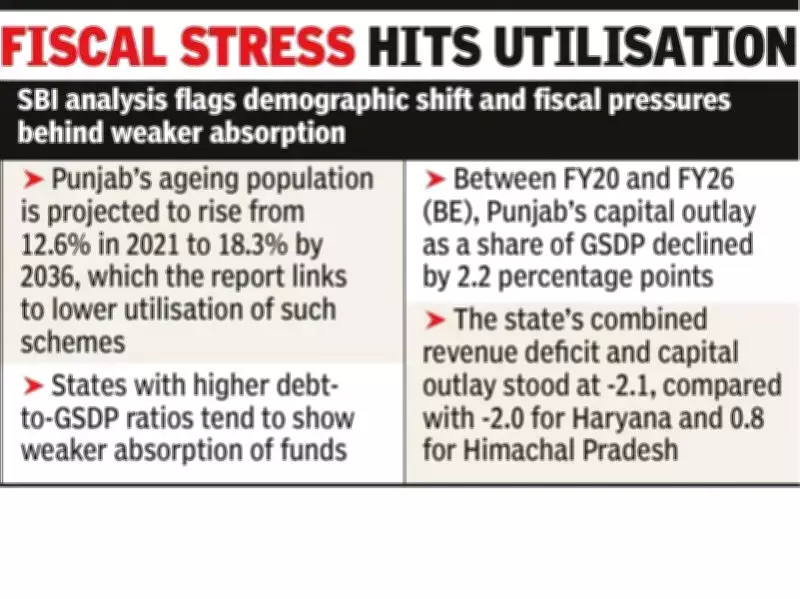
The analysis report notes that the scheme utilisation is inversely related to a state's debt-to-GSDP ratio, with those having higher debt levels generally exhibiting weaker utilisation. Demographic trends add another layer of complexity. Punjab is gradually transitioning towards an ageing population, with the share of people aged above 60 projected to rise from 12.6% in 2021 to 18.3% by 2036. The report notes that ageing states tend to have lower scheme utilisation compared to intermediate and youthful states.
Fiscal Indicators
Fiscal indicators further underline the challenge. Between financial year 2020 and financial year 2026 (budget estimates), Punjab's capital outlay as a percentage of GSDP declined by 2.2 percentage points, while its combined revenue deficit and capital outlay stood at -2.1. In comparison, Haryana recorded -2.0, while Himachal Pradesh stood at 0.8.