Nagpur Women Transition from Kitchens to Drone Assembly in Innovative Training Program
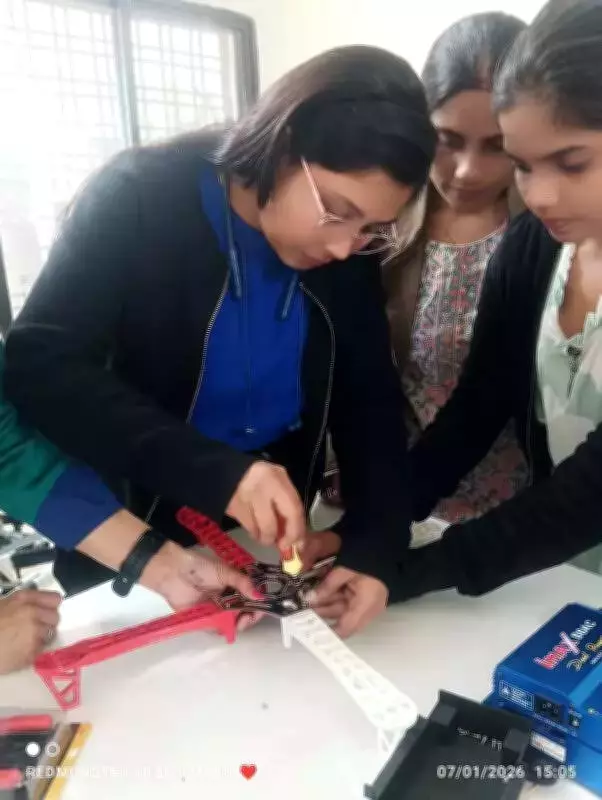
Inside a specialized training lab situated within the Ambajhari Ordnance Factory campus in Nagpur, a remarkable technological transformation is quietly taking place. Surrounded by soldering irons, intricate circuit boards, and propellers, a group of women who previously dedicated most of their time to managing household kitchens are now meticulously assembling drones—component by component.
Municipal Initiative Drives Modern Skill Development
This significant shift is part of a pioneering skill development initiative launched by the Nagpur Municipal Corporation's social welfare department. Recently, 30 women successfully completed a comprehensive two-month drone technician training program under this initiative. Supported by a government grant of Rs 11,000 per trainee, the course ran from December to February, immersing participants in the rapidly expanding field of drone technology.
For the Nagpur Municipal Corporation, this program represents a substantial departure from traditional livelihood training typically offered to women. "Earlier we organized courses such as weaving, stitching, pickle-making, and other small household-based skills," explained additional municipal commissioner Vaishnavi B. "Now, we aim to align training programs with the demands of modern industries. That is precisely why we initiated the drone technician training program in collaboration with the VDIA Engineering Design Innovation Centre," she emphasized.

Hands-On Learning for Practical Employment
The course was meticulously designed to prioritize hands-on learning over conventional classroom lectures. Most participants came from modest educational backgrounds, with many having studied only up to Class 10 or 12. Consequently, trainers concentrated on imparting practical skills that could directly translate into employment opportunities.
Participants received instruction in assembling drones from scratch, connecting motors and sensors, soldering electronic components, and understanding battery systems and flight controllers. Although drone flying itself was not included in the syllabus, trainees were introduced to the underlying science of drone functionality and the regulatory frameworks governing their use.
"We focused on practical learning because theory alone would not benefit them," stated VEDIC director Bhavna Deshpande. "Instead of emphasizing written work, we trained them to physically assemble the drone and comprehend how each component operates," Deshpande added.
Building Confidence Beyond Technology
The training extended beyond mere technical skills. To foster confidence among participants, the program incorporated personality development sessions, communication exercises, and small presentations. "For many women, it was the first time they stood up and explained something in front of others," Deshpande noted. "By the end of the course, they were confidently explaining drone parts to visitors."
For 25-year-old Mansi Agashe, a BCom graduate, the experience unveiled a career path she had never envisioned. After completing both theory and practical assessments, she and her batchmates are now preparing for interviews with companies associated with the program.
Expanding Career Horizons for Women
Another trainee, 36-year-old Hema Thakur, highlighted how the training provided an opportunity to explore beyond conventional career options. A BA graduate and former schoolteacher, she observed that opportunities in the education sector had become increasingly competitive. "Teaching is the only career path we usually consider after graduation," she remarked. "But this course enabled me to learn something entirely new and technical."
Thakur discovered the program unexpectedly while visiting an NMC office to pay property tax, overhearing a conversation about the training. Following course completion, the women were also exposed to industry platforms, where they interacted with companies and explained drone components at exhibition stalls—gaining firsthand experience in the technology ecosystem.

Future Prospects and Broader Implications
Officials indicate that the next phase involves connecting trainees with industries for internships and potential job placements. Although the current initiative involved only 30 women, it signals a broader shift where skill development programs are no longer confined to traditional crafts.
On the eve of Women's Day, the narrative of these trainees embodies a quiet yet powerful transformation: women stepping out of kitchens and into laboratories, workshops, and technology labs—assembling not just drones, but also new possibilities for their futures.