

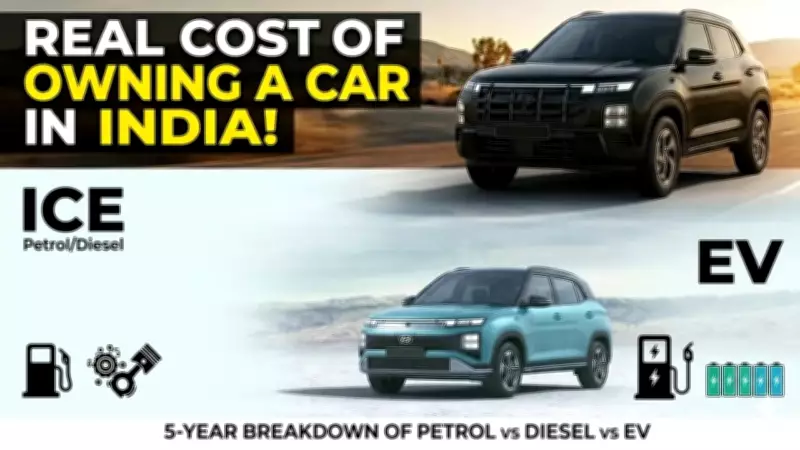
Beyond Sticker Price: The Real Cost of Owning Hyundai Creta Petrol, Diesel, and Electric SUVs
The debate over car ownership in India frequently centers on a basic choice: petrol, diesel, or electric? However, the genuine answer emerges not from the initial purchase price but from the comprehensive total cost of ownership evaluated over an extended period. When you incorporate critical factors like fuel expenses, maintenance charges, insurance premiums, and resale depreciation, the financial landscape transforms entirely. To illustrate this clearly, we examine the Hyundai Creta, a popular SUV available in all three powertrain variants: Petrol, Diesel, and Electric. This analysis aims to uncover the authentic long-term expenses associated with each version over a five-year ownership cycle.
Setting the Stage: Assumptions and Methodology for Realistic Comparison
To ensure a practical and relevant assessment, we have based this comparison on Delhi-specific conditions. Fuel prices are estimated at approximately Rs 100 per litre for petrol and Rs 90 per litre for diesel. Electricity for convenient home charging is calculated at an average rate of Rs 7 per unit. For accuracy, we utilize real-world efficiency figures rather than optimistic ARAI claims. Accordingly, we assume 15 kmpl for petrol, 20 kmpl for diesel, and around 8 km per kWh for the electric SUV. Annual driving distance is fixed at 15,000 kilometers, accumulating to 75,000 kilometers over five years. This represents a fair estimate for typical urban private car usage patterns across India.
Initial Investment: Upfront Purchase Price Disparities
Commencing with purchase price, the petrol-powered Hyundai Creta manual transmission variant carries an approximate on-road price of Rs 12.80 lakh in Delhi. The Diesel-Manual version positions higher at around Rs 15 lakh, while the Creta Electric commands a substantially steeper starting on-road price of Rs 19.50 lakh. These figures are indicative estimates derived from current pricing trends rather than exact costs. Consequently, the electric vehicle begins its ownership journey with a significant disadvantage of roughly Rs 7 lakh compared to petrol and approximately Rs 4-5 lakh over diesel. This substantial upfront gap frequently acts as the primary deterrent for prospective buyers considering electric cars.

Operational Expenditure: Running Costs Over Five Years
When evaluating running costs, the distinctions between the three powertrains become strikingly evident. In Delhi, with petrol priced around Rs 100 per litre and real-world efficiency of roughly 15 kmpl, the running cost computes to about Rs 6.6 per kilometer. Diesel, costing approximately Rs 90 per litre and delivering close to 20 kmpl, reduces the expense to around Rs 4.5 per kilometer. For electric vehicles, assuming home charging at an average tariff of Rs 7 per unit and efficiency of about 8 km per kWh, the running cost plunges dramatically to nearly Rs 1 per kilometer. Over a five-year period covering 75,000 kilometers, this translates to roughly Rs 5 lakh for petrol, about Rs 3.3–3.5 lakh for diesel, and merely Rs 70,000–75,000 for an EV. This represents an enormous financial gap, though home charging infrastructure plays a pivotal role in achieving these savings.

- Petrol: Fuel price ₹100 per litre, efficiency 15 kmpl, running cost ~₹6.6/km, 5-year cost ~₹5,00,000
- Diesel: Fuel price ₹90 per litre, efficiency 20 kmpl, running cost ~₹4.5/km, 5-year cost ~₹3,37,500
- Electric (EV): Energy price ₹7 per unit, efficiency 8 km per kWh, running cost ~₹0.88/km, 5-year cost ~₹70,000
Maintenance and Insurance: Balancing Annual Outflows
Regarding maintenance, petrol cars remain relatively affordable, averaging around Rs 10,000–Rs 20,000 annually for routine servicing. Diesel cars typically incur 20–30 percent higher expenses due to costlier components and additional systems like turbochargers, elevating annual costs to roughly Rs 12,000–Rs 23,000. Electric vehicles, featuring far fewer moving parts and no engine-related components, are substantially cheaper to maintain, usually costing around Rs 2,000–Rs 7,000 per year. Over five years, this amounts to approximately Rs 50,000–Rs 80,000 for petrol, Rs 60,000–Rs 1 lakh for diesel, and just Rs 15,000–Rs 35,000 for an EV.
Insurance costs, however, slightly favor conventional cars. Over five years, a compact petrol SUV would require about Rs 60-70,000 in insurance premiums, while a diesel variant would be marginally higher at Rs 1.1 lakh. EVs, owing to their elevated upfront cost and expensive battery packs, generally command higher premiums, pushing the five-year insurance expenditure to around Rs 1.25 lakh. This partially counteracts the savings achieved in maintenance, though not to a significant degree.
- Petrol: Annual service ₹10k–₹20k, 5-year maintenance ₹50k–₹80k, 5-year insurance ~₹60k–₹70k, combined total ₹1.1L–₹1.5L
- Diesel: Annual service ₹12k–₹23k, 5-year maintenance ₹60k–₹1L, 5-year insurance ~₹1.1L, combined total ₹1.7L–₹2.1L
- Electric (EV): Annual service ₹2k–₹7k, 5-year maintenance ₹15k–₹35k, 5-year insurance ~₹1.25L, combined total ₹1.4L–₹1.6L
Resale Value: Depreciation Dynamics in Delhi Market
Resale value introduces intriguing complexities, particularly in a city like Delhi. After five years, a petrol car like the Creta petrol is anticipated to retain about 60 percent of its value, translating to roughly Rs 7.8 lakh. Diesel cars often exhibit better resale value than petrol counterparts, but in Delhi where NGT’s 10-year diesel rule applies, it might result in approximately Rs 80,000–Rs 1 lakh lower than petrol equivalents. EV resale values are still evolving, but current trends suggest retention of about 40 percent, heavily dependent on battery health which constitutes a major portion of the vehicle's residual value.
Comprehensive Five-Year Totals: Final Ownership Economics
Consolidating all numerical data over five years, the petrol-powered Creta culminates in an approximate cost of Rs 11–11.5 lakh, incorporating fuel, maintenance, insurance, and resale. The diesel Creta arrives slightly lower at around Rs 10.5–11 lakh, benefiting from superior fuel efficiency despite higher servicing and insurance expenses. The Creta Electric, notwithstanding its substantially higher upfront price, totals approximately Rs 12–13 lakh over five years, as its low running and maintenance costs are counterbalanced by the steep initial investment and diminished resale value.
Conclusion: Determining the Optimal Choice Based on Usage Patterns
Nevertheless, the conclusion is not as straightforward as proclaiming EVs the unequivocal winner. Their advantage hinges predominantly on usage intensity. If you drive around 15,000 kilometers or more annually, the reduced running costs validate the higher upfront price. For low-mileage users, however, the gap contracts, rendering petrol cars more sensible. Diesel persists as a robust middle ground, especially for frequent highway travelers.
Charging infrastructure constitutes another critical variable. Excessive reliance on public fast chargers can substantially increase the cost per kilometer, eroding the EV's financial benefit. Ultimately, the genuine cost of owning a car in India is not dictated solely by fuel type but by how you utilize the vehicle. Petrol suits low-mileage, hassle-free ownership. Diesel performs optimally for long-distance, high-efficiency driving. EVs, conversely, reward consistency: the more you drive, the more you save, making them ideal for high-usage urban commuters.





