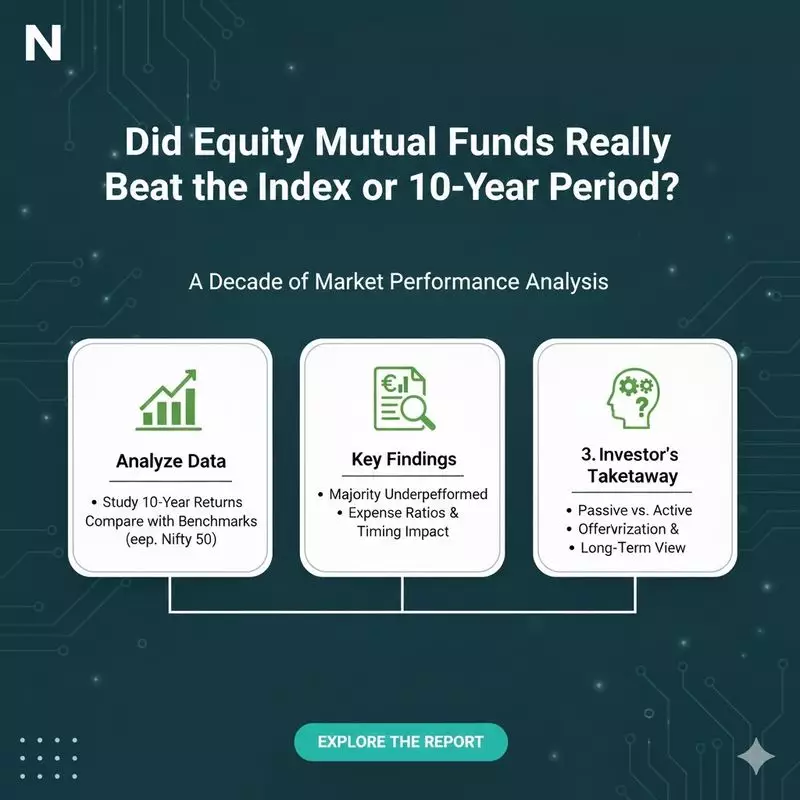
A critical question for every Indian investor is whether paying for professional fund management is worth it. Does the active management of equity mutual funds generate returns that justify their fees over the long haul? A detailed analysis of performance over a 10-year period provides crucial answers, comparing funds against their passive benchmark, the Nifty 50 Total Returns Index (TRI).
The Core Finding: A Mixed Bag of Results
The central revelation of the analysis is not a simple yes or no. Over the decade ending in 2023, the performance of actively managed equity funds presented a complex picture. Only a select group of funds managed to consistently outperform the Nifty 50 TRI, which serves as the most accurate benchmark by including dividends reinvested. The broader category, however, showed significant variation, with many funds failing to cross this high bar.
This underscores a vital principle for investors: past performance is not a reliable indicator of future results. While historical data is instructive, the fund management landscape is dynamic, with changing market cycles, fund manager turnover, and shifting investment strategies all playing a role.

Digging Deeper into the Numbers and Categories
To understand the full story, one must look beyond the overall category. Performance differed markedly across various types of equity mutual fund schemes:
- Large-Cap Funds: This category faced the toughest challenge. Given that these funds invest in the same large companies that constitute the Nifty 50, generating alpha (excess return) is notoriously difficult. The analysis found that beating the Nifty 50 TRI was a formidable task for most large-cap funds over the 10-year horizon.
- Mid-Cap and Small-Cap Funds: These categories, which invest in smaller companies, showed a greater propensity for outperformance. The potential for higher growth in these segments allowed several skilled fund managers to pick winners that drove returns above the large-cap index. However, this also came with inherently higher volatility and risk.
- Multi-Cap and Flexi-Cap Funds: Funds with the flexibility to invest across market capitalisations based on opportunities demonstrated a stronger record. Their ability to dynamically shift allocation between large, mid, and small-cap stocks provided fund managers a broader toolkit to navigate different market conditions and seek outperformance.
The analysis period, ending in 2023, is particularly noteworthy as it encapsulates a full market cycle, including bull runs, corrections, and the unprecedented COVID-19 pandemic volatility. This makes the findings more robust than those from a shorter, bull-market-dominated period.
Key Takeaways for the Indian Investor
What does this mean for your investment strategy? The data leads to several actionable conclusions:

- Benchmarking is Critical: Always evaluate a fund's performance against the Total Returns Index (TRI) of its primary benchmark, not just the price index. The TRI accounts for dividends, giving a true picture of the returns an investor would have received.
- Costs Matter Immensely: The expense ratio of a fund directly eats into returns. In a scenario where many active funds struggle to outperform, a low-cost passive index fund or ETF that simply replicates the Nifty 50 TRI becomes a compelling, low-effort alternative for core equity exposure.
- Diversification Across Fund Types: Relying solely on large-cap funds for alpha may be unrealistic. A blended portfolio that includes strategically chosen flexi-cap, mid-cap, or sectoral funds (with higher risk tolerance) might improve the odds of beating the market over the long term.
- Due Diligence is Non-Negotiable: Blindly picking past winners is a flawed strategy. Investors must look at consistency of performance across cycles, the fund manager's pedigree and tenure, the investment philosophy, and the fund house's reputation.
Ultimately, the 10-year analysis confirms that while the potential for outperformance by active funds exists, it is neither universal nor guaranteed. The onus is on the investor to make informed choices, manage costs, and set realistic expectations. For many, a combination of a low-cost passive core and a satellite of actively managed funds in specific segments may represent a balanced approach to navigating the Indian equity markets.