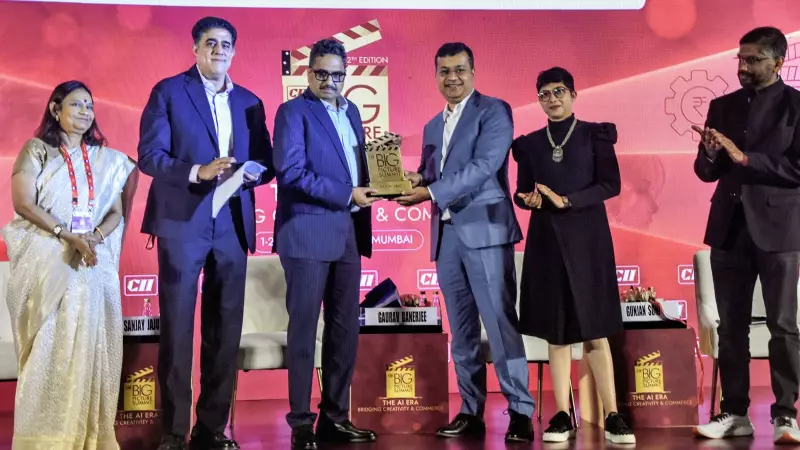
India's vast creative economy is set for a significant policy push, with industry leaders and government officials charting a roadmap for global expansion. The catalyst for this new chapter is a white paper on Priority Policy Reforms, unveiled at the 12th Confederation of Indian Industry (CII) Big Picture Summit in Mumbai.
A Call for Collective Action and Innovation
Speaking at the summit's inaugural session, Sanjay Jaju, Secretary of the Ministry of Information and Broadcasting (I&B), framed the event as part of a continuous movement. He urged the industry to see the WAVES Summit not as an isolated gathering but as a driver for perpetual creativity and progress. Jaju invoked Prime Minister Narendra Modi's perspective, noting that each wave of growth builds upon the last, requiring collective reflection and forward momentum.
Highlighting the sector's foundational importance, Jaju stated that entertainment stands alongside food, shelter, and clothing as a pillar of civilization. He revealed the staggering scale of India's creative economy: it provides livelihoods for over 10 million people and contributes an estimated Rs 3 lakh crore to the national GDP. "The true value of our sector goes beyond numbers: it connects people, fosters harmony, and links nations together," he emphasized.
Bridging the Gap Between Potential and Global Share
Despite this impressive domestic footprint and a rich cinematic legacy, Jaju pointed out a critical challenge: India commands only 2% of the global media and entertainment market. He identified this as both a challenge and a monumental opportunity. The key, according to him, is transforming India's creative potential into products and stories that resonate worldwide, thereby amplifying the nation's soft power.
Jaju also addressed the transformative role of technology, urging filmmakers to embrace new tools like Artificial Intelligence (AI). "As a rising economic power, India’s stories must be heard and seen worldwide. This is the essence of our soft power," he asserted.
Industry Leaders Outline the Growth Blueprint
Echoing the call for strategic growth, Gaurav Banerjee, Chair of the CII National Council on Media & Entertainment and MD & CEO of Sony Pictures Networks India, outlined concrete steps. In his opening address at the two-day summit, Banerjee advocated for establishing specialised creative institutions and forging stronger industry-academia partnerships. He also stressed the need to develop regional creative clusters and initiate urgent public-private collaboration to unlock the sector's next growth phase.
Other industry voices added depth to the discussion. Rajan Navani, Co-Chair of the CII National Council and MD & CEO of Jetsynthesys, highlighted AI's potential as a creative partner and underscored the importance of trusted government-industry frameworks. Meanwhile, Gunjan Soni, Co-Chair and Country MD of YouTube India, focused on the rise of creative entrepreneurship and the ongoing democratization of content creation.
The newly released white paper serves as the cornerstone of this ambitious vision. It provides a set of actionable recommendations designed to drive growth, foster innovation, and ultimately position India as a definitive leader in the global creative economy. The consensus from the summit is clear: through policy reform, technological adoption, and collaborative effort, India's creative sector is poised to make a much larger mark on the world stage.