

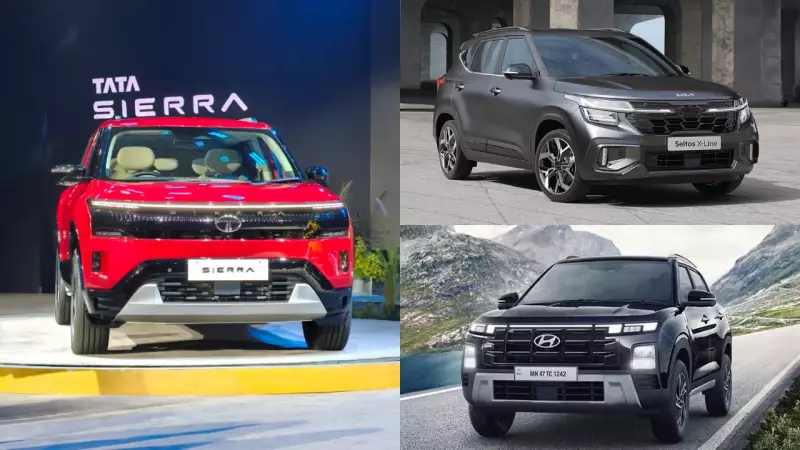
Tata Motors has officially launched the highly anticipated Tata Sierra SUV in the Indian market, marking the triumphant return of an iconic nameplate that was discontinued back in 2003. This modern iteration represents a bold departure from the classic SUV that once dominated Indian roads in the early 2000s, now entering the competitive compact SUV segment.
Prospective buyers can book the new Sierra online or visit their nearest Tata dealership starting December 16, 2025, with customer deliveries scheduled to commence from January 15, 2026. The revived Sierra enters as a direct competitor to established players like the Hyundai Creta, Kia Seltos, Maruti Grand Vitara, and Toyota Hyryder.
Price and Variants Comparison
The 2025 Tata Sierra arrives with seven distinct variants: Smart Plus, Pure, Pure Plus, Adventure, Adventure Plus, Accomplished, and Accomplished Plus. The base model starts at an attractive Rs 11.49 lakh (ex-showroom), though the complete variant-wise pricing will be disclosed at a later date.

Meanwhile, the Hyundai Creta offers nine variants ranging from E to King edition, priced between Rs 10.7 lakh to Rs 20.2 lakh (ex-showroom). The Kia Seltos counters with HTE(O) to X-Line variants spanning Rs 10.8 lakh to Rs 19.8 lakh (ex-showroom).
Dimensions and Practicality Analysis
When it comes to sheer size, the Tata Sierra clearly establishes its dominance. It measures 4340 mm in length, 1841 mm in width, and 1715 mm in height with an impressive 2730 mm wheelbase. The SUV boasts 205 mm ground clearance and a massive 622-litre boot capacity, with wheel sizes ranging from 17 to 19 inches.
In comparison, the Hyundai Creta measures 4330 mm in length, 1790 mm in width, and 1635 mm in height with a 2610 mm wheelbase. It offers 190 mm ground clearance and 433 litres of boot space. The Kia Seltos stands at 4365 mm length, 1800 mm width, and 1645 mm height, sharing the same 2610 mm wheelbase as the Creta, along with identical ground clearance and boot capacity.
The Sierra's significant advantages in wheelbase, ground clearance, and boot space position it as the most practical choice for Indian families and adventure enthusiasts.
Powertrain and Performance Options
Tata Motors has equipped the new Sierra with three robust engine options: a 1.5-litre Kryotec turbo diesel generating 118 hp and 280 Nm torque, a newly developed 1.5-litre NA petrol producing 106 hp and 145 Nm torque, and a powerful 1.5-litre Hyperion turbo petrol delivering 160 hp and 260 Nm torque. The company has also confirmed plans to launch an AWD version soon.
The Hyundai Creta and Kia Seltos share identical powertrain options, including a 1.5-litre turbo petrol (160 hp/260 Nm), a 1.5-litre NA petrol (115 PS/144 Nm), and a 1.5-litre turbo diesel (116 PS/250 Nm). Transmission choices across both models include 6-speed MT, iMT, CVT (iVT), 6-speed AT, and 7-speed DCT.
Features and Safety Technology
The Tata Sierra comes loaded with premium features including a four-spoke steering wheel with illuminated logo, iRA connected car technology with Snapdragon chip and 5G connectivity, OTA updates, 12.3-inch passenger and center screens, 10.5-inch digital instrument cluster, 12-speaker JBL sound system with Dolby Atmos, HypAR HUD display, panoramic sunroof, and Level 2 ADAS.
Safety is comprehensive with six airbags, front parking sensors, 360-degree camera, electronic parking brake with auto hold, and multiple advanced driver assistance systems.
The Hyundai Creta matches up with twin 10.25-inch screens, dual-zone climate control, panoramic sunroof, ventilated seats, Bose sound system, and similar Level 2 ADAS features with six airbags and 360-degree camera.
The Kia Seltos impresses with dual 10.25-inch connected screens, panoramic sunroof, 8-inch head-up display, Bose-tuned 8-speaker system, and Level 2 ADAS with 17 autonomous features, making this three-way competition incredibly tight in the features department.

The return of the Sierra nameplate represents Tata Motors' ambitious attempt to capture significant market share in India's hottest SUV segment, bringing nostalgia together with cutting-edge technology and modern design aesthetics.





