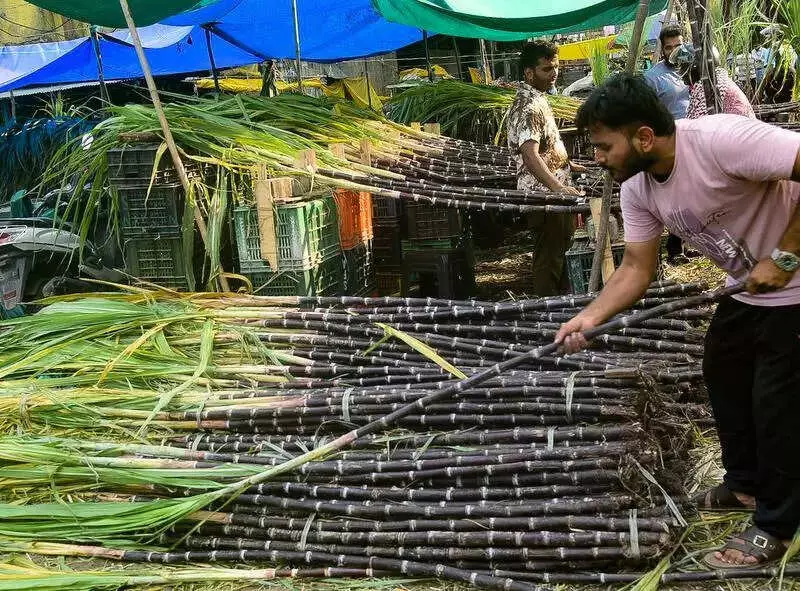
Farmers across the sugar cane growing belts of Maharashtra, particularly in regions like Kolhapur, are grappling with a severe agricultural concern: premature flowering in their crops. This phenomenon is leading to a significant drop in the weight of the cane and a reduction in its sugar content, directly impacting their income and yield.
Weather Woes Trigger Premature Maturity
Industry experts point to constant changes in weather patterns and unseasonal rains that continued until late November as the primary cause for the widespread flowering this year. Sachin Patil, secretary of the Vishwasrao Naik Sugar Factory in Shirala, Sangli district, explained that flowering represents a maturity stage which halts the growth of the sugar cane. "After flowering, the crop starts becoming hollow," Patil stated. He attributed the problem to an extended monsoon, noting that rains began in mid-May and persisted through November.
Since sugar cane is typically a 12 to 16-month crop depending on the seed variety, rains received in late October and November delayed the harvest. This delay, coupled with the late commencement of the sugar crushing season, forced the cane to remain in the fields beyond its optimal period, triggering flowering. Dr. Ashokrao Pisal, associate dean at Rajarshi Shahu Maharaj Agricultural College in Kolhapur, warned that if cane remains in the field for over 1.5 to 2 months after reaching the stalk stage, the stalks burst and become hollow. The sucrose inside then decomposes into glucose and fructose, drastically reducing sugar extraction during processing.

Crushing Data and Farmer Anguish
According to the Sugar Commissionerate of Maharashtra, the crushing season for the state's 191 sugar factories has begun, with a combined daily crushing capacity of 10,03,050 metric tonnes. Data shows that till December 21, crushing of 44.606 million metric tonnes of cane was completed, producing 38.021 million quintals of sugar.
However, for farmers like Atul Save from Kuditre, these numbers are overshadowed by the damage in the fields. Save recounted how the cane survived multiple disasters, including excess rain, cloudy weather, floods, and attacks by 'humani' and 'mawa' insects, only to be threatened by flowering. "Sugar cane that survived all these disasters is certain to lose weight due to the breaking of stalks," he said. Farmers have been demanding that sugar factories begin harvesting earlier to mitigate losses. "The more such sugar cane with flowering, the more it will lose its yield and sugar content, resulting in loss to farmers. The more the weight of the sugar cane, the more the outcome for farmers," Save emphasized.
Ripple Effects and Economic Concerns
The crisis has broader economic implications. Sachin Patil estimates that such flowering will result in a nearly 5% yield loss for farmers. Furthermore, there is growing anxiety among cane cutters who took advances from sugar factories. With the late start of the crushing season, they are now concerned about repaying those amounts, adding another layer of financial strain to the agricultural community.
The situation is especially critical in flood-affected agriculture belt regions near rivers. The combination of natural disasters and crop physiology issues has created a perfect storm, threatening the livelihood of thousands dependent on the sugar cane industry in Maharashtra.