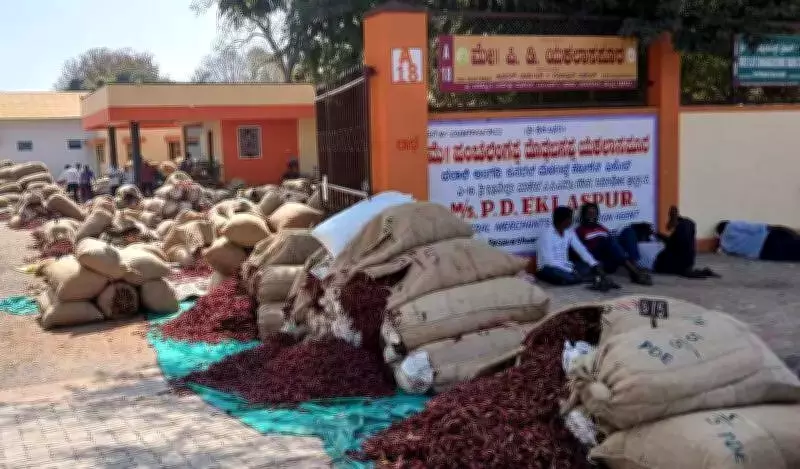
Hubballi's APMC Witnesses Historic Chilli Price Surge Amid Supply Shortfall
The Jagajyoti Basaveshwar Agricultural Produce Market Committee (APMC) in Hubballi, renowned as one of Asia's largest markets, is currently experiencing a dramatic scenario in its dry chilli trade. While prices have skyrocketed to unprecedented levels, the quantity of chilli arriving at the market has sharply declined compared to previous years, creating a unique economic dynamic for farmers and buyers alike.
Record-Breaking Prices and Reduced Arrivals
Over the past three weeks, the market set a new benchmark with Dabbi Kempu chilli reaching an astonishing Rs 78,211 per quintal. Simultaneously, the kaddi variety is commanding prices between Rs 59,000 and Rs 63,000 per quintal. These figures represent a significant increase from previous years, attracting more growers to bring their produce to Hubballi. However, this influx has not compensated for the overall reduction in supply.
According to KH Guruprasad, Secretary of APMC Hubballi, the market is receiving approximately 25,000 bags per week currently, a notable decrease from the 40,000 bags per week recorded during the same season last year. He provided detailed comparative data: "In the past three weeks, we received a total of 30,470 quintals, with prices ranging from a minimum of Rs 1,100 to the maximum of Rs 78,211. In contrast, during the same period in 2025, arrivals were 69,712 quintals, and the maximum price was Rs 46,001."

Market Dynamics and Regional Impact
Basavaraj Ekalaspur, former President of the APMC Cell at the Karnataka Chamber of Commerce and Industry and a commission agent, highlighted the evolving market trends. He noted that while the turnover of dry chilli increases annually, Hubballi receives fewer varieties compared to markets like Byadagi. The primary arrivals here are Byadagi and Deluxe Dabbi (Kashmiri) chillies, which previously sold for Rs 46,000 to Rs 48,000 per quintal but now exceed Rs 70,000.
Ekalaspur explained, "Yield is arriving from districts including Gadag, Bagalkot, Vijyapura, and Belagavi. To better serve growers, we have expanded our special market sessions to Wednesdays and Saturdays, up from once a week previously." He also observed a surge in buyer participation, with daily numbers jumping from 10-20 in past years to 80-100 currently.
However, he cautioned that heavy rains have led to reduced chilli cultivation in the region, and trading may cease by the end of March this year, unlike last year when it continued until June or July.
Farmer Perspectives and Economic Realities
Ramesh Taligyal, a farmer from Sulibhavi village in Hunagund taluk, shared his personal experience, illustrating the complex reality behind the high prices. "Last time, I sold my produce at Rs 30,000 to Rs 40,000 per quintal. This time, it fetched Rs 70,000 per quintal," he said. However, he quickly added a note of caution: "One should not assume our income has doubled. Our yield reduced from 4-5 quintals per acre to just 2 quintals this year. So, financially, we are in a similar position as before."
Taligyal praised the Hubballi APMC market for its increased buyer presence, which has grown four to fivefold, ensuring growers receive competitive prices despite the challenges.
Conclusion: A Market at a Crossroads
The Hubballi APMC stands at a critical juncture, balancing record-high prices against significantly lower arrivals. While farmers benefit from improved pricing, reduced yields due to climatic factors temper their gains. The market's adaptation, including expanded trading days and heightened buyer interest, reflects efforts to navigate these fluctuations. As the season progresses, stakeholders will closely watch whether supply constraints ease or if prices continue their upward trajectory, shaping the future of Karnataka's chilli trade.