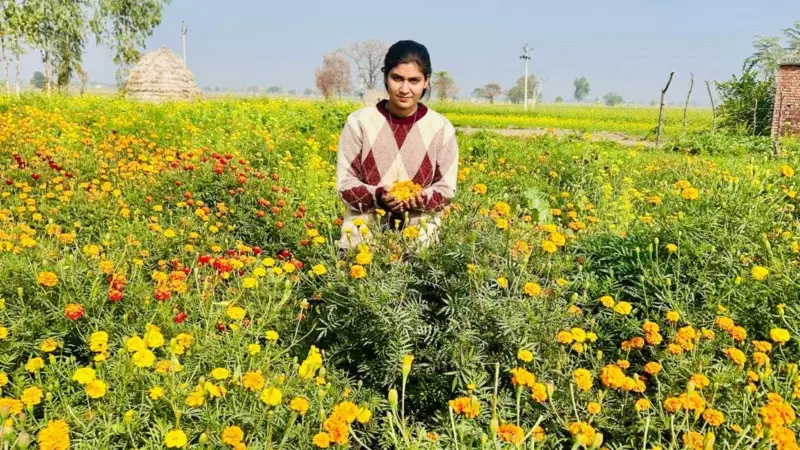
In a powerful narrative of self-reliance and agricultural innovation, a young woman from Punjab's Mansa district has charted a new course for herself and her family, choosing to bloom where she was planted. Amanjit Kaur, a 25-year-old from Kulrian village, has transformed a small piece of land into a flourishing flower business, becoming the financial backbone of her household and an inspiration for the region's youth.
From IELTS Dreams to Homegrown Roots
Amanjit's journey began amidst financial strain. Her father, Jeeta Singh, farms a modest 2-acre plot, which was insufficient to comfortably sustain their family of five, which includes her parents and two brothers. Like many young Indians seeking better prospects, Amanjit looked overseas. She prepared diligently and achieved a score of 6.5 on the International English Language Testing System (IELTS), a common step for migration.
However, a shift in perspective occurred. "I eventually dropped the idea of moving abroad," Amanjit explains. "I wanted to stand on my own feet in my own country." This decisive moment set her on a path of local entrepreneurship, driven by a desire for self-sufficiency within her homeland.

Floriculture: The Blossoming Enterprise
The spark for her new venture ignited during a simple, devotional act. While helping to decorate her local gurdwara with flowers, Amanjit saw potential. She proactively reached out to experts at the Punjab Agricultural University (PAU) in Ludhiana for guidance.
Under the mentorship of Dr. Parminder Singh, head of floriculture, and Scientist Dr. Amandeep Sharma, she took her first steps. In 2022, she began cultivating marigolds on a trial plot of just 7 marlas of land. The success was immediate and encouraging.
Today, her operation has expanded significantly. She now cultivates vibrant blooms across 1 kanal of land. Her flowers reach markets in multiple cities, including Bareta, Budhlada, Mansa, Sunam, Bathinda, Jakhal, and Ludhiana. The economics are compelling: a single marigold season, lasting about three months, brings her a net profit of approximately Rs 40,000. This income is comparable to the savings generated from a one-acre wheat yield, highlighting the high-value potential of floriculture.
Education, Recognition, and a Model for the Future
The financial independence from her farm has had a direct and positive impact on Amanjit's life and family. The steady income has enabled her to pursue higher education without burdening her family. She is currently in her second year of a Master's degree in Punjabi at Guru Nanak College in Budhlada.
Her efforts have not gone unnoticed by local authorities. The Horticulture Department in Mansa provided her with crucial support, including guidance and replacement plants after crop damage caused by rains this year. Furthermore, her story impressed Mansa Deputy Commissioner Navjot Kaur, who met Amanjit at a recent Kisan Mela in Mansa.
Praising her determination, the DC stated, "Though she farms on a small area, Amanjit has become a financial support for herself and her family through hard work." She emphasized that Amanjit has become a true role model, demonstrating that success and sustenance can be built in one's own village, offering a powerful alternative to the dream of migration abroad.
Amanjit Kaur's story is more than an agricultural success; it is a testament to the power of local innovation, expert guidance, and youthful perseverance. It provides a tangible blueprint for how passion, coupled with scientific support, can create sustainable livelihoods and inspire a generation to rethink their future on home soil.