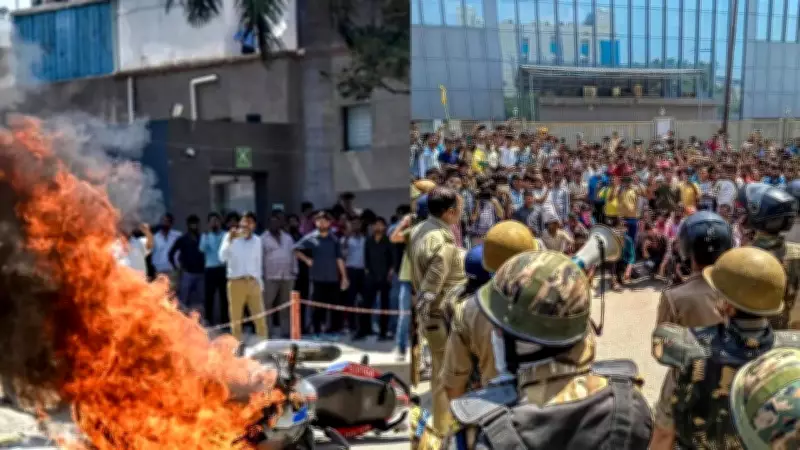
Noida Industrial Workers' Protest Descends into Chaos and Violence
A massive protest by industrial workers demanding higher wages brought Noida to a complete standstill on Monday, escalating into widespread violence, arson, and vandalism across multiple sectors. Authorities have alleged the involvement of "outsiders" and flagged a possible larger conspiracy, initiating parallel probes into suspected links ranging from organized misinformation to Pakistan-backed destabilization attempts and even a potential Naxal revival.
Protests Build and Turn Volatile
The protests, which had been building over several days, saw an estimated 40,000 to 45,000 workers gather at approximately 80 to 83 locations across the Gautam Buddh Nagar commissionerate. Key industrial clusters in Sector 62, Phase-2, Sector 63, Sector 60, Sector 84, and parts of Greater Noida were affected. Workers began assembling around 9:30 AM, initially staging peaceful demonstrations and sit-ins over demands for higher minimum wages, fixed duty hours, overtime pay, and improved working conditions.
While officials stated that most gatherings were handled through dialogue and remained peaceful, the situation turned volatile at several locations. Near industrial units such as Motherson in Phase-2, police reported that a section of protesters became aggressive. According to officers, some workers climbed factory walls, cut wire fencing using tools, and were soon joined by larger crowds. Stone-pelting began, forcing police to use mild force to control the situation.

Authorities Point to External Elements
Gautam Buddh Nagar Police Commissioner Laxmi Singh stated that even as workers began dispersing peacefully from several locations, groups from 'outside' the district entered bordering areas and attempted to provoke unrest. "After the labourers dispersed peacefully, a group from outside arrived and moved around attempting to incite tension and violence. Some have been taken into custody and the rest are being identified," she said, adding that "anti-social elements" played a significant role in escalating the situation.
Industrial Hubs Become Flashpoints
Sector 62 and Phase-2 bore the brunt of the violence, where mobs armed with sticks, belts, and clubs ran amok. They smashed glass facades of factories, vandalized establishments, and torched vehicles. Eyewitnesses reported that at least a dozen vehicles were set on fire during the day, including police vehicles, while 4–5 cars were burnt outside a service centre in Sector 63. The facility itself was extensively vandalized.
Stone-pelting on anti-riot police and damage to industrial property were reported from multiple locations. Police confirmed that arson incidents occurred at two places, which were brought under control through coordinated action involving fire services and local units. At least five police personnel sustained injuries during the clashes.
Probes into Pakistan Link and Naxal Revival
Uttar Pradesh Labour Minister Anil Rajbhar described the violence as a "well-planned conspiracy" aimed at disrupting development and law and order. He revealed that agencies are examining a possible Pakistan link, citing recent arrests of suspected terrorists in Meerut and Noida with connections to handlers based in Pakistan. "In such a situation, the possibility of a conspiracy to create instability gains strength," he said, adding that anti-national forces could be attempting to exploit worker unrest. He also suggested the violence may have been timed to disrupt official programmes of the state leadership.
Chief Minister Yogi Adityanath went a step further, warning that the protests could be linked to attempts to revive Naxalism. "Naxalism is at the point of elimination, but attempts to revive it could be part of a larger conspiracy. Some protests may have involved misleading and disruptive elements," he said after chairing a high-level review. The CM stressed that only "genuine workers" should be allowed in negotiations, cautioning that external elements often infiltrate such movements by posing as labour representatives. He directed officials to strengthen intelligence networks in industrial areas, maintain strict vigilance, and take the strongest possible action against those inciting disorder.

City Paralyzed as Traffic Collapses
The unrest brought traffic to a grinding halt across major routes connecting Noida with Delhi. Protesters blocked the Noida Expressway, the Noida stretch of NH-9, Dadri Road, and the Chilla border, besides internal sector roads, leading to hours-long gridlock. Commuters described chaotic scenes as cars, ambulances, and school buses remained stuck. Several reported little on-ground traffic management as blockades spread rapidly across locations. Office-goers missed meetings, students feared missing exams, and many residents were forced to work from their vehicles as movement became nearly impossible. Shops in affected areas downed shutters fearing vandalism.
Despite diversions and advisories, officials admitted the scale and simultaneity of road blockades overwhelmed local enforcement, even though smaller protests in the preceding days had indicated rising discontent.
Wage Disparity with Gurgaon Fuels Anger
At the core of the unrest lies a widening wage disparity between workers in Noida and their counterparts in Gurgaon. Workers stated that the trigger came when they learned that employees in a Gurgaon unit of the same company would receive significantly higher wages following Haryana’s recent decision to raise minimum wages by about 35%, from roughly Rs 14,000 to Rs 19,000 per month. In contrast, workers in Noida said they continue to earn around Rs 13,000, often for shifts stretching up to 12 hours without weekly offs, with deductions for leave and minimal increments of Rs 280–Rs 300 every six months.
"For eight hours’ work, Rs 20,000 should be the minimum," said a woman protester, echoing a widely raised demand. Others spoke of rising rent, unaffordable healthcare, and inflation making survival difficult, with one worker saying half his salary went into rent alone.
From Simmering Anger to Flash Violence
Labour contractors and officials said the agitation had been building quietly for two to three days after news of the Haryana wage hike spread across factories. With no central union leading the movement, protests erupted simultaneously across units, initially remaining peaceful before turning violent on Monday. Police identified one flashpoint as a demonstration outside the Motherson facility in Phase-2, where workers who had arrived for shifts began protesting, drawing larger crowds in a short span.
Massive Police Deployment and Detentions
Authorities deployed nearly 3,000 police personnel to regain control, alongside fire services and administrative teams. By Monday evening, over 350 people had been detained, with nine FIRs registered—seven against unidentified persons involved in violence and two against social media accounts accused of spreading rumours. Police maintained that they acted with "restraint, patience and prudence", using only minimum necessary force while attempting to disperse crowds through counselling and dialogue wherever possible. Senior officers, including DGP Rajeev Krishna and ADG (law and order) Amitabh Yash, monitored the situation in real time.
Misinformation and Bot Network Under Scanner
Authorities stated that misinformation significantly aggravated the unrest. FIRs were registered against social media users, including those who falsely claimed deaths and injuries during the protests. Police identified more than 50 bot accounts created within 24 hours for spreading misleading content, with the UP STF tasked to trace their digital trail and possible coordination behind them. Officials also denied rumours of firing during the protests.
Government Outreach and Committee Formation
In an effort to defuse tensions, the state government announced that it has accepted four out of five demands raised by workers and constituted a high-powered committee to address the remaining issues. The panel, comprising senior officials from labour, MSME, and industrial departments along with industry representatives, has begun ground-level engagement. Officials said meetings were held with around 2,500 workers on Monday alone, though the absence of formal unions has complicated negotiations.
Earlier, the administration had announced measures including compulsory weekly offs, double overtime pay, annual bonuses before November 30, timely salary disbursal, medical cover, and improved workplace facilities.
Welfare Push and Industry Responsibility
Reiterating its labour welfare stance, the government directed industries to ensure safe, dignified working conditions, clean drinking water, rest facilities, healthcare access, and safety equipment. It also stressed strict compliance with labour laws, timely payment of wages, regulated working hours, and benefits such as EPF and ESI. Officials stated that a structured grievance redressal mechanism would be developed to prevent such flashpoints in the future.
Political Sparring Intensifies
Samajwadi Party chief Akhilesh Yadav attacked the government, blaming it for failing to address wage concerns and alleging that policies favoured industrialists over workers. "When neighbouring states have revised minimum wages, why has this government not acted?" he asked, calling the unrest a result of "injustice" and "one-sided policies".
Authorities said the situation is now under control, with normalcy gradually being restored across the district, though heavy deployment remains in sensitive areas. Police stated that surveillance is ongoing and efforts are underway to identify all those involved in violence, arson, and disruption, including external elements and those spreading misinformation.