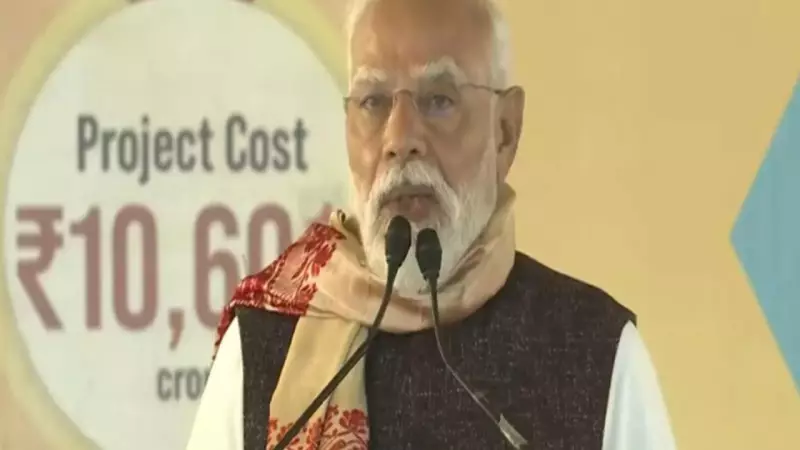
Prime Minister Narendra Modi on Sunday initiated a landmark industrial project for Northeast India by laying the foundation stone for a massive brownfield ammonia-urea plant in Assam's Dibrugarh district. Valued at Rs 10,601 crore, the facility is poised to redefine the region's industrial landscape and boost agricultural productivity.
A New Chapter for Assam's Industrial Progress
Speaking at a public rally in Namrup on the final day of his two-day Assam visit, Prime Minister Modi declared the day as historic for Assam and the entire Northeast. He stated that the long-cherished dream of Namrup and Dibrugarh was finally being realized, marking the beginning of a fresh era of industrial advancement. The new plant, named Assam Valley Fertiliser and Chemical Company Ltd (AVFCCL), is situated within the existing premises of the Brahmaputra Valley Fertiliser Corp Ltd (BVFCL).
The Prime Minister emphasized that the project, with an investment of approximately Rs 11,000 crore, would produce over 12 lakh metric tonnes of fertiliser annually. He highlighted that local production would ensure faster supply and significantly reduce logistical costs for farmers across the eastern states.

Addressing Farmer Needs and Criticising Congress Legacy
In his address, PM Modi launched a sharp critique of the previous Congress governments, accusing them of neglecting the modernisation of the country's fertiliser plants and failing to protect farmers' interests. He alleged that the technology at the old Namrup units became outdated, leading to the shutdown of several plants, which caused distress and income loss for farmers in the Northeast.
"The Namrup fertiliser plant in Assam will become the epitome of the country's industrial growth. It is sad that the Congress did not make efforts to modernise the plant, and find solutions to problems faced by farmers," Modi said. He contrasted this with the efforts of the BJP-led government, which he claimed established several new fertiliser plants across the nation after many were closed during Congress rule.
Project Details and Economic Impact
The AVFCCL project is a joint venture involving the Assam government, Oil India, National Fertilisers Ltd (NFL), Hindustan Urvarak & Rasayan Ltd (HURL), and BVFCL. The company, incorporated in July this year after Union Cabinet approval in March, stated that the plant is designed as a modern, energy-efficient, world-class fertiliser complex.
It will have an annual urea production capacity of 12.7 lakh metric tonnes and is scheduled for commissioning in 2030. Beyond ensuring fertiliser security, the project is expected to be a major catalyst for industrial growth and regional economic development. It will create hundreds of direct jobs and thousands of indirect employment opportunities in associated sectors like repair, supply, and other ancillary activities.
The facility will play a pivotal role in meeting the fertiliser demands of Assam, the entire Northeast region, West Bengal, Bihar, Jharkhand, and eastern Uttar Pradesh.
Broader Agricultural Initiatives Highlighted
Prime Minister Modi used the occasion to outline his government's broader commitment to farmer welfare. He noted that India's domestic urea production had increased from 225 lakh metric tonnes in 2014 to 306 lakh metric tonnes currently. While the annual requirement is 380 lakh metric tonnes, the government is working to bridge this gap and providing subsidies on imported fertilisers to shield farmers from the financial burden.
He also cautioned farmers against the uncontrolled use of urea to protect soil health, stating, "We need to protect our mother earth. If we care and protect it, only then will it give us the fruits."
Modi highlighted the direct benefit transfer of funds under schemes like the PM Kisan Samman Nidhi, through which about Rs 4 lakh crore has been transferred directly to farmers' bank accounts, eliminating the need for them to seek loans. He recalled the era of long queues for urea and police deployment at distribution centres, a situation he claimed his government is rectifying with dedication.

The Prime Minister also expressed confidence that the Centre's palm oil mission would make the Northeast self-sufficient in edible oil and increase farmers' income in the coming years.