

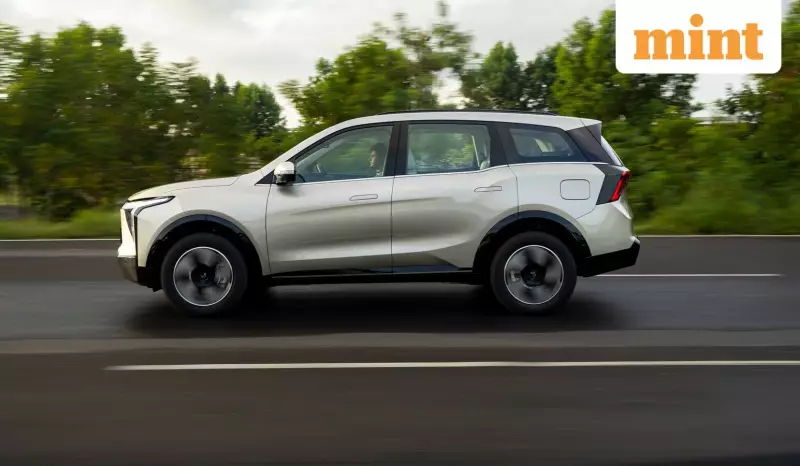
Mahindra Accelerates EV Strategy with New 7-Seater SUV
India's electric vehicle landscape is undergoing a significant transformation as automakers shift focus toward larger, more premium sports utility vehicles. Mahindra & Mahindra has positioned itself at the forefront of this evolution with the launch of its third electric SUV within a year—the XEV 9s, marking the company's first seven-seater electric offering.
The new model enters the market with an aggressive pricing strategy, starting at just under ₹20 lakh for the base variant and reaching up to ₹30 lakh for higher-end versions. This strategic move comes as Mahindra seeks to reclaim its revenue market leadership after briefly falling behind Tata Motors during the September quarter.
Expanding EV Portfolio in Competitive Market
Mahindra's electric SUV lineup now includes three distinct models. The company previously launched two five-seater options—the BE 6 priced between ₹18-28 lakh and the XEV 9e ranging from ₹21-31 lakh. The introduction of the seven-seater XEV 9s represents a calculated expansion into a segment that accounts for nearly half of the utility vehicle market's revenue.

This expansion comes at a crucial time when competition in the electric SUV space is intensifying significantly. Maruti Suzuki is set to introduce its e-Vitara next week, while Tata Motors has the Sierra EV scheduled for launch in the next fiscal year.
Rajesh Jejurikar, Executive Director and CEO of Mahindra's Auto and Farm sectors, confirmed the company's regained market position, stating, "We are back on top in October in revenue market leadership. Between April to October, we were the number one player."
Revenue Performance and Market Share Battle
Mahindra's electric vehicle division has demonstrated impressive financial performance in recent months. The company reported generating more than ₹8,000 crore from EV sales during April-September, accounting for nearly 9% of its total revenue of ₹91,635 crore for the period.
According to the company's investor presentation for the September quarter, Mahindra held 33.1% revenue market share compared to the leading OEM's 34.3%. Industry executives indicate Tata Motors was the competitor that briefly overtook Mahindra. However, during the first half of the fiscal year (April-September), Mahindra maintained a stronger position with 37.9% revenue share against Tata Motors' 29%.
The company has sold over 30,000 electric SUVs in the last seven months, competing directly with Tata Motors, MG Motor India, and Hyundai Motor India.
Production Plans and Market Opportunities
Mahindra is significantly ramping up its electric vehicle manufacturing capabilities. The company plans to increase its monthly EV production from the current 5,000 units to 7,000 units by the beginning of the next financial year.
Nalinikanth Gollagunta, Chief Executive of Mahindra's Auto Division, highlighted the potential of the seven-seater market, though he acknowledged the exact size of the EV opportunity remains uncertain. "It is anybody's guess, is it 20% of the overall seven-seater SUV segment, is it 30%, is it 40%, but I know it is not going to be 90% and I know it is not going to be 10%," Gollagunta stated.
According to Mahindra's internal analysis, the addressable market for seven-seaters represents 30% of the total 2.7 million utility vehicle market, contributing approximately 50% of the segment's revenue.
Competitive Positioning and Future Outlook
The electric vehicle market in India has shown remarkable growth, with EV penetration increasing from 2.5% in FY25 to reaching the 5% mark in FY26. Mahindra aims to capture 20-25% of its overall portfolio from green vehicles by 2028.

Gollagunta emphasized the company's competitive pricing advantage, noting, "Forget about price parity with internal combustion vehicles, we have managed to bring the cost of the vehicle even lower than many of the ICE seven-seaters. This is in addition to the number of new features we have been able to get for consumers."
In the broader passenger vehicle market, Mahindra is challenging Hyundai Motor India for the number two position. During the first nine months of 2025, Mahindra sold 446,697 passenger vehicles compared to Hyundai's 425,330 and Tata Motors' 410,155. Maruti Suzuki continues to dominate the market with 1.4 million vehicle sales in the same period.
Jejurikar also addressed concerns about potential losses from competitive pricing, assuring that the company has established efficient cost structures that allow it to offer advanced features without financial losses.
With the electric vehicle revolution gaining momentum in India, Mahindra's strategic focus on larger SUVs and seven-seater models positions the company to capitalize on the premium segment of the market while strengthening its overall standing in the competitive automotive landscape.





