Ludhiana's vast industrial community has stepped into the new year with a heavy dose of scepticism and concern. Industry leaders across sectors are voicing deep frustration over a slew of unfulfilled promises, persistent policy bottlenecks, and mounting operational challenges that threaten the region's manufacturing backbone.
Core Issues: GST, Credit, and Power Tariffs
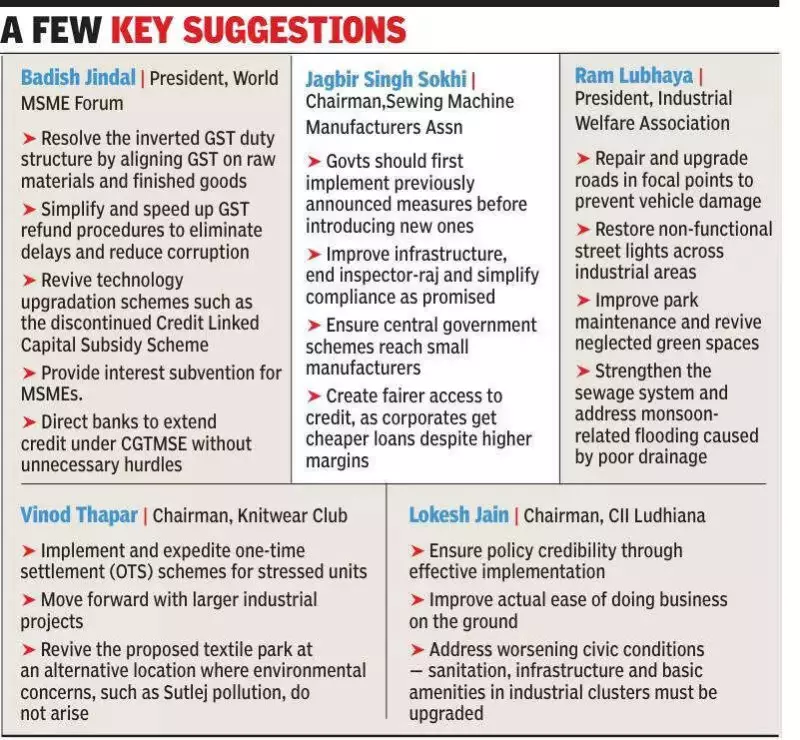
Badish Jindal, President of the World MSME Forum, pinpointed the inverted GST duty structure as a critical pain point. He explained that the problem occurs when the Goods and Services Tax on raw materials is set higher than the tax on finished products. This forces manufacturers into a complex cycle of filing refund claims, a process often mired in delays and susceptible to corruption. Jindal advocated for aligning the GST rates on inputs and final goods to eliminate this structural flaw entirely.
Jindal also stressed the urgent need to revive technology upgradation schemes, like the discontinued Credit Linked Capital Subsidy Scheme, which previously helped small units modernise. He called for clear instructions to banks to ease loan disbursement under the CGTMSE scheme and urged government support for exporters hit by US tariff hikes through targeted incentives.

On the state front, Jindal highlighted the crippling cost of electricity. Despite promises of power at Rs 5 per unit, the effective cost after taxes and duties soars to between Rs 7 and Rs 8. He demanded a correction in this discrepancy and pushed for active promotion of solar power. He also underlined the prohibitive cost of compliance, noting that even mandatory BIS testing at private labs can exceed Rs 25,000, putting it out of reach for many small manufacturers.
A Plea for Implementation Over Announcements
Jagbir Singh Sokhi, chairman of the Sewing Machine Manufacturers Association, stated that the industry would be content if governments simply delivered on promises made in previous years. He argued that ground-level implementation of already declared measures would provide significant relief, even without new announcements.
Sokhi pointed out a stark disparity: while large corporates access loans at lower interest rates, small units struggle for credit. He further noted that corporate margins can reach 300%, while small-scale industries often operate on margins below 10%, yet both pay identical power tariffs. For the sewing industry, stuck GST refunds and the inverted duty structure are direct threats to survival.
Echoing the sentiment on implementation, Lokesh Jain, Chairman of CII Ludhiana, said the credibility of any policy hinges entirely on its effective execution. He observed that despite several policies announced last year, their tangible impact remains minimal. Jain expressed concern over deteriorating civic conditions in industrial clusters, where sanitation, infrastructure, and basic amenities have worsened. Expectations have fallen so low, he remarked, that the industry would be grateful if conditions simply did not deteriorate further.
Crumbling Infrastructure and a Glimmer of Hope
Focusing on local woes, Ram Lubhaya, president of the Industrial Welfare Association, listed longstanding unaddressed demands. He described roads in focal points as being in poor condition, causing frequent vehicle damage. Non-functional street lights, neglected parks, an inadequate sewage system, and severe waterlogging during monsoons due to poor drainage plague the industrial areas.
Amid the gloom, Vinod Thapar, chairman of the Knitwear Club, identified a sliver of hope in the announcement of one-time settlement (OTS) schemes for stressed units. However, he emphasised that larger projects must also advance. Thapar recalled that a major textile park proposal was shelved over concerns of polluting the Sutlej river and urged the government to announce it at an alternative, environmentally suitable location.
The collective message from Ludhiana's industrial heartland is clear: the time for announcements is over. The new year's demand is for concrete, ground-level action to address fundamental issues in taxation, credit, power, and infrastructure to restore confidence and competitiveness.