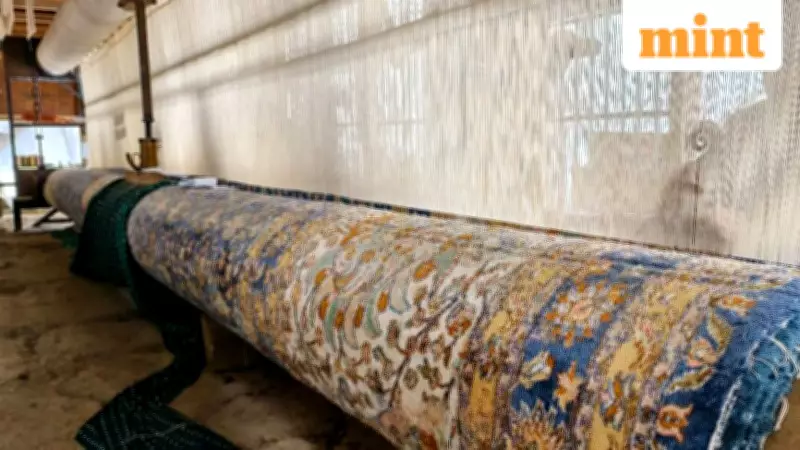
Kashmir's Silk Carpet Renaissance: Crafting the World's Largest Handmade Masterpieces
In the bone-chilling winter of Kashmir's remote hamlets, a quiet revolution is unfolding within modest workshops where master weavers are painstakingly creating what may become the world's largest handmade silk carpets. This represents a strategic pivot for an industry that has faced decades of challenges from machine-made imports, political uncertainty, and the gradual departure of skilled artisans.
Record-Breaking Creations Redefining Global Luxury
In Vailoo-Kunzar hamlet of Baramulla district, approximately 30 kilometers from Srinagar, artisans sit cross-legged on packed-earth floors beneath specially designed looms that carry impossible weights. Their disciplined fingers move in quiet unison, knot by knot, shaping a carpet so vast it cannot be viewed entirely at once. This particular masterpiece, measuring 30 by 72 feet, is expected to become the world's second-largest handmade silk carpet upon completion after more than eight years of work.
"These carpets are not merely products but powerful business statements," explained Habibullah Sheikh, a master weaver involved in producing some of the world's largest handmade carpets. "They demonstrate that Kashmir can still command the world's most demanding buyers and compete globally in an era dominated by speed."

Sheikh speaks from remarkable experience. In 2024, he and his team completed what officials recognize as the world's largest handmade silk carpet, measuring 72 feet by 40 feet. This eight-year project involved more than 36 crore hand-tied knots and was valued at approximately Rs. 37.5 crore before being shipped to Qatar for display in a ceremonial hall.
The Artisan's Journey: Patience, Precision and Preservation
At the loom, Sheikh recites the Talim—a coded language of color, pattern, and count passed down through generations. The instructions flow steadily, unhurried, and weavers follow without pause, their hands moving almost instinctively. From adjoining rooms, women serve hot cups of Nun Chai, the traditional pink salty tea of Kashmir, as the season's first snow drifts outside.
"In winter, shorter days limit us to about nine hours of work, but in summer we often exceed ten hours daily," Sheikh noted, explaining that Fridays remain reserved as the weekly break.
For the Sheikh brothers and their artisans, these record-breaking carpets represent more than scale or spectacle—they have become symbols of hope for an industry fighting for survival. Both brothers learned their craft early, with Sheikh beginning at seven and his younger brother Abdul Gaffar starting at eleven.
"Attempting to compete with machines cost us our market position," Gaffar reflected. "Today, we understand our strengths clearly. Machines produce speed, but we create craftsmanship, quality, and precision that cannot be replicated."
Strategic Shifts and Global Recognition
Kashmir's carpet revival is being shaped by multiple strategic approaches. While record-size commissions primarily come from Gulf buyers seeking visually appealing, uncompromising quality, a new generation of designer-artisans is repositioning the craft for global luxury markets through limited-edition wall pieces and bespoke designs.
In downtown Srinagar—designated a UNESCO Craft City in 2021—Shahnawaz Ahmad Sofi, a Fine Arts graduate, creates wall-hanging carpets featuring calligraphy, birds, and floral motifs rather than traditional floor coverings. At 44, he straddles tradition and technology, using computers to design carpets rooted in Kashmiri motifs that have reached prestigious venues including the 2022 FIFA World Cup and the home of Asia's richest man.
"Innovation in motifs and color combinations has worked wonders for Kashmir's carpet industry, which was staring into oblivion," Sofi observed.
Institutional Support and Market Recovery
The government has implemented crucial measures to stabilize this 600-year-old industry, which counts 56,699 registered artisans. In 2022, authorities introduced Geographical Indication tagging for Kashmiri hand-knotted carpets. The QR-code-based label allows buyers to verify a carpet's origin, material, knot density, and artisan details with a simple smartphone scan.

"Without GI tagging, this trade might not have survived," stated Atul Sharma, managing director of the J&K Handloom and Handicraft Corporation. "Buyers spending lakhs or crores were hesitant earlier. The GI tag has restored essential confidence in authenticity."
Recent years have brought significant recognition. Twelve specially commissioned Kashmiri carpets adorned the G20 Summit Room at Bharat Mandapam in New Delhi in September 2023. Traditional silk carpets woven by artisans from Budgam district were installed in India's new Parliament building in 2022. Additionally, Prime Minister Narendra Modi presented a handmade Kashmiri silk carpet to Cyprus President Nikos Christodoulides in June of last year.
Export Figures and Future Prospects
According to official statistics, carpet exports in Kashmir surged to ₹357 crore in 2022-23, rising from ₹251 crore in 2021-2022 and ₹299 crore in 2020-2021. While this remains below the ₹452 crore recorded in 2017-18, the recovery trajectory appears promising.
"We anticipate strong carpet sales through 2026, with exports projected to cross ₹1,000 crore," Sharma projected. "Our carpets are regaining ground in key international markets including the United States, the Middle East, and Australia, supported by strategic international exposure programs."
Despite facing challenges such as last year's 50 percent tariff imposed by the United States on hand-knotted rugs—which increased duties from 2.9 percent to 52.9 percent—the industry is diversifying beyond American buyers who previously accounted for nearly 60 percent of India's handmade carpet imports.
"Our domestic market presents enormous potential," emphasized Sheikh Ashiq of the Carpet Export Promotion Council. "From Kashmir to Kanyakumari, even if just one percent of India's population purchases handmade carpets, it could sustain the entire industry. With 147 crore people, that one percent can achieve remarkable results."
As artisans continue their meticulous work, knot by knot, inch by inch, Kashmir's carpet industry demonstrates that heritage craftsmanship, when combined with strategic innovation and institutional support, can reclaim global relevance in the luxury marketplace.