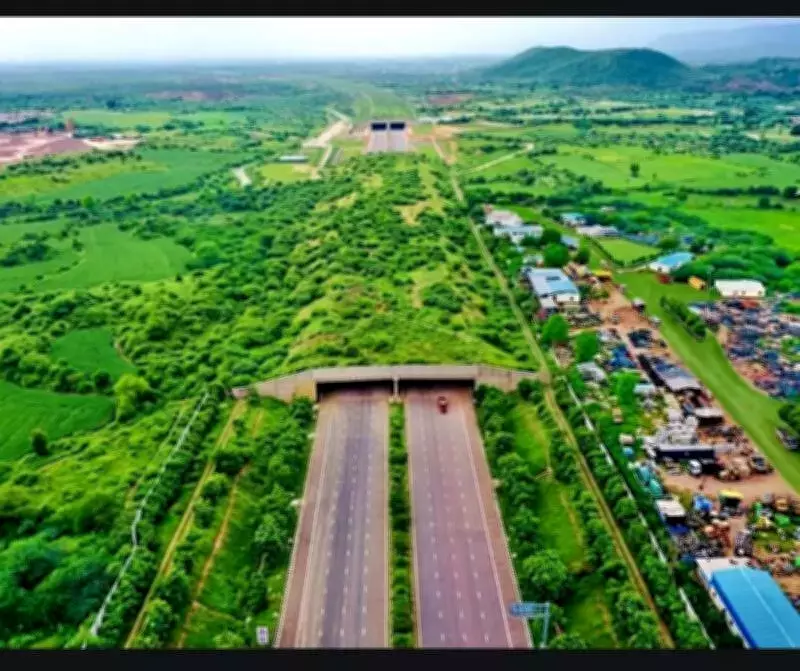
India's Longest Wildlife Crossing Takes Shape on Delhi-Mumbai Expressway
A monumental infrastructure project is emerging on the Delhi–Mumbai Expressway, poised to become the country's longest wildlife crossing once fully completed. Spanning an impressive 11.5-kilometer stretch near the buffer zone of the Ranthambore Tiger Reserve (RTR) in Jaipur, this initiative represents a significant advancement in balancing development with ecological preservation.
Project Overview and Design
Valued at approximately Rs 900 crore, the project incorporates a sophisticated dual-system approach to facilitate safe animal movement. It features both overpasses and underpasses specifically engineered to maintain a crucial wildlife corridor. The primary objective is to enable animals to cross the expressway without the risk of traffic collisions, thereby preventing habitat fragmentation that often results from major road constructions.
The centerpiece of this endeavor is a 3.5-kilometer animal overpass system, which is structured into five distinct segments, each measuring roughly 500 meters with intentional gaps between them. Complementing this aerial pathway is a 1.2-kilometer animal underpass, meticulously constructed to provide secure subterranean passage for wildlife beneath the bustling expressway.

Current Status and Progress
The project has reached a pivotal stage with the partially-completed section recently opened to northbound traffic, specifically in the Kota-to-Delhi direction. However, work on the southbound stretch remains actively ongoing. Authorities have projected that the entire project will be finalized by September of this year, marking a significant milestone in India's infrastructure and conservation efforts.
Expert Insights and Ecological Impact
Chirag Sharma, the maintenance manager at Larsen & Toubro (L&T), the company overseeing the project, emphasized its groundbreaking nature. "This is the country's longest animal overpass, built in an area that sees regular wildlife movement," he stated. Sharma further noted that a diverse array of animals, including bears, chital, sambar, and nilgai, have already begun utilizing both the overpasses and underpasses to traverse the expressway safely.
A senior official from the National Highways Authority of India (NHAI) highlighted the dedicated focus on preserving animal movement. "The underpass stretch is being developed with a dedicated focus on preserving animal movement. It ensures the animal corridor remains undisturbed despite vehicular traffic," the official explained, underscoring the project's commitment to ecological integrity.
Broader Implications and Future Prospects
This initiative sets a new benchmark for wildlife conservation within infrastructure development in India. By integrating such crossings, the project not only protects local fauna but also serves as a model for future highway constructions near sensitive ecological zones. The successful implementation could inspire similar measures across the country, promoting coexistence between human progress and wildlife preservation.
As the completion date approaches, all eyes are on this stretch of the Delhi-Mumbai Expressway, which promises to demonstrate how modern engineering can harmonize with nature, ensuring safe passages for both vehicles and wildlife alike.