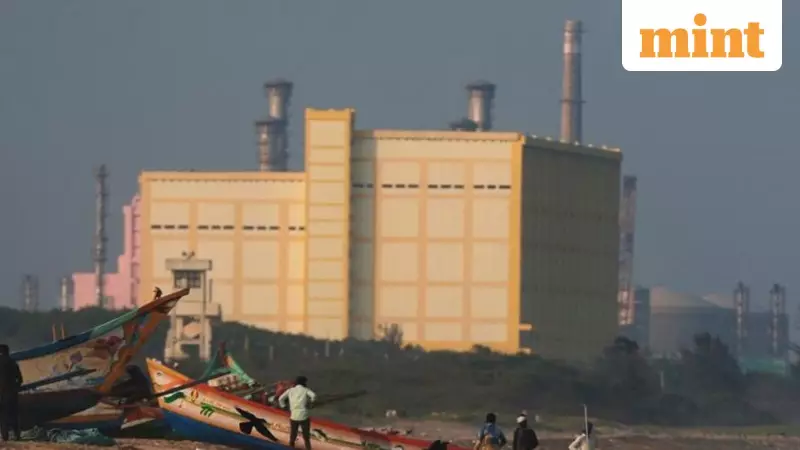
As India strides towards its clean energy future, a monumental 100-gigawatt nuclear power target by 2047 has been set. This ambitious vision, outlined by NITI Aayog, represents a more than tenfold increase from the current installed capacity of 8.78 GW. The recent enactment of the SHANTI Act in 2025 marks a pivotal shift, opening the sector to private players and setting the stage for a technological leap, primarily through Small Modular Reactors (SMRs).
The SHANTI Act: A New Foundation for Nuclear Growth
The Sustainable Harnessing and Advancement of Nuclear Energy for Transforming India (SHANTI) Act, 2025, is a legislative cornerstone for this expansion. It fundamentally restructures the civil nuclear energy architecture by ending the state monopoly. For the first time, the private sector, state-owned public sector undertakings, and state government entities are permitted to participate alongside central government bodies.
The Act is designed to be forward-looking. It establishes new regulatory bodies like the Atomic Energy Redressal Advisory Council and an Appellate Tribunal to oversee the emerging multi-player market. Crucially, it retains sovereign control over sensitive technologies like fuel enrichment and spent fuel management while integrating the core principles of previous atomic energy and liability laws.

Why Small Modular Reactors Are the Key to Scaling Up
With electricity demand projected to triple or quadruple by 2047, India needs reliable, low-carbon base load power to complement its massive renewable energy build-out. Nuclear power, with its negligible operational carbon emissions and small land footprint, fits this need perfectly. However, scaling traditional large reactors to 100GW is a formidable challenge.
This is where Small Modular Reactors (SMRs) enter the picture. Recognising their potential, the Union Budget for 2025-26 allocated ₹20,000 crore to develop and operationalise at least five indigenous SMRs by 2033. SMRs are advanced, factory-assembled reactors that can be deployed singly or in clusters, offering flexibility for repurposing old thermal plants or powering energy-intensive industries like steel and cement.
India's Bhabha Atomic Research Centre (BARC) is already developing three designs: the 200 MW(e) BSMR-200 for industrial use, the 55 MW(e) SMR-55 for remote areas, and the 5 MW(th) HTGCR-5 for hydrogen generation. While current cost estimates for SMRs are higher than indigenous large PHWRs, mass production in fleet mode is expected to bring costs down significantly through economies of scale and shorter construction times.
Building a Domestic Ecosystem and Global Partnerships
Two critical hurdles must be overcome: achieving cost competitiveness and building a robust domestic supply chain. India possesses a strong manufacturing base for large Pressurized Heavy Water Reactors (PHWRs), which must now be adapted for SMR components like reactor pressure vessels, coolant pumps, and control systems.
The private sector's role is now more vital than ever. Moving beyond equipment supply, active partnership is needed across the entire value chain, including building, owning, and operating plants. Experts suggest following the model of India's space sector reform, which created IN-SPACe and NSIL to foster private participation.
International collaboration is also a key pillar of the strategy. Engaging with global peers like the US, South Korea, and Russia can accelerate technology development. India aims to become a partner of choice in the global SMR supply chain, a ambition underscored by recent cooperation agreements, such as the NPCIL's MoU with the UAE's ENEC for operations at the Barakah plant.
The path to 100GW of nuclear capacity is clear but demanding. It requires the synergistic execution of progressive policy under the SHANTI Act, rapid technological innovation in SMRs, and a wholehearted embrace of public-private partnership. If these elements align, India's nuclear dream can become a cornerstone of its sustainable and energy-secure future.