

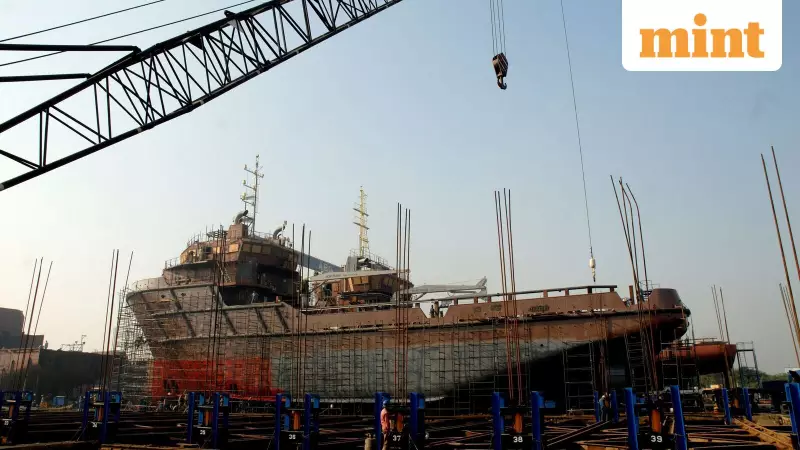
In a significant move to strengthen India's maritime capabilities and energy security, state-owned Shipping Corporation of India (SCI) along with major public sector oil refiners are negotiating with three leading South Korean shipbuilding giants to establish a massive shipbuilding facility in India.
Strategic Partnership for Indigenous Shipbuilding
The proposed joint venture involves Indian Oil Corporation Limited, Bharat Petroleum Corporation Limited, and Hindustan Petroleum Corporation Limited partnering with South Korea's HD Hyundai, Samsung Heavy Industries, and Hanwha Ocean. According to three sources familiar with the discussions, the new shipyard is likely to be established in Andhra Pradesh.
This initiative follows a decision taken in September by the four state-run companies to form a joint venture for procuring dozens of crude and gas carriers over the coming decade. The collaboration represents a strategic shift from India's current practice of chartering foreign vessels toward developing domestic shipbuilding capabilities.

Massive Investment and Scale
The investment required for the shipbuilding facility is projected to range between ₹1,500 crore and ₹15,000 crore, depending on the final size and scale of the operations. This substantial investment underscores the government's commitment to developing indigenous maritime infrastructure.
One of the sources revealed that SCI and oil companies would join the shipbuilding entity as equity partners through a joint venture structure. This arrangement would ensure dedicated buyers for ships manufactured in India, providing assured demand that makes the massive investments financially viable from the outset.
The urgency for this initiative becomes clear when considering India's energy import profile. As one of the world's largest importers of both crude oil and natural gas, supply chain disruptions can significantly impact the economy and energy security. The recent vessel scarcity that drove up freight rates in 2022 highlighted the vulnerabilities in depending entirely on foreign vessels.
Government Push and Industry Requirements
Discussions gained significant momentum after Union Petroleum Minister Hardeep Singh Puri led a high-level delegation to South Korea during November 13-15, where maritime cooperation featured prominently in bilateral talks. The minister highlighted that India's annual expenditure of $5-8 billion on energy freight by state-run companies presents a substantial opportunity for developing such vessels locally.
According to government estimates, Indian oil companies require approximately 112 ships over the next five to ten years. The refiners' consortium plans to acquire about 59 vessels within five years through both second-hand purchases and newly built ships. These will include various types such as Very Large Crude Carriers (VLCCs), Very Large Gas Carriers (VLGCs), Suezmax and Aframax tankers, medium range tankers, and offshore vessels.
The total investment in vessel acquisition could reach ₹7.15 trillion over the next five years, making this one of the largest maritime infrastructure initiatives in recent Indian history.
Expert Perspectives on Strategic Importance
A.K. Sharma, former director (finance) at Indian Oil Corporation, emphasized the strategic benefits of owning vessels. "The initiative to own ships would help in self-sufficiency and at times of exigencies like sanctions on ships carrying Russian crude in the past few years," Sharma stated. "Indian refiners operating their own ships would ensure issues such as bans and sanctions on vessels do not have a major impact on supplies to India."
While Sharma noted that operating costs might not differ significantly from chartering vessels, he highlighted the crucial advantage of flexibility in transportation during emergencies.

Gaurav Moda, partner and leader for energy at EY-Parthenon India, reinforced this perspective, stating that "given the expenditure on leasing and chartering vessels and the need for energy security, India should look at developing ships and oil and gas carrying vessels within the country." He emphasized that building domestic capacity aligns with both economic and national interests toward achieving energy security.
Broader National Maritime Vision
This initiative forms part of India's ambitious Maritime India Vision 2030 and Vision 2047 plans, which aim to position India among the top 10 and subsequently top 5 shipbuilding and ship-owning countries worldwide. The government recently announced a ₹70,000 crore package to develop the maritime sector with specific focus on shipbuilding.
The targets are ambitious but clear: increase the share of Indian-built ships in India's fleet from the current 5% to 7% by 2030, and achieve a substantial 69% by 2047. This represents a dramatic transformation for a country that currently holds less than 1% of global shipbuilding capacity.
The Ministry of Ports, Shipping and Waterways has been coordinating with multiple ministries including steel, chemicals and fertilizers, petroleum, coal, mines, commerce and textiles to develop a comprehensive plan for ship ownership by various state-run firms, creating an ecosystem of assured demand that can sustain large-scale shipbuilding facilities.
While China dominates global shipbuilding with approximately half of worldwide capacity and South Korea holds the second position with 25-30% share, India's new partnership with Korean technological leaders could accelerate its journey toward becoming a significant player in global shipbuilding while securing its energy transportation needs.





