GMDA Proposes Three Elevated Corridors to Alleviate Gurgaon's Chronic Traffic Woes
The Gurgaon Metropolitan Development Authority (GMDA) has unveiled an ambitious plan to construct three elevated road corridors spanning more than 16 kilometers in old Gurgaon. This initiative aims to provide long-term relief from the severe traffic congestion plaguing some of the city's most problematic junctions and arterial roads.
Detailed Breakdown of Proposed Elevated Corridors
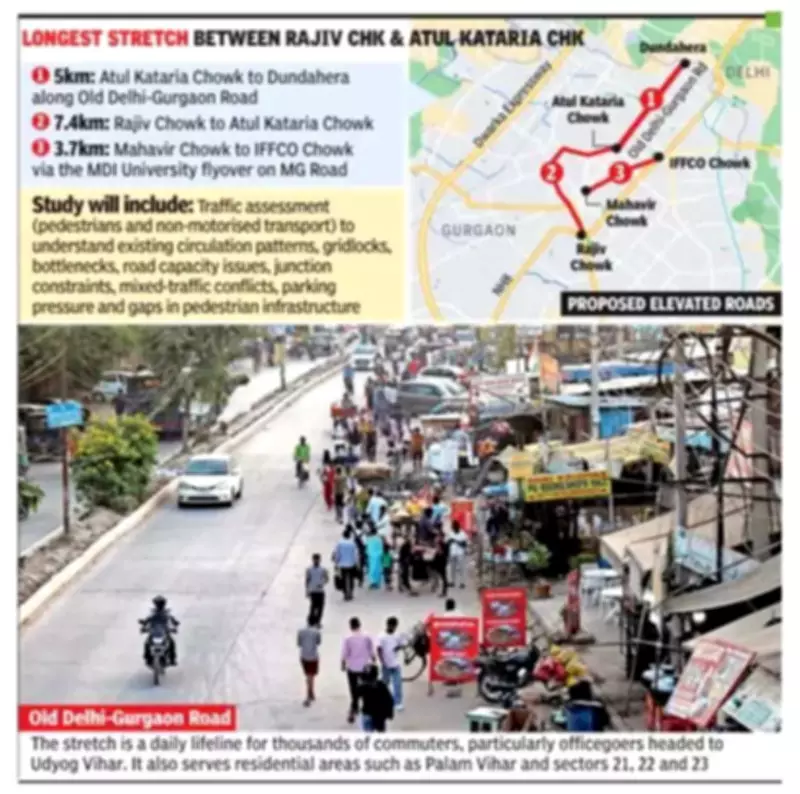
The proposed network consists of three distinct elevated corridors designed to address specific traffic bottlenecks:
- Rajiv Chowk to Atul Kataria Chowk Corridor (7.4km): This stretch will traverse Old Railway Road, Sector 5/6 Road, and Sheetla Mata Road. This area experiences heavy daily traffic due to numerous courts, government offices, hospitals, educational institutions, and dense commercial hubs. Narrow road sections, roadside activities, and closely spaced junctions frequently slow movement here.
- Atul Kataria Chowk to Dwarka Expressway Corridor (5km): Running along Old Delhi Road through Dundahera, this corridor serves as a critical lifeline for thousands of daily commuters, particularly office-goers heading to Udyog Vihar. It also connects residential areas including Palam Vihar and Sectors 21, 22, and 23 to workplaces, schools, and hospitals.
- Mahavir Chowk to IFFCO Chowk Corridor (3.7km): Proposed along MG Road via the MDI University flyover, this corridor aims to create smoother connectivity between old Gurgaon and the NH8 corridor. The existing two-lane flyover near Sukhrali will be studied for potential integration or extension.
Comprehensive Feasibility Studies Underway
GMDA has initiated the process to appoint a consultant through a Request for Proposal (RFP) who will conduct detailed feasibility studies and prepare comprehensive project reports. According to a GMDA official, "The consultant will perform a detailed mobility assessment before finalizing design and alignment. Our objective is to decongest old Gurgaon while improving connectivity toward Delhi. These high-traffic routes require elevated corridors as a long-term solution since surface roads in older areas are already constrained, densely populated, and offer limited space for widening."

The study will encompass a thorough traffic assessment across all transportation modes, including pedestrians and non-motorized vehicles. This analysis aims to understand existing circulation patterns and identify specific causes of repeated gridlocks. The consultant will examine bottlenecks, road capacity limitations, junction constraints, mixed-traffic conflicts, parking pressures, and gaps in pedestrian infrastructure.
Critical Inter-State Connectivity Considerations
One particularly significant aspect of the plan involves the corridor along Old Delhi-Gurgaon Road from Atul Kataria Chowk to Dundahera near the Haryana-Delhi border. This stretch functions as a major connector between Delhi and Gurgaon but suffers from severe congestion due to commercial establishments, encroachments, street vendors, and competition between public transport and para-transit vehicles for limited space.
The GMDA official explained, "The consultant will prepare the feasibility report up to Dwarka Expressway along Old Delhi-Gurgaon Road. GMDA will handle the portion within Gurgaon, while the section beyond the border will require coordination with the Delhi government." This suggests that successful implementation may depend on inter-state cooperation to deliver full benefits.
In Delhi, the corridor passes through Kapashera and Samalka before connecting with Dwarka Expressway. An elevated facility here could potentially separate through traffic from local movement, alleviating pressure on the existing carriageway that currently struggles with constant traffic and frequent stoppages.
Design Considerations and Integration Challenges
For the Mahavir Chowk to IFFCO Chowk corridor, officials are considering whether to develop it as a double-decker structure or as a connecting elevated road. Another GMDA official noted, "The feasibility study will assess how best to integrate or extend elevated connectivity without creating new bottlenecks."

The elevated corridors represent a strategic approach to urban mobility in a city where ground-level expansion options are severely limited. By moving significant traffic volumes above existing roadways, authorities hope to create more efficient transportation networks while minimizing disruption to established urban fabric.
This initiative reflects GMDA's commitment to addressing Gurgaon's growing infrastructure challenges through innovative solutions that prioritize both traffic management and improved connectivity between key urban centers.