

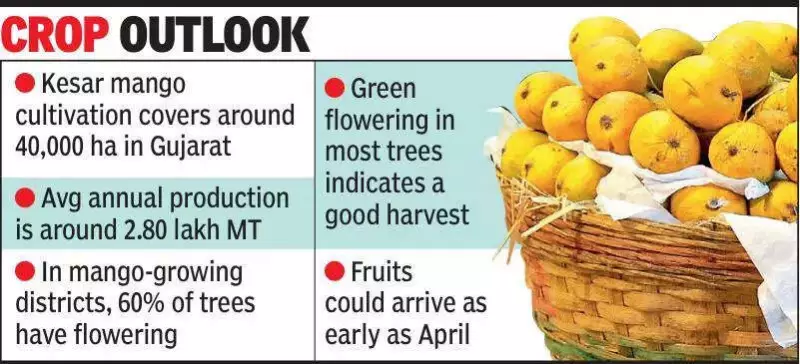
Mango enthusiasts across India could be savoring the rich, sweet taste of Gujarat's famed Kesar mangoes much sooner than usual this year. Orchards in the state's primary Kesar belt are buzzing with activity as an unusually strong and early flowering season has sparked hopes of an advanced harvest, potentially by the middle of April.
Promising Flowering Eases Monsoon Worries
Farmers in Gujarat's key mango-growing districts have reported a highly encouraging start to the season. Nearly 60% of mango trees in the orchards of Gir Somnath and Amreli districts have already exhibited flowering, a sight more typical of later weeks. This robust early bloom has significantly alleviated concerns that the prolonged monsoon, which extended into October this year, might damage the crop prospects. Growers confirm that fears of an adverse impact have been largely put to rest, thanks to largely favourable weather conditions prevailing since November.
While daytime temperatures have been ideal for the trees, agricultural experts and seasoned farmers note that a few more spells of cold nights are crucial for proper fruit setting. The collective hope now hinges on January remaining conducive and the avoidance of any unseasonal rains. If these conditions hold, the first batches of the prized early mangoes are expected to hit the markets by mid to late April.

Early Crop Commands Premium Market Prices
The typical flowering window for mango orchards spans from mid-November to the end of February. Flowers that successfully set fruit by January usually result in an early harvest. This early yield is highly coveted in the market as it arrives before the peak season glut, allowing farmers to command significantly better prices.
Jayesh Hirpara, a mango cultivator from Gir Gadhda in Gir Somnath district, shared that flowering has been particularly strong in areas like Gir Gadhda, Una, and Mendarda, though Talala has seen comparatively weaker activity. "If the current favourable conditions persist, we anticipate the crop to arrive by the third or fourth week of April," Hirpara stated. This is notably earlier than the peak Gir Kesar season, which traditionally starts in May and lasts until the end of June.
Farmers Report Healthy Bloom Across Districts
The optimism is not confined to one area. Farmers in Amreli district have also reported healthy flowering patterns this season. Kamlesh Nasit, a farmer from Abhrampar village in Savarkundla taluka, mentioned that while it is still early for a definitive assessment, the signs are overwhelmingly positive. "Looking at the current level of flowering and the absence of disease, we are expecting a bumper crop," Nasit remarked.
Another Amreli-based farmer, Janak Padasar, provided insight into the flowering pattern, noting that night temperatures are still slightly higher than ideal. He explained the critical difference between two types of flowering: "There are two types of flowering—green and red. Green flowering has a higher chance of fruit setting, while red flowering tends to drop. This year, most of the flowering is green," he said, indicating another positive factor for a successful yield.
Kesar mangoes, renowned for their distinct aroma and saffron-hued pulp, are cultivated across 11 districts in Gujarat. The major production, however, is concentrated in the regions of Gir Somnath, Junagadh, Amreli, and Bhavnagar. An early and abundant harvest from these regions will be welcome news for both farmers seeking premium returns and consumers eager for the first taste of the summer king.






