YEIDA Confirms Ghaziabad-Jewar Rapid Rail Corridor Remains Unchanged
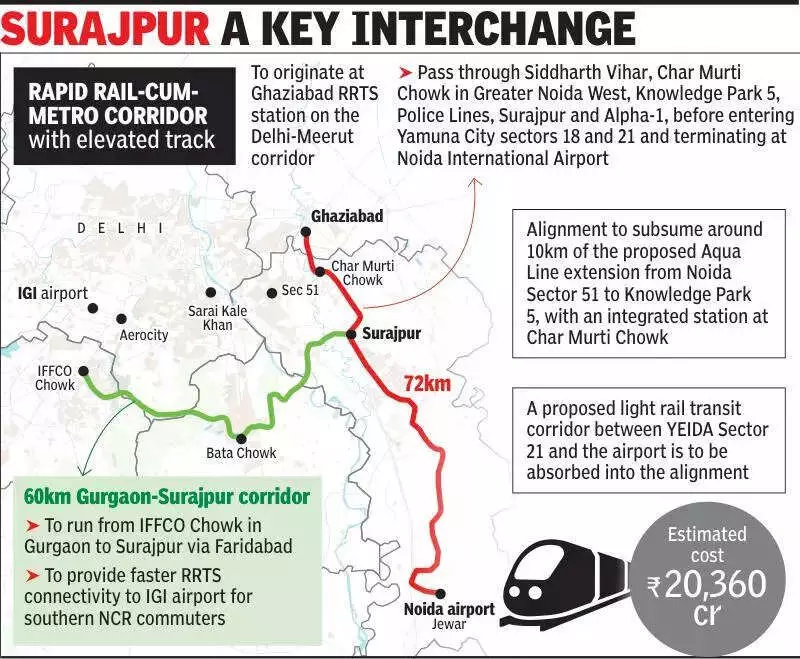
The Yamuna Expressway Industrial Development Authority has made a clear statement. The proposed 72-kilometer rapid rail corridor will stay exactly as planned. This corridor connects Ghaziabad to the Noida International Airport at Jewar. It passes through Greater Noida West.
The state government originally cleared this project in December 2025. Officials now confirm there are no changes to the alignment.
Delhi Link Proposal Shelved After Review
Authorities did explore an alternative route. They considered a direct corridor from Sarai Kale Khan in Delhi to Jewar. This idea was eventually shelved.

In December last year, YEIDA had suggested a fresh survey. They wanted the National Capital Region Transport Corporation to prepare a new project report. This revised alignment would have started from Sarai Kale Khan. It would have gone via the Noida City Centre metro station and Surajpur.
A review prompted this suggestion. The review highlighted a critical need. The Noida airport required stronger long-term connectivity with Delhi. The proposed Ghaziabad-Jewar corridor alone might not deliver this effectively. It could require major technical modifications.
However, this alternative plan was never implemented. Officials made a decisive move just weeks later.
Decision Finalized in Late December Meeting
YEIDA officials provided details on Friday. They said the decision to proceed with the Ghaziabad-Jewar link was taken at a meeting on December 29. This happened shortly after the Sarai Kale Khan corridor was proposed.
Officials emphasized the importance of the Ghaziabad corridor. It is critical for providing high-speed airport connectivity to several areas. These include west Uttar Pradesh towns, Noida, and Greater Noida West.
The corridor also supports planned development. It will aid urban, residential, and industrial growth across YEIDA-notified sectors along the Yamuna Expressway.
Currently, there is no proposal to modify this alignment. The NCRTC originally drew up the plan.
Project Details and Proposed Route
The detailed project report outlines an elevated rapid-rail-cum-metro corridor. It will feature 22 stations. These will be split evenly between rapid rail and metro services.
The corridor will originate at the Ghaziabad RRTS station. This station is on the existing Delhi-Meerut corridor. From there, it will pass through several key locations:
- Siddharth Vihar
- Char Murti Chowk in Greater Noida West
- Knowledge Park 5
- Police Lines
- Surajpur
- Alpha-1
The route will then enter Yamuna City sectors 18 and 21. It will finally terminate at the Noida International Airport.
The estimated project cost is Rs 20,360 crore. Authorities planned for a five-year completion timeline.
Integration with Other Transit Projects
The DPR indicates significant integration. The alignment will subsume about 10 kilometers of the proposed Aqua Line extension. This extension runs from Noida Sector 51 to Knowledge Park 5. It includes 6 stations.
An integrated station is planned at Char Murti Chowk. Furthermore, a proposed light rail transit corridor between YEIDA Sector 21 and the airport will be absorbed. This integration is planned for future phases of the RRTS project.
Ministry Objections and YEIDA's Clarifications
The Union Ministry of Housing and Urban Affairs raised several objections. MoHUA returned the DPR with multiple concerns. They flagged the absence of any direct Delhi link. They noted a lack of a destination survey.
The ministry also pointed out potential duplication. The corridor might overlap with NMRC's proposed Aqua Line extension. Officials expressed doubts about safety. They questioned whether rapid rail and metro could safely share a single elevated corridor.
YEIDA submitted clarifications in response. However, MoHUA maintained its stance. The ministry stated the alignment did not meet airport-connectivity norms. They argued it would not generate the ridership projected by NCRTC.
Most airport-bound passengers would originate from Delhi and Noida. The proposed alignment does not directly serve these areas.

Multimodal Integration and Complementary Corridors
Officials clarified the corridor's design intent. The Ghaziabad-Jewar link aims to provide seamless multimodal integration. It will connect several major transit systems:
- The Delhi-Meerut RRTS and Red Line Metro at Ghaziabad
- The Aqua Line at Char Murti Chowk and Alpha-1
- A proposed Gurgaon-Faridabad-Noida RRTS at Surajpur
- A planned high-speed rail network
YEIDA Additional CEO Shailendra Bhatia provided further insight. He mentioned a 60-kilometer corridor being planned from IFFCO Chowk in Gurgaon to Surajpur. This route would go via Faridabad.
This link aims to provide faster RRTS connectivity to IGI airport. It would serve southern NCR commuters. Bhatia emphasized this plan retains the Ghaziabad-Jewar alignment.
He described the two corridors as complementary. Surajpur is set to emerge as a key interchange. Airport-bound passengers travelling to and from IGI will use this hub.
The DPR estimates show potential time savings. Direct RRTS connectivity could reduce travel time significantly. A trip between IGI Terminal-3 and Noida airport might take only about 60 to 70 minutes.