

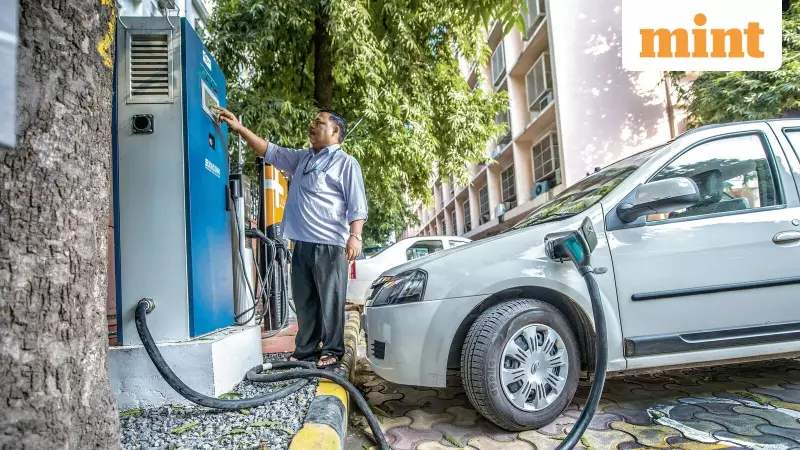
The Great Indian EV Subsidy Battle
India's journey toward electric mobility faces a critical crossroads as competing automotive technologies battle for government subsidies and tax benefits. The recent push by industry body Assocham to include range-extended electric vehicles (REEVs) in the subsidy framework has reignited the ongoing conflict between manufacturers of pure electric vehicles and those advocating for hybrid technologies.
The controversy exposes deeper structural issues in India's subsidy distribution mechanism, where taxpayer money flows without clear objectives, measurable milestones, or proper accountability frameworks.
Modest Budget, Major Conflicts
Despite the massive public attention on electric vehicle promotion, the actual financial allocation tells a different story. The Union Budget for 2025-26 allocated an estimated ₹4.26 trillion for various subsidies, with food and fertilizer accounting for a dominant 87% and LPG subsidies taking another 3%.

Of the remaining ₹42,000 crore, electric mobility subsidies received only ₹5,322 crore. Even the larger FAME-II scheme, which concluded in 2024, spent a total of ₹8,844 crore throughout its lifespan, including ₹6,577 crore specifically for subsidies against a cumulative allocation of ₹11,500 crore.
The current conflict centers around Assocham's formal request to the Ministry of Heavy Industry, seeking tax parity for range-extended electric vehicles with pure electric vehicles. REEVs feature a small onboard internal combustion engine that recharges the vehicle's batteries, extending their driving range beyond what conventional EVs can achieve.
Manufacturers Take Sides
The automotive industry stands divided on the subsidy issue. Companies like Toyota and Maruti Suzuki, which have invested heavily in hybrid vehicle technology, are pushing for lower prices through reduced taxes, buyer subsidies, and waived government charges.
On the opposing side, manufacturers including Tata Motors and Mahindra – companies that have made substantial commitments to pure electric vehicle development – strongly resist extending subsidies to hybrid technologies. They argue this would dilute the government's electric mobility objectives and undermine their significant investments in EV infrastructure.
The current GST framework recognizes only electric vehicles and hybrids as distinct categories, leaving REEVs in regulatory limbo since they aren't currently available in the Indian market.
Fundamental Policy Flaws Exposed
Beyond the immediate industry conflict, the subsidy debate reveals critical weaknesses in India's policy-making approach. The government's subsidy programs lack clear goal-setting and measurable milestones, raising questions about their effectiveness and efficiency.
If reducing pollution represents the primary objective behind EV subsidies, then policymakers must answer fundamental questions: by how much should emissions decrease, and within what timeframe? A technology-neutral approach that subsidizes all emission-reducing technologies based on their carbon reduction potential might prove more effective.
Electric vehicles eliminate local emissions but simply transfer pollution to locations where electricity generation occurs, particularly in regions dependent on fossil fuels for power production.
The absence of periodic reviews and progress assessments means there's no data showing how much carbon reduction each rupee of EV subsidy achieves. While FAME-I and II included sunset clauses, many subsidy programs continue indefinitely without such provisions.
Policy coherence remains another significant challenge. The government simultaneously promotes clean energy through subsidies while bearing the burden of past fuel subsidies via oil bonds and ongoing LPG subsidies. India operates the world's largest food assistance program, yet there's no systematic measurement of its impact on hunger or malnutrition rates.
Historical Precedents and Future Directions
India's automobile market previously tilted heavily toward diesel vehicles due to subsidy-created price differentials between petrol and diesel that persisted for decades without correction. Similar distortions appear possible in the current EV landscape without careful policy design.

The public distribution system continues to experience significant leakage, with subsidized food grains routinely diverted to open markets. Similarly, domestic LPG subsidies often benefit commercial users instead of their intended household beneficiaries.
To prevent future controversies and ensure effective use of public funds, policymakers should incorporate several non-negotiable elements in subsidy program design. Every program must establish clear, measurable targets announced upfront, moving beyond vague objectives like "encouraging faster adoption."
Intermediate milestones and periodic independent reviews should assess progress, preferably conducted by agencies separate from implementing ministries. Programs should strive for technology-neutral outcomes, allowing market forces to identify the most efficient paths to achieving policy goals.
Greater policy coordination between central and state governments is essential to prevent objective dilution and intergovernmental conflicts. The transition from ad hoc handouts driven by lobbying efforts or short-term political considerations toward evidence-based, outcome-focused subsidy policies represents an urgent necessity for India's sustainable mobility future.





