The Chandigarh Department of Industries has launched a city-wide door-to-door drive to register an estimated 30,000 unregistered micro, small and medium enterprises (MSMEs) under the Raising and Accelerating MSME Performance (RAMP) Programme. The initiative, backed by a World Bank credit of Rs 43.07 crore, aims to bring these invisible businesses into the formal economy, enabling them to access institutional credit and government schemes.
What is happening
Trained survey teams from Forvis Mazars LLP, the implementing agency, will conduct field visits across Chandigarh’s industrial areas, commercial markets and business clusters. They will identify unregistered enterprises and provide free, on-the-spot facilitation for Udyam Registration, the Government of India’s official MSME recognition system. No fee is charged, and business owners do not need to visit any office or handle paperwork.
What is Udyam Registration and why it matters
Udyam Registration is a free, paperless, self-declaration-based system launched by the Ministry of MSME in 2020. It classifies businesses into three categories: micro (investment up to Rs 2.5 crore, turnover up to Rs 10 crore), small (investment up to Rs 25 crore, turnover up to Rs 100 crore), and medium (investment up to Rs 125 crore, turnover up to Rs 500 crore). Registration requires only an Aadhaar number and PAN, generates a unique Udyam Registration Number, and serves as the gateway to all government schemes for small businesses. Without it, a business has no formal standing.

Who should register
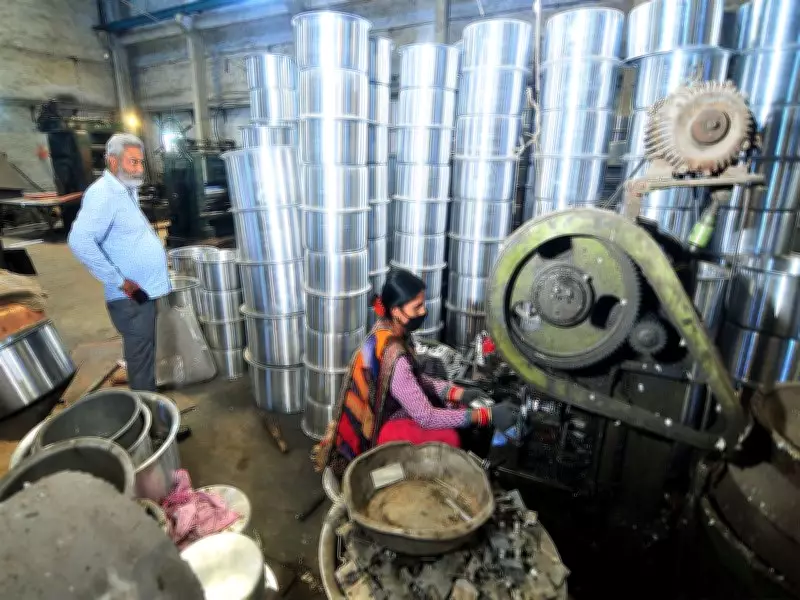
Any enterprise involved in manufacturing, services, or trading can register as an MSME. This includes manufacturing units in Industrial Area Phase 1 and 2, service providers like IT firms and diagnostic labs, traders in commercial markets, home-based micro enterprises, and self-employed artisans. Of Chandigarh’s 65,164 registered units, 10,028 are in manufacturing, 30,221 in services, and 24,951 in trading. The 30,000 targeted are predominantly in services and trading.
Why thousands have stayed unregistered
Many small business owners are unaware of Udyam Registration or assume it invites taxation and compliance burdens. Some have older registrations and do not know they need to migrate. Others lack digital literacy. The survey teams are going to them to overcome these barriers.
What formalisation unlocks: schemes and benefits
Once registered, enterprises gain access to several schemes. The Pradhan Mantri MUDRA Yojana provides collateral-free loans up to Rs 20 lakh. The Credit Guarantee Fund Trust for Micro and Small Enterprises offers collateral-free credit guarantees for loans up to Rs 5 crore. The Prime Minister’s Employment Generation Programme provides up to 35% subsidy on project cost for new micro enterprises. Registered MSMEs also get delayed payment protection under the MSME Development Act, with interest at three times the RBI’s bank rate if payment is delayed beyond 45 days. The Chandigarh MSME Facilitation Council resolved 105 of 115 such cases in 2025-26. Additionally, incentives for ZED and LEAN certification, and priority access under PM Vishwakarma for traditional artisans, are available only to Udyam-registered units.
Impact on workers and the city
Chandigarh’s 65,164 registered MSMEs employ 4.69 lakh people. The 30,000 unregistered units likely employ several lakh more informally. Formalisation brings workers documented wages, statutory benefits, and social security. For the city, it provides accurate data for planning credit, infrastructure, and skill training. A larger formal MSME base also improves Chandigarh’s standing in the Centre’s Business Reform Action Plan assessments.
Deputy Commissioner Nishant Kumar Yadav said, “The goal is not just registration numbers. Every enterprise we formalise is a business that can now access credit, compete in formal markets and grow. That is what drives employment and that is what drives the city’s economy.”
What businesses need to do now
Business owners can register directly at udyamregistration.gov.in using Aadhaar and PAN, or wait for survey teams. Existing Udyog Aadhaar holders should migrate to Udyam. The RAMP programme runs through March 2027, and this drive is the largest outreach by the Department of Industries.