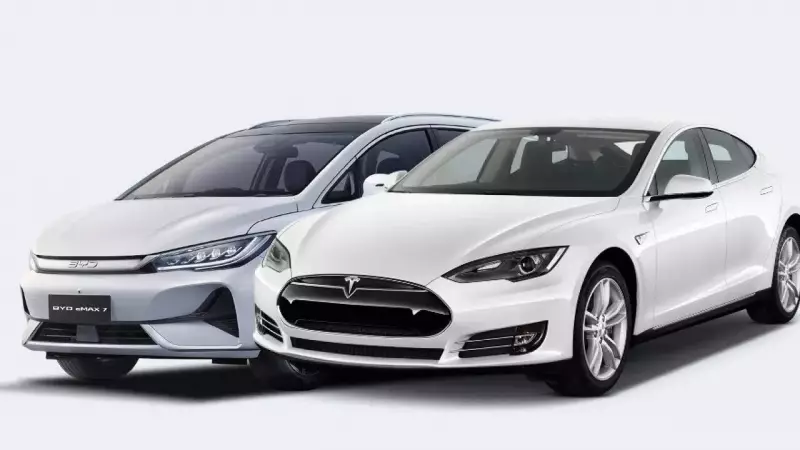
The landscape of the global electric vehicle (EV) market has witnessed a historic power shift. BYD, the Chinese automotive giant, has officially overtaken Tesla to become the new worldwide leader in electric vehicle sales, according to recent data. This development, confirmed in early January 2026, ends the long-standing dominance of the American pioneer and signals a new era defined by volume, affordability, and formidable domestic demand.
The Numbers Behind the New EV Crown
Year-by-year sales figures reveal a clear and steady trajectory where BYD's acceleration finally propelled it past its rival. While Tesla blazed the trail for mainstream electric mobility, BYD's strategy focused on a high-volume, price-competitive model across a broader range of vehicles. This approach, heavily supported by the massive Chinese EV market, has rewritten the established hierarchy. The data underscores that the race is no longer solely about premium technology but increasingly about scale, strategic pricing, and capturing the heart of the world's largest auto market.
How Scale and Strategy Fueled BYD's Rise
The shift in leadership highlights several critical factors reshaping the international EV industry. BYD's integrated manufacturing capabilities, from batteries to complete vehicles, have provided a significant cost advantage. Furthermore, its diverse product portfolio, encompassing everything from affordable city cars to buses and premium models, has allowed it to tap into multiple consumer segments simultaneously. In contrast, Tesla's focus has remained more concentrated on the higher-end spectrum. The role of overwhelming domestic demand in China cannot be overstated, serving as a powerful launchpad for BYD's global export ambitions.

Implications for the Global Electric Mobility Race
This changing of the guard has profound implications for the future of transportation. It demonstrates that the EV market is maturing and fragmenting, with different players winning on different parameters. For consumers worldwide, this intensified competition promises more choices and potentially faster innovation. For traditional automakers and new entrants alike, BYD's success story offers a blueprint on leveraging vertical integration and local market strength. The event marks a pivotal moment where the center of gravity in the electric vehicle industry continues to tilt decisively towards Asia.
The battle for EV supremacy is far from over, but as of 2026, the trophy for volume sales has a new holder. BYD's ascent signifies that in the marathon towards an electric future, consistency, scale, and understanding mass-market needs are proving to be just as crucial as groundbreaking technology and brand charisma.