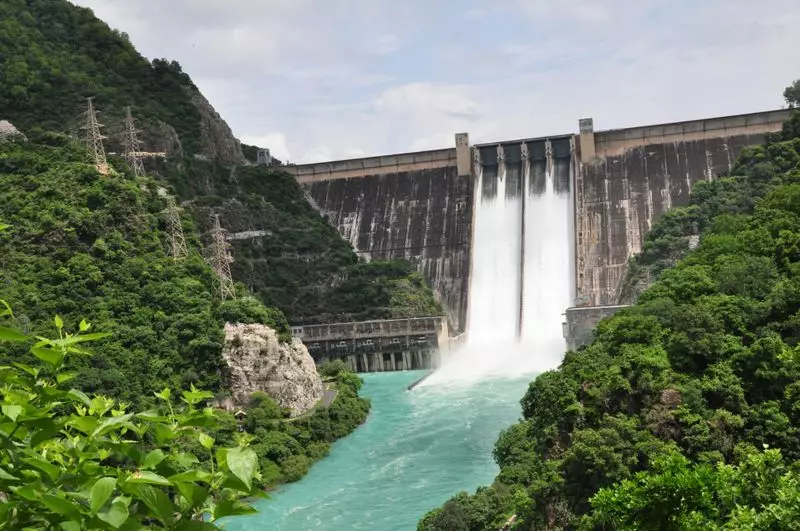
The Bhakra Beas Management Board (BBMB) is embarking on a major engineering feat to tackle India's renewable energy storage challenge. The state-owned body has unveiled a detailed plan to construct a pumped storage hydropower project with an estimated cost of Rs 4,000 crore. This ambitious initiative aims to act as a giant 'water battery' for the northern grid, enhancing stability and supporting the integration of solar and wind power.
How the Giant 'Water Battery' Will Work
Unlike conventional hydropower, a pumped storage project does not generate new electricity. Instead, it functions as a massive energy storage system. The BBMB's plan involves creating two reservoirs at different elevations. During periods of low electricity demand, typically at night or when renewable generation is high, surplus power from the grid will be used to pump water from the lower reservoir to the upper one.
This process effectively stores electricity in the form of gravitational potential energy. When demand peaks, such as during the afternoon or evening, the water is released back to the lower reservoir. As it flows down, it spins turbines to generate electricity that is fed back into the grid. The proposed project is designed for a power generation capacity of 500-600 MW and can supply this power for about 6 to 7 hours daily.
Strategic Location and National Importance
The project is strategically planned to utilize BBMB's existing infrastructure in the Bhakra-Nangal complex. The initial detailed project report (DPR) proposes using the Bhakra reservoir as the lower pool and constructing a new upper reservoir on the left bank of the Sutlej River. This location leverages the significant height difference necessary for efficient energy storage.
This initiative is not just a BBMB project but aligns with a national push for pumped storage. The Union Power Ministry has identified a potential of about 119 GW from such projects across India. For the northern region, struggling with grid instability and the intermittent nature of renewables, this project is critical. It will provide quick-start power during outages and help manage frequency fluctuations, ensuring a more reliable power supply for states like Punjab, Himachal Pradesh, and others in the Northern Grid.
Overcoming Challenges and Looking Ahead
The path forward involves several key steps. The BBMB has submitted the DPR to the Central Electricity Authority (CEA) for appraisal. Following this, it must secure techno-economic clearance and crucial environmental and forest clearances. Land acquisition for the new upper reservoir will be a significant undertaking.
Financing the Rs 4,000 crore project is another major hurdle. The BBMB is exploring various models, including borrowing from financial institutions or seeking equity partnerships. The success of this project could pave the way for more such facilities, making India's renewable energy transition more sustainable and its power grid more resilient against future demands.
In conclusion, the BBMB's pumped storage project represents a forward-thinking investment in India's energy security. By converting existing hydro assets into large-scale storage, it addresses the core problem of renewable intermittency and marks a significant step towards a cleaner, more stable power system for North India.