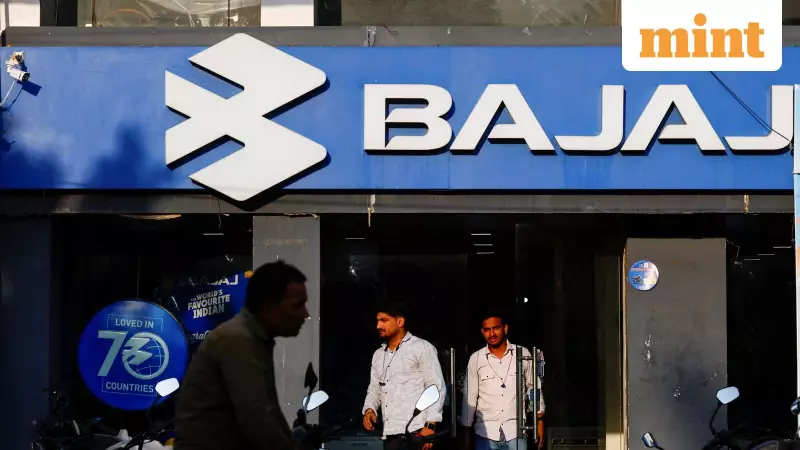
Bajaj Auto's Mixed Q2 Performance: Export Strength vs Domestic Challenges
Bajaj Auto Limited delivered a performance marked by contrasting trends during the September quarter of FY26, with robust export numbers providing a silver lining amid persistent domestic headwinds. The automaker reported a 14% year-on-year revenue increase to ₹14,922 crore, primarily fueled by impressive double-digit growth in international markets, while domestic volumes remained subdued, continuing to pressure the company's stock performance.
Export Momentum Drives Financial Performance
The company's export division emerged as the standout performer in Q2FY26, registering a substantial 24% growth across multiple regions. This export surge contributed significantly to overall volume growth of 6%, reaching 1.29 million units. Exports accounted for slightly over 40% of total sales volumes during the quarter, demonstrating their critical importance to Bajaj Auto's business model.
The export success story was broad-based, with Asia and Africa markets reporting double-digit growth, particularly in Sri Lanka, the Philippines, and East Africa. Nigeria maintained steady performance despite macroeconomic challenges in the region. Notably, Bajaj Auto's export growth rate to top 30 country markets—which represent 70% of total exports—doubled the 14% growth recorded by industry peers.

Domestic Market Struggles and Market Share Concerns
While exports flourished, the domestic motorcycle segment presented a contrasting picture with muted volumes, primarily due to declining two-wheeler sales. This domestic weakness has been a persistent concern for investors, reflected in the stock's underperformance compared to sector benchmarks. The Bajaj Auto stock has declined 12% over the past year, while the Nifty Auto index gained 12% during the same period.
Market share data reveals concerning trends, with Bajaj losing 160 basis points market share in FY25 to 16.6% in motorcycles, followed by an additional 60 basis points decline to 16% in H1FY26. However, the management highlighted a significant turnaround in the key 125cc+ and 150cc+ sports segments, where the company has begun regaining market share, reversing a previously declining trend that had worried investors.
Management Outlook and Strategic Initiatives
The company's leadership remains optimistic about domestic recovery in the second half of FY26, projecting a 6-8% growth rate for domestic motorcycles, buoyed by recent goods and services tax (GST) rate cuts. The management noted that the impact of GST reductions is already visible through increasing consumer preference for higher-end models compared to base variants.
Bajaj Auto has outlined an aggressive product launch strategy to capitalize on market opportunities. The Pulsar portfolio, which delivered peak performance in Q2, will see three new introductions in December, March, and May. Additionally, a new non-Pulsar brand is planned for FY27, while the company is recalibrating Triumph and KTM models for the under-350cc segment to benefit from lower GST rates. A new Chetak variant is also scheduled for launch next year.
Financial Metrics and Margin Performance
The company's operational performance showed resilience with EBITDA increasing 15% to ₹3,052 crore, while margins improved by 20 basis points to 20.5%. This margin expansion was supported by favorable currency movements and an improved product mix. Net revenue per unit increased 7% to ₹115,307, largely driven by the strong export performance.
Despite rising input costs for materials such as aluminium, platinum, and rhodium, Bajaj Auto has refrained from implementing price hikes, expressing confidence in offsetting commodity price pressures through currency tailwinds. The company's financial stability prompted DAM Capital to upgrade earnings per share estimates by 5.5% and 5% for FY26 and FY27, respectively.

Challenges and Opportunities Ahead
While the Q2 results contained several positive indicators, analysts highlight ongoing concerns. A Motilal Oswal Financial Services report dated November 8 emphasized that despite recovery in exports and healthy ramp-up of Chetak and three-wheelers, market share losses in domestic motorcycles remain a key concern, particularly in the crucial 125cc+ segment.
The electric vehicles business faces uncertainty due to challenges surrounding rare earth minerals, while the acquisition of niche brand KTM represents the biggest medium-term overhang for the stock, according to a DAM Capital report. The stock currently trades at approximately 23 times FY27 price-to-earnings multiples, as per Bloomberg data.
Overall, while Bajaj Auto's export performance provides a solid foundation for recovery, sustained domestic momentum and successful execution of new product launches will be crucial for reversing the stock's underperformance and capitalizing on emerging opportunities in the evolving automotive landscape.