

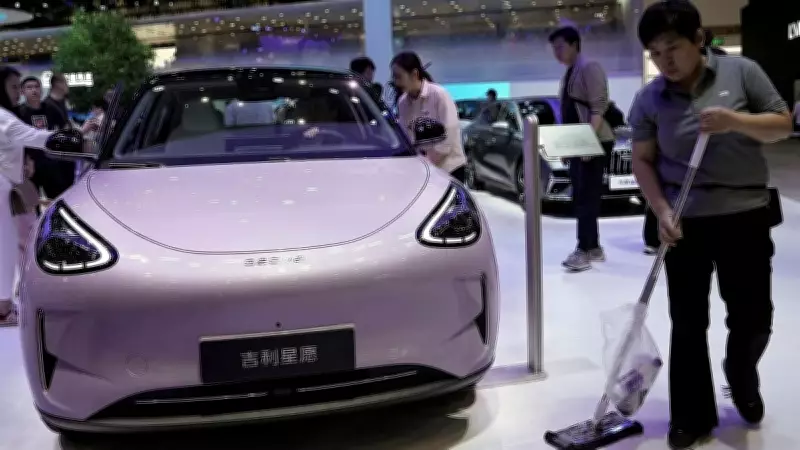
For the price of an average new car in the United States, consumers could purchase five new Chinese electric vehicles (EVs), highlighting the stark price disparity between the two markets. According to recent data, the average transaction price for a new car in the US is around $48,000, while several Chinese EV models are priced under $10,000.
Price Gap and Market Implications
Chinese automakers like BYD, SAIC, and NIO have been aggressively pricing their EVs to capture market share. For instance, the BYD Seagull, a compact EV, starts at approximately $9,700 in China. In contrast, the cheapest new EV in the US, the Nissan Leaf, has a starting price of around $28,000. This price difference underscores the competitive advantage Chinese manufacturers have in producing affordable EVs.
Factors Driving Low Prices in China
Several factors contribute to the low cost of Chinese EVs:

- Government subsidies: The Chinese government provides substantial subsidies for EV production and purchases, reducing costs for manufacturers and buyers.
- Battery supply chain: China dominates the global battery supply chain, with companies like CATL and BYD producing batteries at lower costs.
- Economies of scale: Chinese automakers produce large volumes of EVs, benefiting from economies of scale that lower per-unit costs.
- Lower labor costs: Labor costs in China are significantly lower than in the US, reducing manufacturing expenses.
Impact on the US Auto Market
While Chinese EVs are not currently sold in the US due to tariffs and regulatory hurdles, the price disparity could pressure US automakers to lower prices or accelerate EV development. Some analysts predict that Chinese automakers may enter the US market in the coming years, potentially disrupting the industry.
However, US automakers are also investing heavily in EV production. Ford, General Motors, and Tesla are ramping up their EV offerings, though they face challenges with battery costs and supply chain constraints. The Biden administration's Inflation Reduction Act offers tax credits for EVs assembled in North America, which could help US manufacturers compete.
Consumer Perspectives
For US consumers, the high cost of EVs remains a barrier to adoption. A recent survey found that 60% of Americans consider price the main obstacle to purchasing an EV. If Chinese EVs were available in the US, they could significantly boost EV adoption rates. However, trade tensions and national security concerns may limit their entry.
Future Outlook
The global EV market is expected to grow rapidly, with Chinese automakers playing a key role. As they expand into other markets, including Europe and Southeast Asia, their low-cost EVs could reshape the industry. For the US, the challenge lies in balancing competition with protectionist policies while promoting domestic EV production.






