Andhra Pradesh Tobacco Farmers Confront Mounting Crisis Ahead of Auction Season
In the fertile agricultural belts of Andhra Pradesh, a significant crisis is unfolding for tobacco farmers as weak trader interest and formidable policy headwinds threaten to severely depress prices just before the crucial auction season commences. Growers across key districts including Prakasam, Nellore, and Godavari are expressing deep anxiety that poor market demand may result in substantial quantities of their produce remaining unsold or fetching distressingly low returns.
Market Sentiment Turns Cautious as Auctions Approach
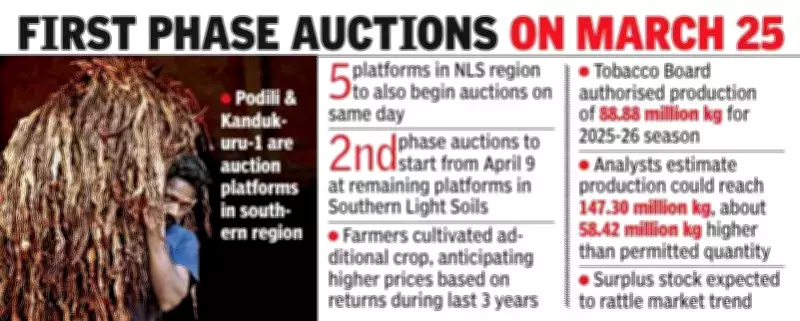
According to informed market sources, traders are demonstrating minimal enthusiasm in lifting tobacco stocks in the immediate run-up to the auctions, signaling what could become an exceptionally dull season for the farming community. The Tobacco Board of India has officially decided to initiate the first phase of auctions starting from March 25, but this announcement has done little to alleviate the pervasive fears gripping the market.
The situation has been critically compounded by the Central government's recent decision to increase taxes on cigarette manufacturers by approximately 40%. This substantial tax hike is expected to directly impact procurement strategies by major companies, thereby reducing the overall demand for flue-cured Virginia (FCV) tobacco, the primary variety cultivated in the region.

Multiple Factors Converge to Create Perfect Storm
Officials closely associated with the Tobacco Board indicate that market sentiment has turned decidedly cautious, with buyers likely to adopt a prolonged wait-and-watch approach throughout the auction process. Industry representatives further elaborate that the increased tax burden could significantly squeeze profit margins for cigarette manufacturing companies, prompting them to scale back their purchase volumes during the auctions.
Adding another layer of uncertainty are the prevailing global geopolitical tensions, which are adversely affecting export prospects. Andhra Pradesh's tobacco economy remains heavily dependent on international markets, and any noticeable slowdown in global demand could further weaken already fragile price structures. Exporters are reportedly hesitant to commit to large volume contracts amid fluctuating currency trends and persistently unstable international trade conditions.
Surplus Production and Rising Costs Exacerbate Concerns
Another major concern contributing to the crisis is the issue of surplus production. The current season has witnessed higher-than-expected output across several tobacco-growing regions, raising legitimate fears of market oversupply. The Tobacco Board is likely to face an exceptionally challenging task in managing these excess stocks during the auctions, with limited demand potentially leading to significant carry-forward inventories.
Farmers on the ground report that the cost of cultivation has increased substantially due to escalating input prices, including fertilizers, labor, and curing expenses. With profound uncertainty surrounding final auction prices, many growers fear they may not even recover their basic investments. "If buyers do not come forward with reasonable offers, we will be forced to sell at distress prices simply to clear our stocks," lamented a distressed farmer from the Ongole region.
Broader Economic Implications and Calls for Intervention
Lakhs of farmers across Andhra Pradesh depend on tobacco cultivation for their primary livelihood. Any prolonged downturn in prices could trigger a cascading negative effect on rural incomes and the stability of local economies. Grower associations have already urgently appealed to the Central government to reconsider the recent tax hike and implement supportive measures to stabilize the volatile market.
These associations have also called for proactive intervention by the Tobacco Board to boost export initiatives and ensure fair price mechanisms during the upcoming auctions. With the auction season set to begin imminently, all agricultural and economic eyes are now focused on how the market will ultimately respond. Unless demand shows a significant and sustained pickup, farmers fear that this season could transform into one of the most challenging and financially devastating periods in recent memory.