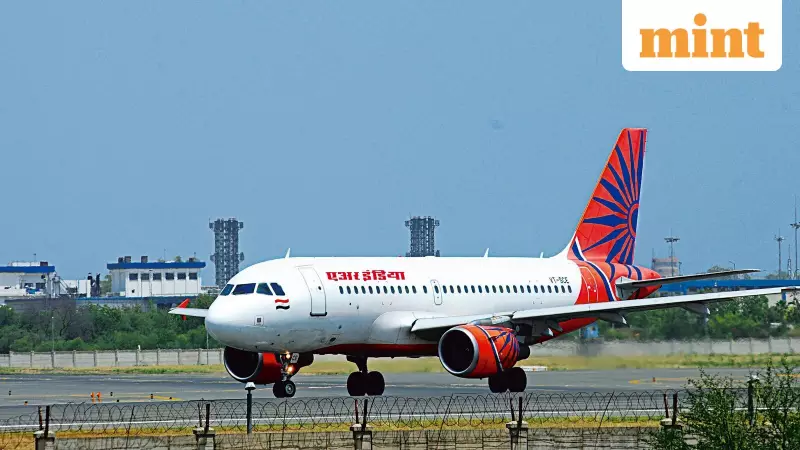
India's domestic aviation landscape has witnessed a significant power shift in the year following the merger of Vistara with Air India. The consolidation has propelled the Tata Group-owned airline to challenge and, on several key routes, overtake the long-dominant IndiGo. This strategic repositioning is most evident on the country's busiest air corridors, where frequencies and market leadership are being aggressively contested.
The Battle for the Busiest Skies
Data from aviation analytics firm Cirium reveals a clear change in dynamics. On the premier Delhi-Mumbai-Delhi sector, Air India now operates 205 weekly flights each way. In comparison, IndiGo schedules 140 weekly flights. When subsidiary Air India Express adds its 15 weekly flights on this route, the Air India group's competitive edge becomes even more pronounced, offering up to 30 daily flights against IndiGo's 20.
The story repeats on the second-busiest route, Delhi to Bengaluru. Here, Air India operates 138 weekly flights, surpassing IndiGo's 105. With Air India Express contributing another 21 flights, the group's total reaches 159 weekly services. This marks a decisive turnaround from a year ago when the two carriers were nearly tied.

Route-by-Route Analysis of the Top 10
The competition plays out differently across India's top domestic routes. Air India has secured leadership on three of the top four corridors. After drawing level a year ago, it now leads on the Delhi-Hyderabad route. However, IndiGo maintains its advantage on several others.
IndiGo remains ahead on routes like Delhi-Kolkata (77 vs 70 weekly flights) and Delhi-Chennai (70 vs 63). It also leads on Mumbai-Bengaluru (98 vs 84) and Mumbai-Chennai (70 vs 49). On the Delhi-Pune sector, while IndiGo operates 61 flights to Air India's 54, the combined strength of Air India and Air India Express (74 weekly flights) gives the group the upper hand. The Delhi-Ahmedabad route is virtually tied.
Strategic Shifts and Future Implications
Post-merger, Air India has selectively added capacity on high-traffic metro routes like Delhi-Mumbai and Delhi-Bengaluru, while vacating others such as Bengaluru-Hyderabad. This reflects a strategy to chase volumes where fares are attractive and to leverage its full-service, multi-class product. IndiGo, meanwhile, has largely held its ground on metro routes despite recent flight cuts, introducing its business-class 'Stretch' cabin to target premium traffic more aggressively.
The evolving multi-airport systems in Delhi and Mumbai add another layer to this competition. With new airports like Navi Mumbai (operational from December 25) and Jewar on the horizon, airlines have more options for city-wise grouping. Currently, Air India does not operate from Navi Mumbai, while IndiGo offers its 'Stretch' product only on core Delhi-Mumbai flights, not on services to alternative airports.
For now, Air India's merger-fueled expansion has successfully disrupted IndiGo's long-held dominance on specific, lucrative routes. The coming months will show whether IndiGo responds by matching frequencies or continues its strategy of regional expansion, all while managing its operational constraints.