

UPSC Essentials | Daily Subject-Wise Quiz: Economy MCQs on Production Linked Incentive Scheme, Central Counterparties, and More (Week 147)
Are you actively preparing for the UPSC Civil Services Examination (CSE) Prelims 2026? This detailed subject-wise quiz on Economy is designed to help you assess your current progress and thoroughly revise some of the most important static topics from the syllabus. Written by Nitendra Pal Singh, this quiz provides essential practice questions that mirror the pattern and difficulty level of the actual examination.
Why This Quiz Matters for UPSC Aspirants
Regular practice through targeted quizzes is crucial for UPSC success. This initiative helps you identify knowledge gaps, reinforce learning, and build confidence. Today's focus on Economy covers high-probability areas that frequently appear in Prelims, including government schemes, financial institutions, and current economic developments. Engaging with these questions will enhance your analytical skills and factual recall.
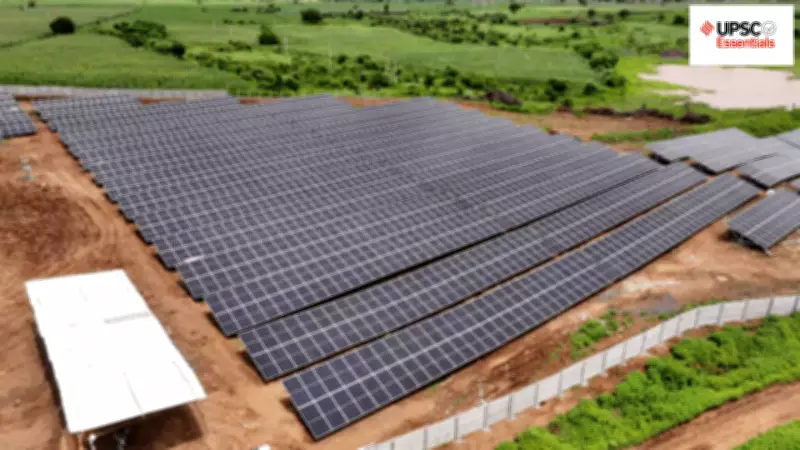
Question 1: Production Linked Incentive (PLI) Scheme for Solar PV Modules
The Production Linked Incentive (PLI) scheme for solar PV modules covers which of the following components?

- Ingots (monocrystalline or multicrystalline)
- Wafers for cell manufacturing
- Module manufacturing
- Manufacturing Polysilicon
Select the correct answer using the codes given below:
- (a) 1, 2 and 3
- (b) 2 and 3 only
- (c) 3 and 4 only
- (d) 1, 2, 3 and 4
Relevance and Explanation:
This question is highly relevant as UPSC often tests value-chain based schemes, particularly those linked to Atmanirbhar Bharat, clean energy transition, and import substitution. The PLI scheme for solar photovoltaic (PV) manufacturing is a critical component of India's renewable energy strategy.
The existing PLI scheme for solar PV modules comprehensively covers both upstream segments—including ingot, wafer, and polysilicon production—and downstream segments such as solar cell and module manufacturing. However, progress has been slower in upstream areas like polysilicon refining due to its electricity-intensive nature. Polysilicon production requires significant energy, with refining from silica to polysilicon being extremely power-hungry, necessitating access to low-cost electricity sources.
Therefore, the correct answer is option (d), as all four components—ingots, wafers, module manufacturing, and polysilicon—are included under the scheme's ambit.
Question 2: Functions of Central Counterparties (CCPs)
Which of the following are primary functions of central counterparties (CCPs)?
- Act as an intermediary in market transactions for clearing and settlement
- Guarantee the terms of a trade
- Eliminate price volatility risk
- Directly supervise stock exchanges and clearing corporations
Select the correct answer using the codes given below:
- (a) 1 and 4 only
- (b) 1 and 2 only
- (c) 2 and 3 only
- (d) 1, 2, 3 and 4
Relevance and Explanation:
Central counterparties are vital financial market infrastructures that interpose between buyers and sellers to ensure smooth clearing and settlement of trades. They are increasingly in focus due to concerns over financial stability, systemic risk, and market resilience, especially following global banking stress episodes.
CCPs perform two main functions: they act as intermediaries in market transactions for clearing and settlement, and they guarantee the terms of a trade, thereby mitigating counterparty default risk. However, CCPs do not eliminate market or price volatility risk; they only manage default risk. Supervision and regulation of financial markets, including stock exchanges and clearing corporations, fall under the purview of market regulators like SEBI, not CCPs.
Hence, statements 1 and 2 are correct, while statements 3 and 4 are incorrect. The correct answer is option (b).
Question 3: India's Oil Imports and Energy Dependence
Consider the following statements:

- The UAE is India's third-largest source of oil imports, behind Russia and Saudi Arabia.
- India depends on imports to meet over 88% of its oil demand and around half of its natural gas demand.
Which of the statements given above is/are correct?
- (a) 1 only
- (b) 2 only
- (c) Both 1 and 2
- (d) Neither 1 nor 2
Relevance and Explanation:
India-UAE energy cooperation is a significant topic due to rising crude oil imports, gas security concerns, and strategic clean energy investments. Data on India's energy import dependence and major oil suppliers are frequently tested in UPSC Prelims through factual and elimination-based questions.
The UAE is actually India's fourth-largest source of oil imports, behind Russia, Iraq, and Saudi Arabia, making statement 1 incorrect. Statement 2 is accurate: India relies on imports for over 88% of its oil demand and approximately half of its natural gas demand, highlighting the country's substantial energy import dependency.
Thus, the correct answer is option (b).
Question 4: Evacuation Challenges for Renewable Energy
Consider the following statements:
Statement 1: Evacuation of renewable energy (RE) power is a major challenge.
Statement 2: Renewable power plants can become operational much faster than conventional thermal power plants, and there is inadequate transmission infrastructure and grid integration issues, which create a major challenge in evacuation.
Which one of the following is correct in respect of the above statements?
- (a) Both Statement 1 and Statement 2 are correct and Statement 2 is the correct explanation for Statement 1.
- (b) Both Statement 1 and Statement 2 are correct and Statement 2 is not the correct explanation for Statement 1.
- (c) Statement 1 is correct but Statement 2 is incorrect.
Relevance and Explanation:
UPSC frequently frames assertion-reason type questions linking renewable energy expansion with grid infrastructure gaps, making this a high-probability conceptual area for Prelims 2026.
Evacuation of RE power is indeed a major challenge, as renewable projects like solar and wind farms can be completed within one to two years, whereas transmission systems often take three to five years to become operational. This mismatch leads to issues like curtailment during peak generation hours, as seen in states like Rajasthan.
Both statements are correct, and Statement 2 provides the direct explanation for Statement 1, as the faster execution timelines of renewable projects compared to transmission infrastructure create evacuation bottlenecks. Therefore, the correct answer is option (a).
Question 5: Jal Jeevan Mission (JJM)
With reference to the Jal Jeevan Mission (JJM), consider the following statements:
- It aims to provide safe and adequate drinking water through individual household tap connections.
- It is based on a community approach to water.
- Now states would receive funds under the Jal Jeevan Mission (JJM) only after signing of separate MoUs, with each scheme mapped through a unique Scheme ID.
How many of the statements given above are correct?
- (a) Only one
- (b) Only two
- (c) All three
- (d) None
Relevance and Explanation:
Jal Jeevan Mission is a flagship government scheme frequently in the news for coverage milestones, reforms in funding, and digital monitoring, making it a high-probability area for UPSC Prelims 2026.
All three statements are correct. JJM aims to provide safe and adequate drinking water through individual household tap connections by 2024 to all rural households. It emphasizes a community-based approach to water management, including extensive information, education, and communication. Additionally, states now receive funds only after signing separate MoUs, with each scheme mapped through a unique Scheme ID and future releases linked to demonstrating 15 days of continuous water supply.
Hence, the correct answer is option (c).
Conclusion and Preparation Tips
This Economy quiz covers essential topics that are likely to appear in UPSC CSE Prelims 2026. Regular practice with such subject-wise quizzes can significantly enhance your preparation by reinforcing key concepts and improving time management. Focus on understanding the underlying principles behind each question, as UPSC often tests application-based knowledge rather than rote memorization. Revise these areas thoroughly and stay updated with current economic developments to boost your confidence and performance in the examination.





