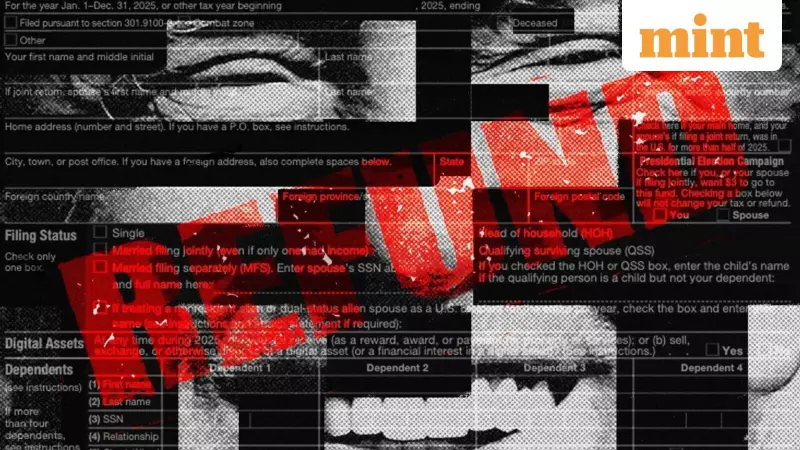
Trump's High-Stakes $100 Billion Tax Refund Gamble Ahead of Midterm Elections
In a bold political maneuver, Republicans and President Trump have engineered a massive tax refund bonanza designed to land in American bank accounts just months before the crucial midterm elections. The annual tax-filing season that commenced this week is projected to deliver an unprecedented cash surge of approximately $100 billion beyond last year's $329 billion total, creating what analysts describe as a carefully timed economic stimulus with clear political objectives.
The Political Calculus Behind the Refund Strategy
This strategic move comes at a critical juncture for Republicans, who are grappling with declining public confidence in Trump's economic leadership despite better-than-expected growth figures. The party faces the daunting challenge of overcoming Americans' persistent anxiety about the cost of living and a slowing job market. At stake is nothing less than Republican control of both the House and Senate, which would determine their ability to shape the federal agenda and potentially shield the administration from investigations.
The political strategy appears straightforward on the surface: put substantial money directly into voters' wallets and hope for electoral rewards in return. However, this represents what political observers describe as a "double-bank shot" with no guaranteed outcome. Republicans must navigate multiple hurdles, including a significantly reduced Internal Revenue Service workforce and the crucial task of ensuring voters understand why they're receiving larger refunds.

The Legislative Framework: "Working Families Tax Cut"
Central to this strategy is the legislation Trump signed on July 4 last year, originally dubbed the "one big beautiful bill act" but now rebranded by Republicans as the "working families tax cut." This comprehensive legislation includes targeted tax breaks for various demographic groups, including tipped employees, overtime workers, senior citizens, car buyers, parents, and individuals burdened by high state and local tax bills.
According to Treasury Department projections, average tax refunds are expected to increase by approximately $1,000 this year compared to last year's average of $3,167. More than three-fifths of American households received refunds last year, and this percentage is expected to remain substantial under the new provisions.
Deliberate Design and Targeted Benefits
Republicans made several calculated decisions to maximize the political impact of these tax cuts. By making the reductions retroactive for the 2025 tax year and delaying adjustments to paycheck withholding formulas, they effectively concentrated the benefits into this year's tax-filing season. This creates what Representative Nick LaLota (R-N.Y.) openly acknowledged as an intentional strategy: "Hell yeah, that was intentional."
The legislation specifically targets middle- and upper-middle-income taxpayers, with high-income individuals also benefiting through provisions like a permanent 37% top tax rate and extensions of tax cuts for estates, corporations, and closely held businesses. Notably, the increase in the state and local tax deduction cap from $10,000 to $40,000—a provision championed by representatives from high-tax states—accounts for approximately one-quarter of the tax cuts' total boost according to the Tax Foundation.
Administrative Challenges and IRS Capacity
The success of this political strategy faces significant practical hurdles, particularly concerning the Internal Revenue Service's capacity to handle the increased workload. The IRS began 2025 with over 100,000 employees but has since shrunk by approximately 25% due to layoffs and retirements. While much of this reduction occurred in enforcement staffing that doesn't directly affect tax-filing operations, the agency still faces substantial challenges in areas requiring human intervention.
Janet Holtzblatt, a former Treasury official now at the Tax Policy Center, warned that "the opportunity for snafus is there," particularly in call centers that handle taxpayer inquiries and in processing paper correspondence. The IRS is currently responding to individual taxpayer letters received as far back as October, raising concerns about potential backlogs during the crucial filing season.

Democratic Skepticism and Alternative Perspectives
Democrats remain deeply skeptical about both the effectiveness and fairness of this refund strategy. Representative Brendan Boyle (D., Pa.) characterized it as "the sort of short-term fix that someone like Donald Trump absolutely loves" and plans to highlight the law's cuts to healthcare spending. Senate Minority Leader Chuck Schumer (D., N.Y.) emphasized that despite the refunds, "every week, their costs are going up and they have to pay more for things they need."
Critics also point to the uneven distribution of benefits, noting that almost no one in the bottom 20% of households will receive more under the new law, primarily because few in this demographic pay income taxes and expanded deductions don't substantially help them.
Economic Implications and Consumer Behavior
Beyond the political dimensions, the refund surge is expected to provide a modest economic stimulus, acting as what economists describe as a "mini-round of stimulus payments." Research from the JPMorgan Chase Institute indicates that tax refunds are typically spent quickly by most Americans, with a 2018 study showing a sudden increase in out-of-pocket healthcare spending among refund recipients.
Jared Bernstein, former chairman of the White House Council of Economic Advisers under President Joe Biden, noted that "for most other people, especially if they're squeezed, they'll spend it," suggesting the refunds could fuel consumer spending in the coming months.
The Communication Challenge and Historical Lessons
Republicans have learned from what they perceive as mistakes during the 2017 tax cuts, when many voters remained unaware they had received tax reductions because the benefits arrived in small increments through paycheck withholding. Former Representative Kevin Brady (R., Texas), who chaired the House Ways and Means Committee in 2017, acknowledged that "even though tax refunds don't reflect your tax burden, people pay attention to it."
The current strategy deliberately creates more visible, lump-sum benefits that Republicans hope will make a stronger impression on voters. However, the challenge remains keeping these tax cuts and refunds fresh in voters' minds through the fall, particularly given what critics describe as the administration's tendency to veer off-topic.
Looking Toward November
As Representative Lloyd Smucker (R., Pa.) candidly admitted, "A lot of our success in November is dependent on how people are feeling about how our economic policies are working for them." The $100 billion tax refund gambit represents one of the most significant pre-election economic interventions in recent memory, testing whether direct financial benefits can translate into electoral advantages in an environment of broader economic uncertainty.
The coming months will reveal whether this calculated strategy pays political dividends or becomes another chapter in the complex relationship between tax policy, economic perception, and electoral outcomes in American politics.