

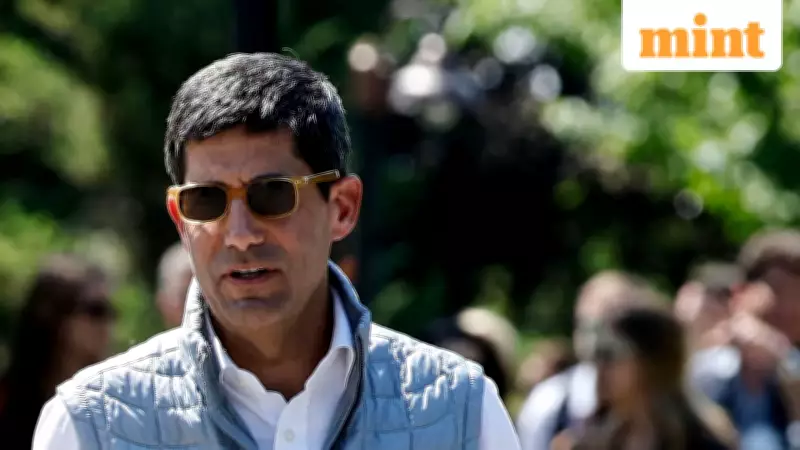
In a significant development for U.S. economic policy, former President Donald Trump has announced his intention to nominate Kevin Warsh as the next chair of the Federal Reserve. The announcement was made via Trump's Truth Social platform, where he expressed strong confidence in Warsh's potential to excel in the role.
A Long-Awaited Nomination
Trump revealed his decision to select Warsh, stating, "I have known Kevin for a long period of time, and have no doubt that he will go down as one of the GREAT Fed Chairmen, maybe the best." He further praised Warsh's demeanor and reliability, adding, "On top of everything else, he is 'central casting,' and he will never let you down." This nomination represents a notable comeback for Warsh, who was previously passed over for the position in 2017 when Trump chose Jerome Powell instead.
Background and Experience
Kevin Warsh, 55, brings a wealth of experience to the table, having served on the Federal Reserve's Board of Governors from 2006 to 2011. Appointed by President George W. Bush, Warsh became the youngest person ever to serve as a Fed governor and was among the richest. His background includes stints in the Bush White House and on Wall Street, which proved invaluable during the 2008 financial crisis.

Since leaving the Fed, Warsh has maintained a close advisory relationship with Trump, dating back to his first presidential campaign. He has also been a frequent critic of the central bank, advocating for what he calls a "regime change" and proposing plans for lower interest rates. In a July interview with Fox News, Warsh emphasized the need for aggressive action, saying, "It's about breaking some heads, because the way they've been doing business is not working."
Policy Implications and Independence Concerns
If confirmed by the Senate, Warsh would take charge of U.S. monetary policy at a critical juncture. Many economists and investors are concerned that the Fed's traditional insulation from political influence is under threat from the White House. Warsh's alignment with Trump on economic issues, particularly his public advocacy for lower interest rates in 2025, has raised eyebrows given his longstanding reputation as an inflation hawk.
During his tenure at the Fed, Warsh was consistently wary of inflation and often supported higher interest rates. However, last year he echoed Trump's view that rates could be significantly lower, a shift that some see as a litmus test for the next chair. This willingness to cut rates worries Fed watchers who fear it could undermine the central bank's independence.
Structural Challenges and Confirmation Hurdles
It's important to note that Warsh's selection does not guarantee an immediate change in Fed policy. Interest rates are determined by a majority vote of the 12-member Federal Open Market Committee (FOMC), which includes seven Fed governors and five regional Fed bank presidents. The FOMC recently held its benchmark rate steady after three consecutive cuts in late 2025, with rates remaining well above Trump's desired levels.
Warsh's Senate confirmation may face complications due to a recently announced Department of Justice probe into the central bank. On January 9, the Fed received subpoenas related to Powell's 2025 congressional testimony about a building renovation project. Powell issued a videotaped statement condemning the probe, and several Republican lawmakers have vowed to defend the Fed, with one pledging to block any nominations until the legal matter is resolved.
Political Dynamics and Historical Context
Trump has been a frequent critic of Jerome Powell almost since he took the helm in 2018. In 2020, Trump expressed regret over selecting Powell instead of Warsh, saying, "Kevin, I could have used you a little bit here. Why weren't you more forceful when you wanted that job?" This history adds a layer of political intrigue to the current nomination.
Warsh's personal connections also play a role in his nomination. He is married to Jane Lauder, daughter of prominent Republican donor Ronald Lauder, who is the son of makeup scion Estee Lauder and a former Wharton School classmate of Trump's. Lauder donated $5 million in March to MAGA Inc., Trump's super political action committee, highlighting the intertwined nature of politics and finance.

Market Reactions and Future Outlook
Economists at Evercore ISI, led by Krishna Guha, noted that if Warsh is chosen, investors might react by steepening the yield curve, expecting him to be more hawkish than other candidates, though they anticipate he would hold off on a hawkish approach in 2026. They also predict the dollar could rise and risk assets might fall initially.
Despite three quarter-point interest rate cuts in 2025, Powell indicated broad support for leaving rates unchanged amid signs of labor market stabilization. Futures markets suggest investors expect rates to drop to about 3% by the end of 2026, from the current range of 3.5-3.75%, still far above Trump's preferences.
Warsh's resignation from the Fed in 2011 came shortly after it embarked on a second round of bond purchases to support the crisis-scarred economy. He has since criticized the Fed's balance-sheet expansion, arguing that more aggressive reduction would allow for lower interest rates. This openness to rate cuts marks a significant shift for Warsh, who once called for higher rates even during the financial crisis.





