

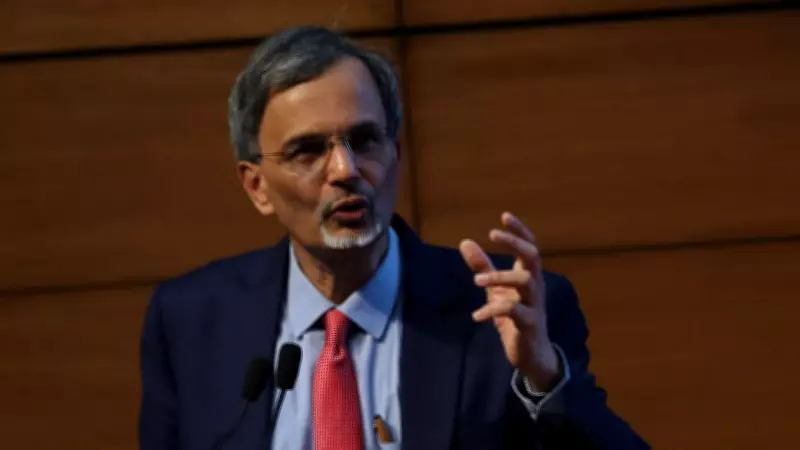
India Must Aspire for Strong Currency Without Derailing Export Prowess: CEA Nageswaran
According to the government's Chief Economic Advisor, V Anantha Nageswaran, India should strive to reach a position where a robust rupee does not undermine the country's export capabilities. In an exclusive interview following the tabling of the Economic Survey for 2025-26 in Parliament, Nageswaran, who served as the principal author of the Survey, elaborated on this vision for economic stability.
Currency Strength and Economic Stability
Nageswaran emphasized that currency stability and strength are highly desirable attributes, often synonymous with strong and stable economies globally. He pointed out that a currency known for constant depreciation conveys a sense of vulnerability, which can deter investor confidence. "If you are a currency that is known for constant depreciation, that conveys a certain sense of vulnerability," he stated, underscoring the importance of moving beyond this perception.
Drawing parallels with economic powerhouses like Switzerland, Germany, and Japan, the CEA highlighted that these nations have maintained strong currencies while continuing to excel as export leaders. "It shows that they have made products that were in demand and which were also price inelastic," he explained, indicating that India must focus on enhancing manufacturing competitiveness, particularly in niche and high-tech sectors, to achieve similar outcomes.

Attracting Foreign Capital Amid Global Dynamics
Addressing the challenges in attracting foreign capital due to shifting global dynamics, Nageswaran advocated for a balanced approach. He stressed that while some external factors are beyond control, India must proactively work on domestic reforms. "We need to keep doing what we have to do and for global matters we have to wait because they're not in our control anyway," he remarked.
The CEA outlined key areas for improvement, including providing tax simplicity, predictability, continuity, and stability—factors that investors have consistently highlighted. He noted that even if India is not an outlier in these aspects, demonstrating consistency can enhance appeal. "As long as we can continue to demonstrate predictability, continuity, and stability—I think they are desirable in and of themselves," he added, acknowledging that outcomes depend on multiple variables.
Fiscal Discipline at the State Level
When questioned about fiscal discipline among state governments, Nageswaran emphasized the need for careful consideration rather than hasty decisions. He indicated that determining the right fiscal metric for states requires thorough analysis. "We need to do some scenario analysis to see which one plays out better than the other, etc., and come to a considered decision," he stated.
With the upcoming report from the 16th Finance Commission, the CEA suggested that it is prudent to await its recommendations before speculating on specific targets. "After that, too, we need to do some more empirical work and scenario planning before we respond as to which is the right fiscal parameter to target," he concluded, highlighting a methodical approach to policy-making.
Economic Survey Focus and Future Adjustments
Responding to observations about the Economic Survey's emphasis on global developments, Nageswaran expressed surprise, noting that the document covers diverse topics such as agriculture, climate adaptation, and state capacity. He reiterated that manufacturing competitiveness remains a core theme, essential for achieving currency stability.
Looking ahead to fiscal year 2027, described as a year of adjustment, the CEA discussed potential revisions in GDP, CPI, and IIP data. He advised caution, stating, "It would be somewhat premature and mostly speculative to talk about this at this stage." He emphasized that structural reforms should continue regardless of growth numbers, with policy directions likely to remain consistent.
In summary, Nageswaran's insights underscore a strategic vision for India's economic future—one that balances currency strength with export vitality, fosters foreign investment through domestic reforms, and upholds fiscal prudence at all levels of governance.






