

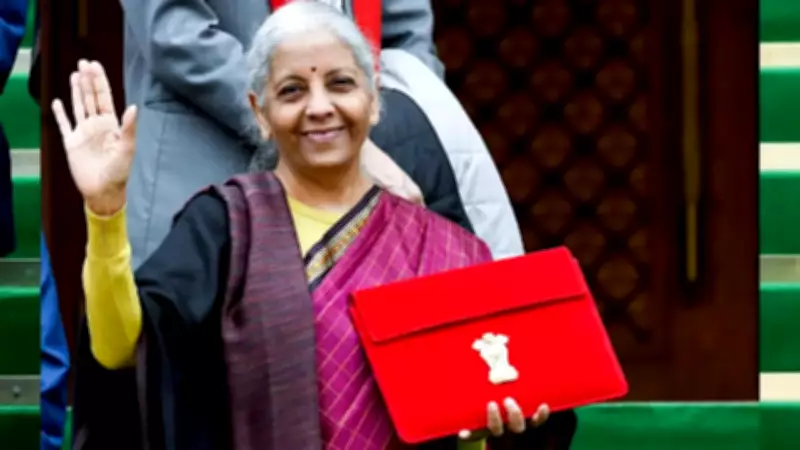
Union Finance Minister Nirmala Sitharaman on Sunday delivered her ninth consecutive Union Budget speech in the Lok Sabha, marking a significant milestone in India's parliamentary history. The presentation, which lasted precisely 1 hour and 25 minutes, outlined the government's comprehensive fiscal roadmap for the financial year 2026-27, encompassing detailed spending plans, strategic tax proposals, and key policy priorities that will shape the nation's economic trajectory.
A Historic Parliamentary Moment
Prime Minister Narendra Modi hailed Sitharaman's ninth straight Budget presentation as "a moment of pride in India's parliamentary tradition." Having assumed office as finance minister on May 31, 2019, Sitharaman now holds the distinguished record as the longest-serving finance minister in continuous office, completing an impressive six years and eight months in this crucial role. She stands as only the second woman in independent India to present the Union Budget and the first full-time woman finance minister to accomplish this feat.
Key Budgetary Announcements for 2026-27
The Budget speech revealed several critical economic targets and figures that will guide national development. The government has set an ambitious capital expenditure (capex) target of Rs 12.2 lakh crore for FY27, representing a substantial increase from the Rs 11.2 lakh crore allocated in the current fiscal year. This move underscores the administration's continued emphasis on infrastructure development and public investment as drivers of economic growth.

On the fiscal front, the deficit is projected to narrow slightly to 4.3 per cent of GDP, down from the 4.4 per cent estimated for 2025-26. Net tax receipts are estimated at Rs 28.7 lakh crore, while the total size of the Union Budget has been pegged at Rs 53.5 lakh crore. The general government debt-to-GDP ratio stood around 85 per cent in 2024, with central government debt accounting for approximately 57 per cent of this figure.
The Evolution of Sitharaman's Budget Speeches
Over her tenure, the duration and style of Sitharaman's Budget presentations have evolved significantly, reflecting both changing economic priorities and her distinctive approach to governance.
- 2019 Budget: Her maiden presentation lasted 2 hours and 8 minutes, making it the longest on record at that time. This historic speech featured couplets in Urdu, Hindi, and Tamil, and notably replaced the traditional leather briefcase with a red cloth 'bahi-khata'.
- 2020 Budget: She delivered India's longest Budget speech in independent history, running nearly 2 hours and 39 minutes, before concluding slightly early due to feeling unwell.
- 2021 Budget: Lasting 1 hour and 50 minutes, this presentation focused on health and infrastructure, framed around six pillars including well-being, infrastructure development, inclusive growth, human capital enhancement, innovation promotion, and governance reforms.
- 2022 Budget: This 1 hour 32 minute speech outlined a long-term roadmap for the Amrit Kal, emphasizing public investment and infrastructure modernization, presented while wearing a brown Bomkai saree from Odisha.
- 2023 Budget: Lasting 1 hour and 27 minutes, this presentation introduced the Saptarishi vision, guiding the country through Amrit Kaal with seven priorities ranging from inclusive development to green growth. It marked the first time a woman finance minister presented the Budget to a woman president.
- 2024 Budget: Included both an Interim Budget of 56 minutes and a full Budget of 1 hour 22 minutes, surpassing Morarji Desai's previous record.
- 2025 Budget: Underlining a focus on Garib, Yuva, Annadata, and Nari, this was her shortest full Budget speech to date at just 1 hour and 14 minutes.
Historical Context and Comparisons
Historically, other long-serving finance ministers include Morarji Desai, who presented the Budget ten times, and P Chidambaram, who did so nine times. However, neither delivered their presentations consecutively, making Sitharaman's uninterrupted nine-Budget streak particularly noteworthy in India's fiscal history.

The 2026-27 Budget continues to be one of the most closely watched events on India's economic calendar, with salaried individuals, middle-class taxpayers, and various industry sectors eagerly anticipating policy directions that will influence financial planning, investment decisions, and economic growth in the coming year.





