

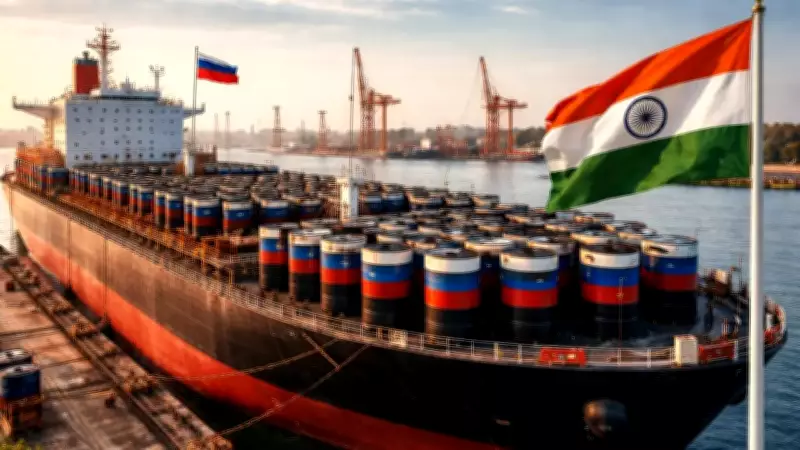
Russian Crude Emerges as India's Strategic Buffer in Global Oil Turmoil
The escalating conflict between the United States and Iran has severely disrupted global crude oil supplies, particularly through the critical Strait of Hormuz. This chokepoint, vital for Middle Eastern oil exports, has seen flows dwindle, causing a dramatic spike in global crude prices. For India, which imports nearly 90% of its oil, the implications are profound, forcing a rapid recalibration of its energy procurement strategy.
Sanctions and Shifts: The Rollercoaster of India-Russia Oil Trade
Following the Russia-Ukraine war in 2022, Russia became a major supplier, contributing 35-40% of India's crude imports at its peak. However, by early 2026, stringent sanctions led to a significant drop in these purchases. The landscape shifted dramatically in March 2026, as the US-Iran war intensified. With Hormuz shipments faltering, inflows of Russian crude to India have surged sharply, now approaching lifetime monthly highs.
The Donald Trump administration has issued a 30-day waiver allowing purchases of Russian crude to stabilize global oil prices. A government source emphasized, "We source crude from wherever supplies are available, competitively priced and deliverable, and we will continue to do so." The source suggested the waiver might be aimed at the US domestic audience, highlighting India's pragmatic approach to energy security.

Historical Context and the Recent Rebound
Traditionally, India relied heavily on Middle Eastern oil from Iraq, Saudi Arabia, and the UAE, favored for proximity and stable shipping. Post-2022, Western sanctions redirected Russian oil to markets like India, attracted by steep discounts. This diversification helped cut import costs but faced setbacks in late 2025 due to US pressure, including a 25% penalty tariff and sanctions on Russian firms like Lukoil and Rosneft.
Now, the conflict has reversed that trend. Analysis from Kpler indicates India has purchased 45–50 million barrels of Russian crude since the Middle East conflict began, with March 2026 imports expected to hit 1.8–2.0 million barrels per day (Mbd). Sumit Ritolia, Lead Research Analyst at Kpler, notes this rebound is swift, cushioning the Hormuz disruption without major refinery impacts. Sourav Mitra of Grant Thornton Bharat adds that March imports may reach 60 million barrels, nearing the all-time high of 66 million barrels in May 2023.
India vs. China: Diverging Dependencies on Russian Oil
While both India and China are major buyers of Russian crude, their exposure differs. China, with larger reserves, is less vulnerable to Hormuz shocks and continues substantial imports via seaborne and pipeline routes. In contrast, India's recent surge is more directly tied to replacing lost Middle Eastern barrels, making Russian oil critically important for energy security.
India imports 5-5.5 Mbd of crude, compared to China's 11 Mbd. In 2025, Russia accounted for 18% of China's imports, with shipments rising 40% year-on-year in early 2026. However, high prices and ample inventories may lead China to cut purchases, potentially moderating Russia's shipments. Mitra observes, "Russian oil may remain one of China’s preferred choices due to the stability and scale it provides in uncertain times."
Energy Security and Resilience in a Volatile Market
India's historical dependence on the Strait of Hormuz for 50% of its crude imports has made it vulnerable. The conflict has disrupted both crude and LPG flows, but the US waiver has enabled a sharp increase in Russian intake. Pre-conflict, India imported 2.6-2.7 Mbd from the Middle East and 1.0 Mbd from Russia; post-conflict, Russian imports have jumped to 1.9–2.0 Mbd, offsetting much of the disruption.
Middle Eastern producers are partially rerouting supplies via pipelines like Saudi Arabia's East-West and the UAE's Habshan–Fujairah, providing some relief. Overall, India's total crude imports are down by around 800,000 barrels per day compared to early 2026, but refinery runs remain stable, supported by diversified sources. The Ministry of Petroleum & Natural Gas confirmed, "Every Indian refinery is running at over 100% utilisation. Crude oil supplies for next 60 days have already been tied up... There is NO supply gap."

Future Outlook and Strategic Diversification
Experts predict Russian crude will remain central to India's import strategy, with March 2026 likely marking one of the highest intake months since mid-2025. Opportunities for Iranian or Venezuelan barrels may arise, but no significant flows have been observed yet. Refinery throughput may decline by 5–8%, but domestic supply remains balanced, and India could play a key role in exporting refined products to Asia.
In summary, India has effectively mitigated Hormuz-related disruptions by boosting Russian crude imports. Ritolia concludes, "While some pressure on runs is expected, the system remains resilient, with no immediate risk to domestic fuel supply and continued strength in product exports." This strategic pivot underscores India's growing energy resilience in a turbulent global landscape.





