

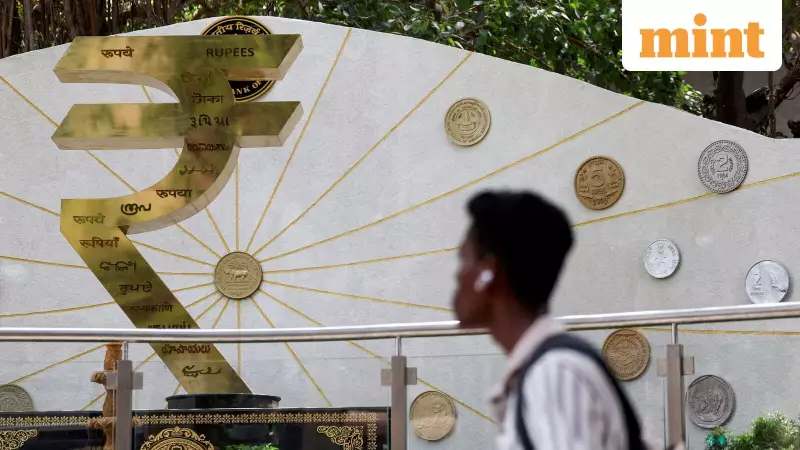
The Indian rupee is entering 2026 under significant pressure, having endured a tumultuous year marked by sharp depreciation and intense volatility. The currency, which began 2025 at a level of 85.65 against the US dollar, has shed more than 6% of its value over the course of the year, earning the dubious distinction of being Asia's worst-performing currency. After breaching the critical psychological barrier of 90 per dollar, it hit a fresh record low of 91.07 on December 18 before some recovery.
The Twin Scenarios: Stability or Further Slide?
Market experts and economists are not painting a uniformly bleak picture for 2026. Instead, they outline two distinct paths, with the outcome heavily dependent on external factors, particularly the resolution of trade tensions with the United States.
In an optimistic scenario, clarity on tariffs between India and the US by early 2026 could reverse export losses, attract equity investors back to Indian markets, and improve overall sentiment. Neeraj Gambhir, Executive Director at Axis Bank, suggests that if these positive developments materialize, the rupee could see either no depreciation or a very mild decline, potentially hovering around the 90-91 to the dollar range.

The pessimistic outlook is less forgiving. If trade negotiations falter and external pressures from global markets persist, the currency could face another 3-4% depreciation, potentially pushing it closer to 95 against the dollar. This scenario stems from the 50% tariffs the US slapped on Indian goods in August 2025, which have weakened exports. However, Gambhir dismissed fears of a rapid collapse to 100, noting that a 10% drop is typically a two-to-three-year event.
The Capital Flight That Defined 2025
A primary driver of the rupee's weakness in 2025 was relentless selling by Foreign Portfolio Investors (FPIs). Data from the National Securities Depository Ltd. shows FPIs sold Indian equities worth a staggering ₹1.58 lakh crore so far in 2025.
Hitendra Dave, CEO of HSBC India, attributed the recent currency weakness almost entirely to this daily FPI selling. The pressure was exacerbated by large Initial Public Offerings (IPOs), which prompted foreign investors to exit existing positions to fund primary market investments and then repatriate the proceeds.
India's external financing mix has shifted unfavourably. While the current account deficit remains modest, both Foreign Direct Investment (FDI) and FPI flows have turned negative. This has forced the currency market to adjust to prolonged capital outflows.
A Shift in the RBI's Strategy
An important development in 2025 has been the Reserve Bank of India's (RBI) apparent higher tolerance for a weaker currency. Constrained by its forward book and the need to preserve domestic liquidity, the central bank has intervened more selectively in the forex market.
For instance, after the rupee hit a record low on December 18, it recovered to 89.65 on December 19 following RBI dollar sales. The central bank had also intervened forcefully on December 17, leading to an intraday gain of 1%. However, economists see this as a structural change, with the RBI willing to accept gradual, orderly depreciation. Research from IDFC FIRST Bank notes that gross dollar sales by the RBI in FY26 (till November) are tracking at $79 billion, compared to $399 billion in the previous fiscal year.
For 2026, this implies fewer attempts by the RBI to "draw a line in the sand," allowing the rupee to respond more freely to global forces like US monetary policy and investor risk appetite.
Fundamental Factors and the Road Ahead
Not all analysis points to continued doom. Axis Bank's India Economic Outlook 2026 expects depreciation pressures to ease as growth strengthens and the rupee's real effective exchange rate becomes more competitive. Their base case forecasts only 'mild, not wild' depreciation, with the current account deficit remaining manageable at around 1.2–1.3% of GDP.

Seasonal factors are also expected to provide support. The January-March quarter typically sees a narrower trade deficit and a surplus in the balance of payments, which could bolster the rupee. IDFC FIRST Bank's research report from December 17 projects the rupee to reach 88.50 against the dollar by March 2026 and 89.50-90.00 by June 2026, assuming a trade deal is reached in the fiscal year 2026.
Ultimately, the rupee's trajectory in 2026 will oscillate between relative stability and slow weakening. Its fate rests on a delicate balance: the revival of foreign capital flows and the easing of global trade uncertainty, particularly through a resolution with the United States. The currency's ability to find its footing after a bruising year hinges on these external factors aligning in India's favour.





