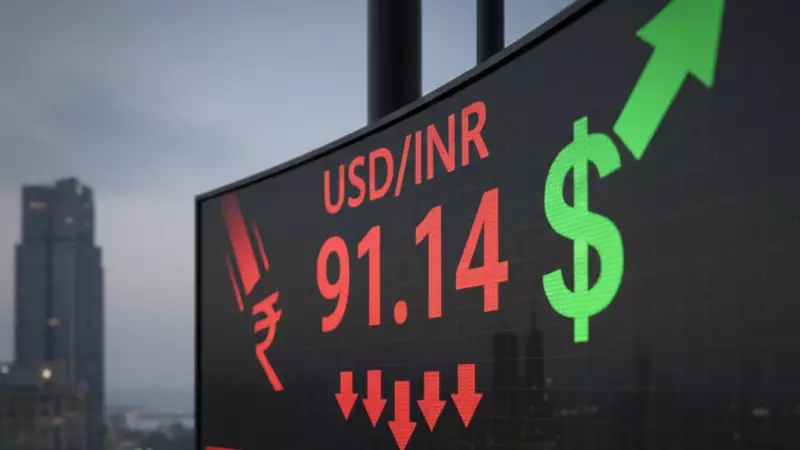
The Indian rupee, having breached the psychological barrier of 90 against the US dollar, is back in the spotlight, stirring anxiety and debate. The core question remains: is the currency being managed effectively? A group of prominent economists has analyzed the Reserve Bank of India's (RBI) approach, acknowledging improvements but issuing a stark warning against repeating the costly errors of the recent past.
From a Damaging Peg to Flexible Management
The analysis credits the current RBI leadership under Governor Sanjay Malhotra for steering away from a problematic policy employed between mid-2023 and late 2024. During that period, the rupee was kept artificially fixed at a level that seemed to favor large foreign currency borrowers. This peg, sustained by burning through over $150 billion in foreign exchange reserves, hurt India's economic competitiveness and ultimately led to a speculative attack on an overvalued currency.
In contrast, over the last year, the RBI has adopted a more flexible stance. It has partially allowed the exchange rate to reflect capital outflows, with the rupee depreciating from about 85 to 90 against the dollar. This outflow is puzzling given India's reported 8.2% GDP growth, which should ideally attract foreign investment.

Old Habits Die Hard: The Return of Intervention
However, the economists point out that old tendencies have resurfaced. From mid-2025, facing renewed pressure from external factors like Trump's tariffs and a global investor reassessment favoring China, as well as domestic concerns, the RBI resumed defending the rupee.
Estimates suggest that since June 2025, the central bank has sold approximately $30-35 billion in the spot market and potentially up to $30 billion in forward markets. This intervention raises a critical question: why spend precious reserves to prevent a depreciation when high inflation isn't a threat?
The authors speculate that two interest groups lobby against a weaker rupee: Indian entities with dollar expenses (like corporates with foreign debt and families funding overseas education) and nationalist politicians who view currency depreciation as a sign of weakness.
The Case for a Weaker Rupee: Jobs vs. Privilege
The economists present a powerful counter-argument focused on distributional consequences. They urge policymakers to consider the plight of tens of millions of workers in labor-intensive export sectors like fisheries, gems and jewellery, and clothing, who face job losses due to devastating Trump tariffs. A weaker rupee acts as a subsidy for exporters, protecting these vulnerable jobs.
"In this instance, a weaker rupee protects millions of the poor, while a strong rupee favours the rich few," they state. They also point to China's example, where the real exchange rate has depreciated about 12.5% since January 2020 despite massive trade surpluses, as Beijing actively maintains competitiveness.
In comparison, India's real exchange rate has only depreciated about 5.5%. Given the 25% punitive Trump tariffs and the need to catch up with Chinese competitiveness, the analysis suggests a further 10% depreciation is almost necessary, especially with limited fiscal support from the government.
The economists argue that a rupee gradually moving towards 100 against the dollar, rather than being held near 90, is the minimum required to support the economy and its crucial export sector.
The irony, they note, is that market forces are attempting to achieve this necessary adjustment—a task policymakers have been unwilling to undertake. By thwarting this market correction, vested interests are inflicting self-damage on the economy. They advocate for the government to allow the RBI to manage a truly flexible exchange rate, which would amplify the benefits of other ongoing reforms.

The tragedy, according to the authors, is India's repeated failure to learn from history. They reference a recent book, "A Sixth of Humanity," which finds the Indian state is often self-reflecting but rarely self-correcting. The 2023-24 rupee peg was a textbook example of poor currency management. While the current policy is an improvement, it must not regress. In 2026, repeating the egregious errors of 2023-24 would be unforgivable.
The opinion piece is authored by Abhishek Anand (Visiting Fellow, Madras Institute for Development Studies), Josh Felman (Head, JH Consulting), and Arvind Subramanian (Senior Fellow, Peterson Institute for International Economics).