

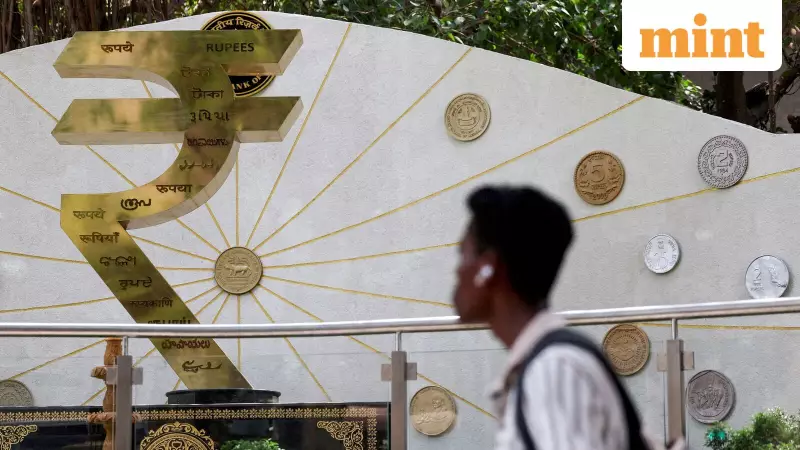
The Indian rupee tumbled to a fresh all-time low on Tuesday, coming perilously close to the 90 mark against the US dollar before suspected intervention by the Reserve Bank of India (RBI) provided a temporary cushion. The domestic currency closed at a record low of 89.87 against the dollar, marking its fifth consecutive day of decline as it shed 42 paise.
RBI Steps In as Rupee Nears Psychological 90 Mark
During the trading session, the rupee's fall intensified, pushing it to an intraday low of 89.9475. Traders reported that as the currency neared the critical threshold of 90, state-owned banks stepped into the market aggressively to sell US dollars. This action, widely believed to be on behalf of the RBI, helped cap the rupee's sharp descent. The central bank's move highlights its intent to manage excessive volatility and anchor market expectations in the near term.
In the offshore non-deliverable forwards (NDF) market, which often signals future currency stress, the rupee briefly breached the 90-per-dollar mark. This divergence, where forward rates are weaker than the spot rate, indicates that global investors are hedging against further depreciation of the Indian currency. The rupee has now earned the dubious distinction of being the worst-performing Asian currency this year.

Global and Domestic Headwinds Mount
Market experts point to a complex mix of challenges driving the rupee's weakness. Rama Chandra Reddy, Treasury Deputy General Manager at Karur Vysya Bank, explained that the traditional suppliers of global carry-trade capital, namely the US and Japan, are now dealing with higher interest rates. This has significantly weakened the flow of low-cost capital into emerging markets like India, reducing fresh inflows and increasing the risk of existing investments being pulled out.
Domestic fundamentals are also creating strong headwinds. India's Balance of Payments (BoP) swung into a deficit of $10.9 billion in the second quarter of FY26, a stark reversal from a $4.5 billion surplus in the previous quarter. This was driven by a collapse in capital inflows, which fell to a mere $0.6 billion from $8 billion sequentially. Foreign portfolio investments slowed dramatically, and external commercial borrowings weakened.
Simultaneously, the current account deficit widened to $12.3 billion, or 1.3% of GDP. A key driver was a ballooning trade deficit that rose to 9% of GDP, exacerbated by a surge in gold imports amid higher global prices. Exports to the United States, India's largest market, continued to suffer due to the 50% bilateral tariffs, adding to the downward pressure on the rupee.
What Lies Ahead for the Rupee?
The immediate consensus in the market is that the RBI will continue to defend the 90 level. Experts, including Ritesh Bhansali, Deputy CEO of Mecklai Financial Services, predict the rupee will trade in a range of 89.70 to 90.00 in the very near term, with all eyes on the central bank's actions. However, the medium-term outlook remains cautious.
Market participants expect the rupee to trade in the 91-92 range in the medium term, unless there is a significant positive trigger. The most anticipated catalyst is a breakthrough in the India-US trade deal. Bhansali noted that without such a deal, the rupee could even fall to 94-95 levels. Conversely, an announcement of a trade agreement could trigger a short-term appreciation, potentially pulling the rupee back to 88.00-88.50 levels.
Gaura Sengupta, Chief Economist at IDFC First Bank, cautioned that even if a trade deal is struck, the full-year FY26 BoP may remain negative due to tepid capital flows and elevated trade deficits. She added that the pace of depreciation would be more moderate with a deal, and faster without one.
As the monetary policy committee considers its rate decision, many treasury desks believe the RBI's defence of the rupee will be a crucial stabilizing force. The currency's trajectory now hinges on a delicate balance between global financial conditions, India's external balances, and the central bank's strategic interventions.






