

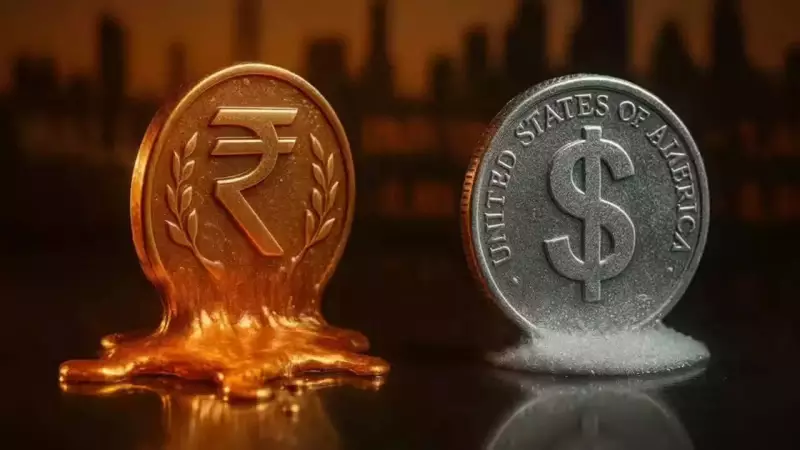
Rupee Plunges to Historic Low of 92 Against US Dollar, Impacting Economy
The Indian rupee has tumbled to an unprecedented low of 92 against the US dollar, marking a significant milestone in the currency's recent downward trajectory. This sharp depreciation, recorded on January 23, is exerting considerable pressure on household budgets and business operations across the nation.
Currency Movement and Contributing Factors
During trading hours, the local currency weakened to an all-time intraday low of 92 per dollar before recovering slightly to close at 91.88 on a provisional basis. This decline follows a previous record low closing level of 91.65 set just two days earlier on January 21, when the rupee fell by 68 paise.
The rupee's slide has been driven by multiple factors:

- Sustained selling pressure from foreign institutional investors
- Weak performance in domestic equity markets
- Prevailing risk-off sentiment in global financial markets
So far in January, the rupee has depreciated by 202 paise, representing a decline of over 2%. Looking at the broader picture, the currency has fallen nearly 5% throughout 2025, primarily due to persistent foreign fund outflows and strengthening of the US dollar.
Immediate Impact on Import Costs
A weaker rupee directly translates to higher costs for imported goods, as Indian buyers must pay more rupees for the same quantity of dollar-priced products. This effect is particularly significant for a country that imports approximately 85% of its crude oil requirements for essential fuels including petrol, diesel, and aviation turbine fuel.
India's diverse import basket includes:
- Crude oil and petroleum products
- Coal and other energy resources
- Plastics, chemicals, and fertilizers
- Electronic goods and components
- Vegetable oils and agricultural products
- Machinery and industrial equipment
- Gold, pearls, and precious stones
- Iron, steel, and metal products
Consumers should brace for price increases not only at fuel pumps but also for electronic items such as mobile phone components, certain automobile models, and household appliances that rely on imported parts.
Education and Travel Expenses Rise
The depreciating rupee is making international education more expensive for Indian students, who now need to allocate more rupees for every dollar charged by overseas educational institutions. Similarly, foreign travel becomes costlier as travelers must exchange more rupees to obtain dollars for expenses abroad.
Silver Lining for Exporters and NRIs
While importers face challenges, the currency depreciation offers some compensatory benefits. Non-resident Indians (NRIs) sending remittances home benefit as foreign currency converts to higher rupee values in India.
Exporters generally gain from the rupee's fall as they earn more rupees per dollar of export revenue. However, the advantage varies across sectors:
- Textiles and other sectors with low import dependence stand to gain the most
- Electronics and gems/jewellery sectors with high import content may see reduced benefits due to increased input costs
Recent Trade Data and Expert Perspectives
According to recent statistics, India's imports increased by 8.7% to reach $63.55 billion in December 2025. The trade deficit expanded to $25.04 billion, compared to $24.53 billion in November 2025 and $22 billion in December 2024.
Notable import trends include:
- Crude oil imports rose approximately 6% to $14.4 billion
- Silver imports surged nearly 80% to $758 million
- Gold imports declined 12% to $4.13 billion
Economic think tank Global Trade Research Initiative (GTRI) emphasizes that India needs to carefully balance growth objectives with inflation control while reconsidering rupee management and trade strategies for long-term economic stability.
The Federation of Indian Export Organisations (FIEO) acknowledges that a weaker rupee enhances the global price competitiveness of Indian goods but cautions that sectors heavily reliant on imported inputs may not fully realize these currency advantages due to rising production costs.






