

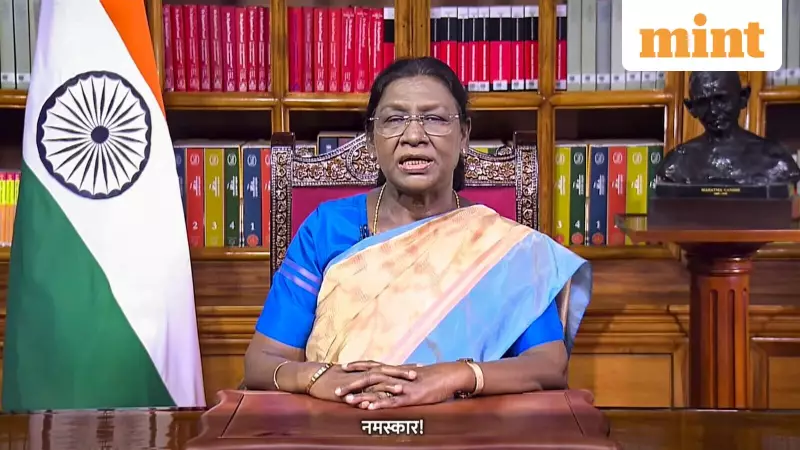
President Murmu Affirms India's Economic Momentum Amid Global Uncertainties
Against a backdrop of geopolitical tensions and slowing global growth, President Droupadi Murmu on Sunday asserted that India's economic momentum remains robust, underpinned by comprehensive reforms, substantial infrastructure investment, and a renewed focus on self-reliance. Addressing the nation on the eve of the 77th Republic Day, Murmu highlighted the country's resilience in navigating international challenges while maintaining a steady growth trajectory.
India's Economic Outlook and Growth Projections
President Murmu stated, "India is the world's fastest-growing major economy. Despite global uncertainties, India is recording continuous economic growth. We are moving towards achieving our goal of becoming the world's third-largest economy in the near future." This confidence is supported by recent data from the Ministry of Statistics and Programme Implementation, which released its first advance estimates on 7 January. According to these estimates, India's nearly $4 trillion economy is expected to grow by 7.4% in real terms during fiscal year 2026 (FY26), following growth rates of 6.5% in FY25 and 9.2% in FY24.
The president emphasized that India's principles of 'swadeshi' and self-reliance would continue to serve as vital channels for growth. "By investing in the creation of world-class infrastructure, we are rebuilding our economic strength at a much larger scale. In this journey of shaping our economic destiny, aatmanirbharata (self-reliance) and swadeshi are our guiding principles," she remarked. This aligns with Prime Minister Narendra Modi's Independence Day address in August 2025, where he urged citizens to promote the production and consumption of made-in-India items.

Key Reforms Driving Economic Growth
President Murmu detailed several government reforms that have enhanced the ease of doing business in India, positioning them as engines for future growth. These include:
- Rationalization of the goods and services tax (GST) rates to boost consumption.
- Notification of four labour codes aimed at widening social security for millions of informal workers.
- Decriminalization of obsolete laws and reduction of compliance burdens through initiatives like the Jan Vishwas Bill.
"The recent decisions to make the GST system even more effective will further strengthen our economy," Murmu said. "Four labour codes have been issued in the field of labour reforms. These will benefit our workers and will also accelerate the development of enterprises." Over recent months, the Centre has actively pushed reforms across multiple sectors to channel growth and improve the business environment.
Linking Economic Strength with National Security
The president also connected economic strength with national security, pointing to India's growing defence self-reliance. "Our self-reliance in the field of defence powered the historic success of Operation Sindoor," she noted, referring to the nearly four-day conflict between India and Pakistan in May 2025. This offensive was launched in response to a terror attack in Pahalgam the previous month, which resulted in over 20 civilian casualties.
Murmu underscored India's commitment to global peace, stating, "The future of humanity can remain secure only if there is peace in the whole world. In an atmosphere marked by conflicts in many parts of the world, India is spreading the message of world peace."
Social Welfare and Financial Inclusion Initiatives
Highlighting the government's efforts in social welfare, President Murmu mentioned that the PM Garib Kalyan Yojana, aimed at providing basic necessities, has reached approximately 810 million people. "Millions of our people who have been struggling with poverty for decades have been lifted above the poverty line. Efforts are also being made to ensure that they do not fall back into the poverty trap," she said.

In terms of financial inclusion, Murmu noted that over 570 million bank accounts have been created under the PM Jan Dhan Yojana, with nearly 56% belonging to women. She also highlighted India's digital payments infrastructure, which facilitates more than half of all digital transactions globally, and the increased participation of women in voting and financial systems.
Youth and Startups as Future Growth Drivers
Echoing Prime Minister Modi's remarks, President Murmu emphasized the critical role of youth and startups in driving future growth. "The impressive success demonstrated by start-ups in our country is mainly driven by our young entrepreneurs. The country's development will gain momentum through policies and programs focused on the aspirations of the younger generation. I am confident that the power of youth will play a leading role in the making of Viksit Bharat by 2047," she declared.
This vision positions India's dynamic startup ecosystem and its young population as key pillars in the nation's journey towards becoming a developed country by 2047, reinforcing the government's focus on innovation and entrepreneurship as catalysts for sustained economic progress.





