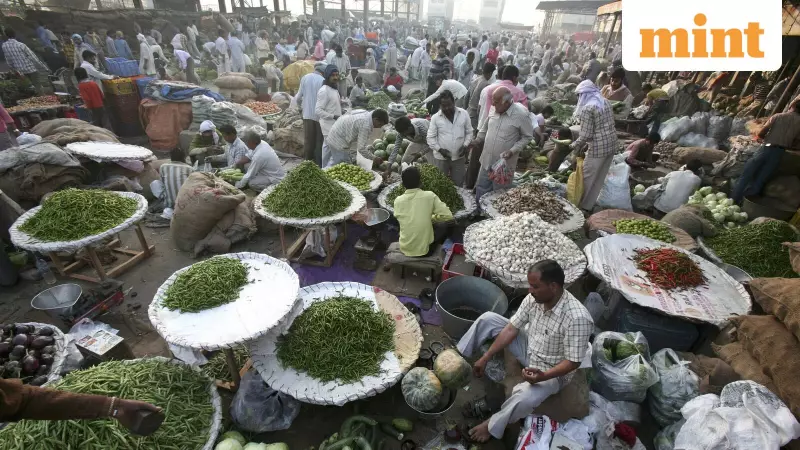
New Delhi witnessed a continued easing in wholesale price pressures as official data released on Monday showed India's wholesale inflation staying in negative territory for the second consecutive month in November. The decline was primarily driven by falling prices of food articles, mineral oils, and crude petroleum.
Key Drivers of Deflation
The Wholesale Price Index (WPI)-based inflation rate stood at -0.32% year-on-year in November. This marks a significant drop from the 2.16% recorded in the same month last year, although it represents a rise from the -1.21% seen in October 2024. The data, published by the Department for Promotion of Industry and Internal Trade (DPIIT), underscores a sharp cooling in wholesale prices, largely attributed to supply-side improvements.
Food prices, which carry substantial weight in the WPI basket, registered a decline of 2.6% compared to November 2023. This fall was led by steep drops in the prices of vegetables, pulses, and onions, even as costs for cereals and milk remained relatively firm.

Similarly, the fuel and power segment witnessed deflation, with prices decreasing by 2.27% on an annual basis. This softening was fueled by lower global energy prices and moderated domestic electricity tariffs. In the crucial manufactured products category, which constitutes over 64% of the index, inflation remained muted at 1.33%, indicating weak pricing power among producers amid subdued demand conditions.
Sequential Uptick and Economic Implications
Despite the annual deflation, a month-on-month analysis reveals a 0.71% increase in wholesale prices for November. This points to a mild rebound after two straight months of contraction. The sequential uptick was largely propelled by a rise in primary articles, especially food items, hinting at seasonal pressures and suggesting that the pace of disinflation may slow in the coming months.
For the economy, prolonged wholesale price deflation signals easing input costs for manufacturers and wholesalers, thereby reducing the risk of cost-push inflation filtering through to consumers. For households, the impact is indirect but significant. Lower wholesale costs for food, fuel, and industrial inputs can help stabilize retail inflation, improve affordability, and support purchasing power, particularly if companies absorb costs instead of raising final prices.
Policy Outlook and Expert Warnings
The soft WPI print offers reassurance to policymakers that supply-side pressures are under control. While the Reserve Bank of India (RBI) primarily targets retail inflation, low wholesale inflation eases concerns about cost shocks and provides more room to focus on stimulating consumption demand and economic growth.
However, economists caution about potential headwinds. Aditi Nayar, chief economist at Icra, noted that the pace of WPI deflation narrowed faster than expected, reflecting base effects, a weakening rupee, and firming prices of select commodities. She projected WPI inflation to turn positive at around 0.5% in December and average above 1.5% in the fourth quarter of FY26.
Sonal Badhan, economist at Bank of Baroda, highlighted that core inflation remained elevated at 1.5% in November, unchanged from October. Risks also stem from stronger growth expectations in the US and potential pressure on the rupee, which could lift commodity prices and fuel inflation in the near future.
Within manufactured goods, eight out of 22 sub-indices saw slower price increases. Deflation in basic metals extended for an eighth straight month, although global mixed trends signal upside risks if external conditions tighten. This comes at a time when India's retail inflation, as measured by the Consumer Price Index (CPI), edged up to 0.7% in November from a historic low of 0.25% in October.