

India's Gig Economy Expands Rapidly But Workers Face Persistent Challenges
India's rapidly growing gig economy is creating employment opportunities at an unprecedented scale, yet workers continue to grapple with unstable incomes, limited access to formal credit, and increasing risks from algorithm-driven platforms, according to findings from the Economic Survey 2025–26. While the sector demonstrates remarkable expansion, the survey highlights that income volatility remains a persistent issue, creating significant challenges for workers seeking financial stability and credit access.
Explosive Growth and Workforce Composition
The gig economy has witnessed extraordinary growth in recent years, expanding from 7.7 million workers in fiscal year 2021 to approximately 12 million in FY25. This represents a substantial 55% increase over just four years, demonstrating the sector's accelerating momentum. Currently, gig workers constitute over 2% of India's total workforce, with projections suggesting this segment could grow to represent 6.7% of the non-agricultural workforce by 2029–30.
Within this expanding workforce, e-commerce and logistics emerge as the dominant employment sectors, engaging about 3.7 million and 1.5 million workers respectively. The Economic Survey also reveals a sharp skill-based segmentation developing within the gig economy, with estimates indicating that by 2030, high-skilled workers will comprise 27.5% of the gig workforce while low-skilled workers will account for approximately 33.8%.

Financial Exclusion and Algorithmic Vulnerabilities
The survey identifies several critical vulnerabilities affecting gig workers. Most significantly, most gig workers remain financially invisible to traditional lenders due to what the report describes as 'thin file' credit histories. These workers typically lack conventional proof of income, making it difficult for banks and non-banking financial companies to assess their creditworthiness accurately. This financial exclusion often pushes workers toward informal borrowing channels or short-term loans with substantially higher costs.
Beyond financial vulnerability, the Economic Survey expresses growing concern about platform governance practices. Digital platforms increasingly rely on algorithms to control multiple aspects of work, including:
- Work allocation and task distribution
- Performance monitoring and evaluation
- Wage determination and payment structures
- Supply-demand matching and optimization
This heavy dependence on automated systems raises significant risks, including algorithmic bias, opaque decision-making processes, and limited worker agency. The survey further identifies burnout as an emerging concern, driven by unpredictable earnings, extended working hours, and constant performance tracking through mobile applications.
Worker Perspectives and Union Advocacy
Labor representatives have voiced strong concerns about these systemic issues. Shaik Salauddin, co-founder and national general secretary of the Indian Federation of App Based Transport Workers and founder president of the Telangana Gig and Platform Workers Union, emphasized the urgency of stronger labor protections. "This is what we have been fighting for," he stated, highlighting how gig workers face income volatility, algorithmic control, and limited financial inclusion.
Nirmal Gorana, national coordinator of the Gig and Platform Service Workers' Union, pointed out that many gig workers earn below minimum wage standards and called for government intervention to extend minimum wage protection to platform workers. He expressed concern that falling payouts and algorithm-driven targets are pushing many riders into conditions resembling forced labor, leaving them with little choice but to work longer hours to maintain earnings.
"Gig workers are left hanging," Gorana noted. "There is no social security from the old system, and even the new ones don't adequately cover us."

Recent Developments and Industry Response
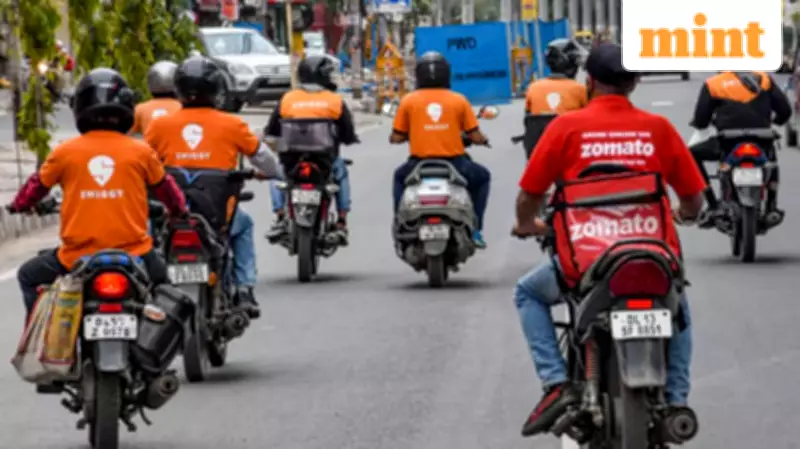
The concerns highlighted in the Economic Survey follow growing unrest among gig workers and union leaders. A nationwide strike call against major food delivery platforms Swiggy and Zomato on New Year's Eve ultimately fizzled out as many riders chose to work during festival incentive periods. While platforms implemented peak-hour payouts and temporary relaxations that helped deliver record orders, workers reported that these bonuses masked a deeper earnings squeeze.
According to worker accounts, base pay for food and grocery deliveries has declined significantly from approximately ₹60 per order earlier this year to nearly ₹15 currently. Gig worker unions argue that incentives offer only short-term relief while systemic issues persist, including shrinking payouts, unsafe delivery targets, arbitrary penalties, and lack of social security protections.
The Economic Survey reveals that approximately 40% of gig workers earn less than ₹15,000 per month, with income volatility making credit access particularly challenging. Meanwhile, industry responses indicate a more measured perspective. Eternal Ltd, parent company of food delivery platform Zomato, stated in its Q3 FY26 shareholder letter that while the government's new social security code mandates digital platforms to contribute toward such benefits, this is not expected to have any material impact on the company's financials.
The company noted it will continue to monitor details such as gratuity, leave encashment, and other aspects but does not foresee significant effects on its business or profitability. Eternal Ltd added that the social security framework is designed to benefit delivery partners and the broader gig economy while potentially encouraging a larger proportion of India's workforce to participate in organized employment.
As India's gig economy continues its rapid expansion, the tension between growth objectives and worker protections remains a central challenge requiring balanced policy interventions and industry adaptations.





