

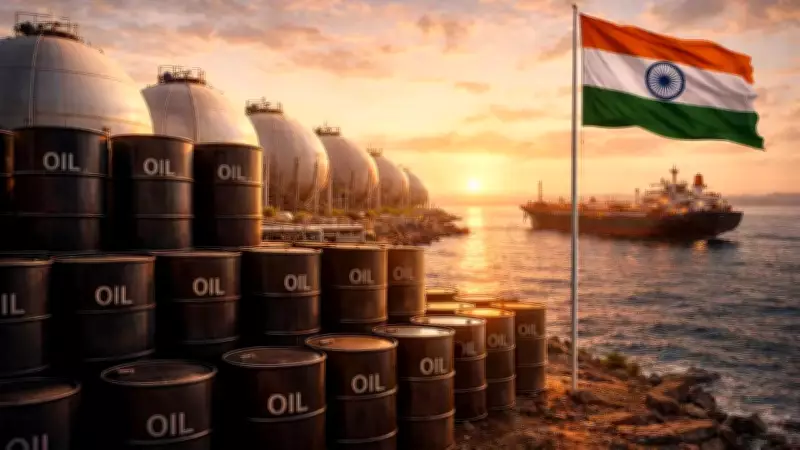
India's Energy Security Robust Amid Middle East Tensions, Holds 2-Month Oil Reserves
As tensions in the Middle East persist into their second week, concerns are mounting globally about potential disruptions to energy supplies. However, India stands firm with a robust energy security framework, as detailed in a recent government report. The country currently holds more than 250 million barrels of crude oil and petroleum products in reserve, providing a substantial buffer to meet domestic demand for nearly two months.
Strategic Reserves and Storage Infrastructure
The combined reserves, estimated at approximately 4,000 crore litres, offer coverage for seven to eight weeks across India's entire energy supply chain. These reserves are strategically distributed across multiple storage points to enhance resilience. Key locations include underground caverns in Mangalore, Padur, and Visakhapatnam, which are designed for long-term security. Additionally, above-ground storage tanks, pipelines, and offshore vessels form part of the extensive distribution network, ensuring flexibility and accessibility.
The report explicitly refutes claims that India maintains only about 25 days of reserves, emphasizing that the broader supply chain stockpile significantly extends the country's energy buffer. This comprehensive approach underscores a major shift in India's energy procurement strategy, which has evolved to prioritize diversification and national interest.

Diversified Import Strategy and Reduced Dependence
India has dramatically expanded its crude oil sourcing, now importing from 40 countries compared to just 27 a decade ago. This diversification strategy is described as being "anchored in national interest," reducing reliance on any single region or transit route. Notably, only around 40% of India's crude imports pass through the Strait of Hormuz, a critical global oil chokepoint. The majority, approximately 60%, arrives via alternative routes from suppliers in Russia, West Africa, the Americas, and Central Asia.
The days when India's energy security was tied to conditions in a single maritime chokepoint are over, the report states. It adds that any disruption in one corridor would result in a "managed sourcing adjustment, not a supply emergency," highlighting the system's adaptability.
Key Suppliers and Geopolitical Considerations
Russia remains India's largest crude supplier as of February 2026, despite geopolitical pressures. India has continued purchases while complying with G7 price cap rules, asserting its independent decision-making. "India has never depended on permission from any country to buy Russian oil," the document notes, emphasizing ongoing imports that contribute to global energy market stability.
A recent 30-day waiver from the US Treasury for Russian oil purchases is cited as removing unnecessary friction and acknowledging India's role in balancing global energy flows. This move underscores India's strategic positioning in international energy diplomacy.
Domestic Initiatives and Refining Capacity
On the domestic front, India's ethanol blending programme has significantly reduced crude import dependence. The 20% blending initiative now replaces roughly 44 million barrels of crude oil annually, promoting sustainability and energy independence. Concurrently, the country's refining capacity has expanded to 258 million metric tonnes per annum, exceeding domestic consumption estimates of 210 to 230 million metric tonnes per annum.
This surplus capacity enabled Indian refiners to supply fuel to Europe during shortages caused by sanctions on Russian crude, demonstrating the sector's flexibility. "Indian refiners do not depend on a fixed slate from a fixed origin," the report highlights, showcasing adaptability in sourcing and processing.
Price Stability and Financial Measures
Data from the Petroleum Planning and Analysis Cell reveals that retail fuel prices in India have remained largely stable over the past four years. Between February 2022 and February 2026, petrol prices in Delhi decreased by 0.67%, contrasting with increases of 55% in Pakistan and 22% in Germany over the same period.

To maintain this stability, public sector oil companies absorbed substantial financial losses. These firms bore losses of Rs 24,500 crore on petrol and diesel and approximately Rs 40,000 crore on LPG, reflecting a commitment to affordability and availability. The report concludes that sector decisions are assessed based on "affordability, availability, and sustainability," with no fuel pump outlets running dry in the past twelve years.





